Common Automotive IGBT Module Package Types for New Energy Vehicle Applications
Insulated Gate Bipolar Transistor (IGBT) modules are the workhorse power semiconductors in electric vehicle (EV) traction inverters. By integrating multiple IGBT dies with diodes into a single package, these modules deliver high voltage and current handling capability, excellent thermal performance, and improved reliability compared to discrete devices. They are indispensable in converting DC battery power to AC for driving electric motors in new energy vehicles (NEVs).
The "Three Electrics" and Electric Drive System Architecture
In NEVs, the "three electrics" - traction battery, drive motor, and motor controller - represent the core of electrification and account for a substantial portion of vehicle cost and performance. The electric drive system encompasses:
- Drive Motor Assembly: Transforms electrical energy into mechanical torque.
- Motor Controller (Inverter): Hardware and software that precisely controls motor operation using power semiconductors like IGBTs or SiC MOSFETs.
- Transmission/Reducer Assembly: Adjusts torque and speed for optimal efficiency.
During acceleration, the controller inverts DC to variable-frequency AC. During regenerative braking, the motor acts as a generator, feeding energy back to the battery.
Operating Principles of IGBT Modules
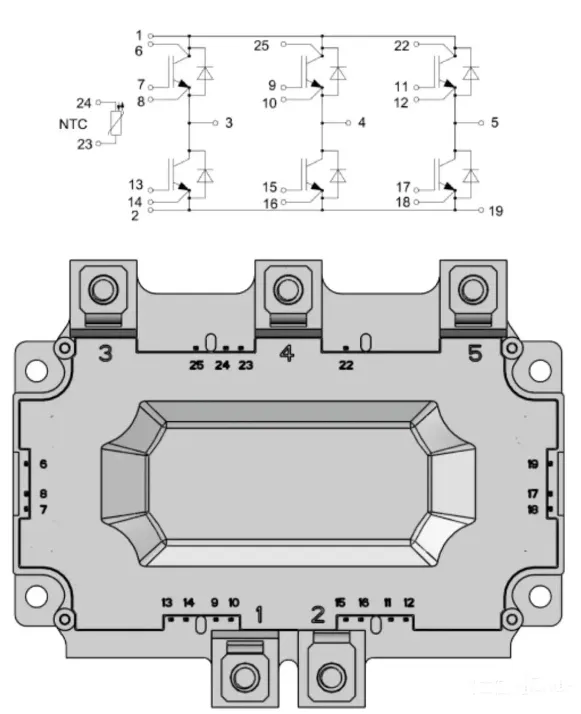
IGBT modules feature a robust package: plastic housing for electrical isolation and a metal baseplate (commonly copper) for heat sinking. Internally, IGBT dies are arranged in half-bridge or full-bridge topologies. By controlling gate signals to switch the dies rapidly, the module synthesizes three-phase AC waveforms with variable voltage and frequency from the DC bus.
Key advantages include high input impedance (easy gate drive), low conduction losses, and fast switching suitable for PWM control in inverters.
IGBT Module Manufacturing Process
Producing automotive-grade IGBT modules involves stringent semiconductor packaging steps:
- Die bonding onto Direct Bonded Copper (DBC) substrates using high-reliability soldering or sintering.
- Ultrasonic wire bonding (aluminum or copper wires/ribbons) for interconnections.
- X-ray inspection to ensure minimal solder voids (typically <1% for automotive reliability, as voids degrade thermal resistance).
- Attachment of DBC to the baseplate.
- Encapsulation/potting for environmental protection.
- Terminal forming, laser marking, and comprehensive testing (static/dynamic electrical, insulation, thermal cycling, and reverse bias SOA).
These processes demand cleanroom conditions, precise process control, and automotive qualifications (IATF 16949).
Common Automotive IGBT Module Package Types
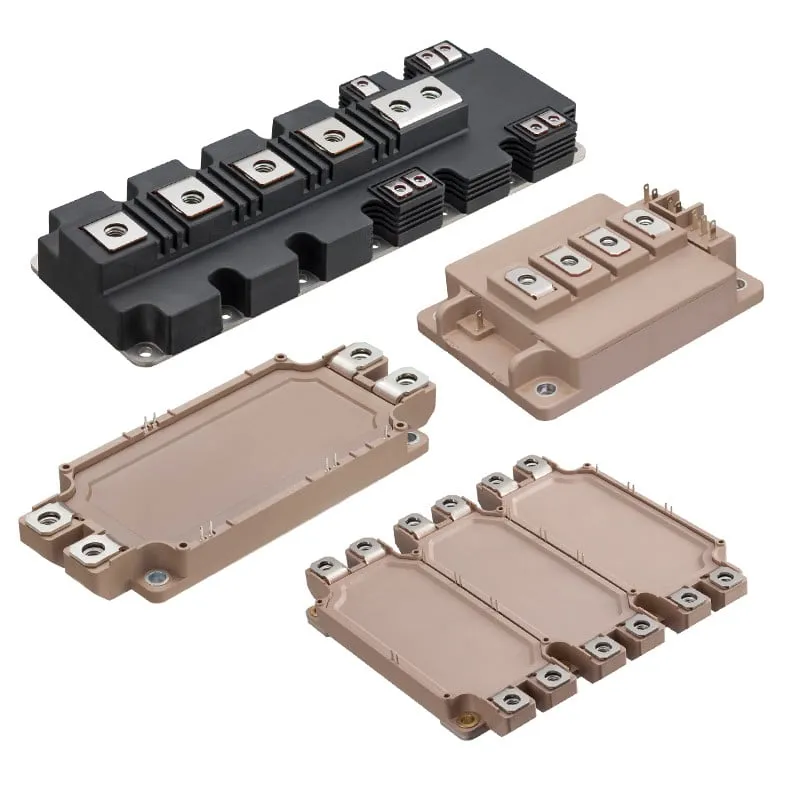
Several standardized packages address different power levels and vehicle segments:
- Econodual (Half-Bridge): Widely used in commercial vehicles and buses. Typical ratings: 1200V/450A or 600A. Offers good scalability for higher power.
- HP1 (Full-Bridge): Targeted at low-to-mid power passenger vehicles (peak power generally <70 kW). Common ratings include 650V/400A, with variants at 750V/300A, 400A, or 550A.
- HPD (Full-Bridge): Suited for mid-to-high power applications in mainstream passenger cars. Example: 750V/820A, with other 750V options.
- DC6 (Integrated Three-Phase Full-Bridge): Provides a compact, high power-density solution with optimized thermal paths and reduced external interconnects, ideal for space-constrained designs.
- TO-247 Discrete Parallelization: Uses multiple discrete TO-247 packaged IGBTs in parallel. Advantages include flexible current scaling and easier parasitic inductance optimization.
Package selection depends on power rating, thermal environment, cost targets, and system voltage (commonly 400V or 800V architectures).
IGBT Market Situation and Major Suppliers
The global automotive IGBT market has been led by established players such as Infineon, Mitsubishi Electric, Semikron, Fuji Electric, ON Semiconductor, ST Microelectronics, ROHM, and Renesas.
In China, rapid NEV growth has accelerated localization. Domestic suppliers including BYD Semiconductor, STARPOWER (Jiaxing), CRRC Times Electric, Silan Microelectronics, Cuizhan Microelectronics, Hongwei Technology, Zhongke Junxin, and Jilin Huahong are gaining significant market share through vertical integration and government support.
Critical Role of PCB Technologies in IGBT Systems
IGBT modules do not operate in isolation - they interface with sophisticated power PCBs in the inverter assembly:
- High-Current Layouts: Thick copper (up to 400um+), wide traces, and heavy busbars manage hundreds of amperes with minimal voltage drop and heating.
- Thermal Management: IMS substrates, dense thermal vias, and optimized component placement work in conjunction with module baseplates and liquid cooling systems.
- Gate Drive and Control: Multi-layer boards integrate isolated gate drivers, current/voltage sensing, and protection circuits while maintaining creepage and clearance for high voltages.
- EMI/EMC Control: Careful layering, shielding, and filtering suppress switching noise that could affect vehicle electronics.
- Reliability Enhancements: Automotive-grade materials, conformal coating, vibration-resistant soldering, and rigorous testing ensure long-term durability under thermal cycling, humidity, and mechanical stress.
Advanced PCB manufacturing capabilities - HDI, embedded components, precise impedance control, and high-reliability assembly - are indispensable for realizing the full potential of IGBT-based inverters in terms of efficiency, power density, and safety.
Frequently Asked Questions
Q1: What package is most common for passenger car inverters?
A1: HP1 and HPD full-bridge packages are prevalent, with DC6 emerging for higher integration.
Q2: Why is package type important?
A2: It affects thermal performance, current rating, inductance, ease of assembly, and overall inverter size/cost.
Q3: How do PCBs contribute to IGBT system success?
A3: By providing low-inductance power distribution, effective cooling, reliable gate control, and robust mechanical integration in harsh automotive environments.