Overview
Using current transformers can reduce losses when measuring a converter's primary current, for example in high-power switching power supplies. When the current is large, a current-sensing coil is used to monitor the current and reduce losses.
Fundamental Difference
The difference between a current transformer and a typical voltage transformer is fundamental: a transformer attempts to transfer voltage from primary to secondary, while a current transformer attempts to transfer current from primary to secondary. The voltage produced by a current transformer is determined by the load connected to its secondary.
Practical Design Example
To illustrate the operating principle, consider a practical design. Assume a current transformer is used to sense the converter primary current: 10 A on the primary corresponds to 1 V on the secondary. One could use a 1 V / 10 A = 100 mΩ resistor to sense this, but that resistor would dissipate 1 V × 10 A = 10 W, which is unacceptable for almost any design. Therefore a current transformer is used, as shown in Figure 1.
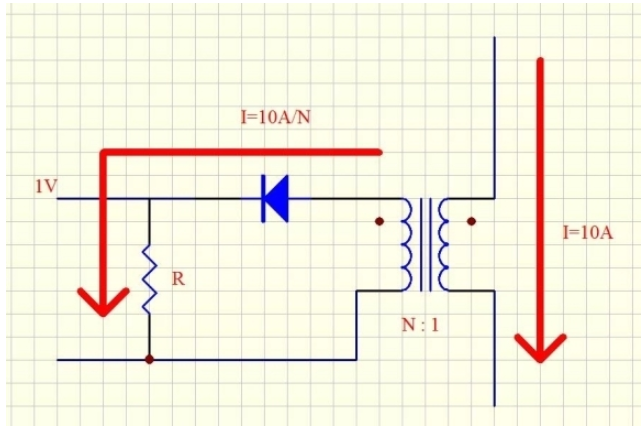
To reduce winding resistance the primary turn count is taken as 1 turn, and to reduce the secondary current the secondary turn count should be large. Let the secondary turns be N. By Ohm's law, (10/N)R = 1 V, and the resistor power dissipation is P = (1 V)^2 / R. If the allowed dissipation is 50 mW (that is, a 100 mW rated resistor is acceptable), R must be at least 20 Ω. Choosing R = 20 Ω yields N = 200.
Core and Diode Considerations
Consider the core and rectifier: assume the diode is a typical general-purpose diode with a forward voltage of about 1 V. The secondary current is 10 A / 200 = 50 mA. The transformer output is 1 V; adding the diode forward drop of 1 V gives roughly 2 V in total. At 250 kHz operation the flux density on the core will not exceed the waveform shown in Figure 2.
Because the primary conduction interval cannot span the switching period (otherwise the core cannot reset), the effective cross-sectional area Ae can be small and the required flux density B will not be large. In this example the core specifications are not determined by loss or saturation requirements but are more likely set by the required isolation voltage between primary and secondary. If isolation voltage is not a concern, the core size is generally determined by the space occupied by a 200-turn winding. Although AWG40 wire could carry a 500 mA peak current, that wire is very thin and typical transformer manufacturers will not wind it.
Practical tip: unless necessary, avoid using wire smaller than AWG36.
Why a Voltage Transformer Cannot Replace a Current Transformer
Why not use a voltage transformer instead of a current transformer? Since the secondary voltage only needs to be 2 V, the primary voltage would be 2 V / 200 = 100 mV. If the input DC voltage is 48 V, the current transformer primary's 10 mV is negligible compared to 48 V — this allows the secondary to provide 50 mA with almost no effect on the primary. In an alternate (unrealistic) case where the primary input DC voltage is only 5 mV, the transformer primary could not develop 10 mV, and because the primary impedance (including reflected secondary impedance) would be large, the secondary could not deliver 50 mA. Even if the entire 5 mV were applied to the primary, the secondary could only produce 200 × 5 mV = 1 V, which is insufficient to produce the required voltage across the sensing resistor. Therefore, a voltage transformer can only be used as a transformer, not as a current sensing device.
From another perspective: although the supply voltage may be 48 V, the magnitude of the current through the current transformer is not determined by that 48 V but by other design factors.
A current transformer can be viewed as a voltage transformer with an impedance constraint.
Measurement Error and Magnetizing Inductance
Finally, consider measurement error. The answer lies in the basic definition: the device senses current. The diode forward drop and the secondary winding resistance of a current transformer do not affect the current measurement, because in a series circuit the current is the same everywhere and independent of the series elements, as long as their impedances are not large.
In practice it does not matter whether a Schottky diode is used for rectification: the diode's low forward voltage affects the transformer voltage but does not affect the current transformer operation.
If the transformer's secondary inductance is too small, measurement error will increase; in other words, if the magnetizing inductance is too small. If the allowable measurement error is 1% for a 10 A primary, the secondary current is 50 mA, which implies the magnetizing current (secondary) must be less than 50 mA × 1% = 500 μA. Magnetizing current does not flow through the sensing resistor, so it cannot be detected and will increase measurement error. The minimum required secondary inductance can be calculated as shown in Figure 3.
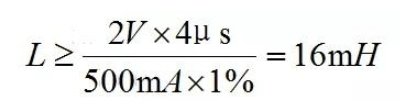
With 200 turns, the required AL is 16 mH / 200 = 400 nH. A common small ferrite toroid can meet this requirement; such ferrite rings are readily available.