Overview
The dual-slope (dual-slope) analog-to-digital converter (ADC) is a common ADC topology that converts analog signals into digital form. It is mainly used to measure stable, slowly varying inputs such as temperature, voltage, and pressure.
Operating principle
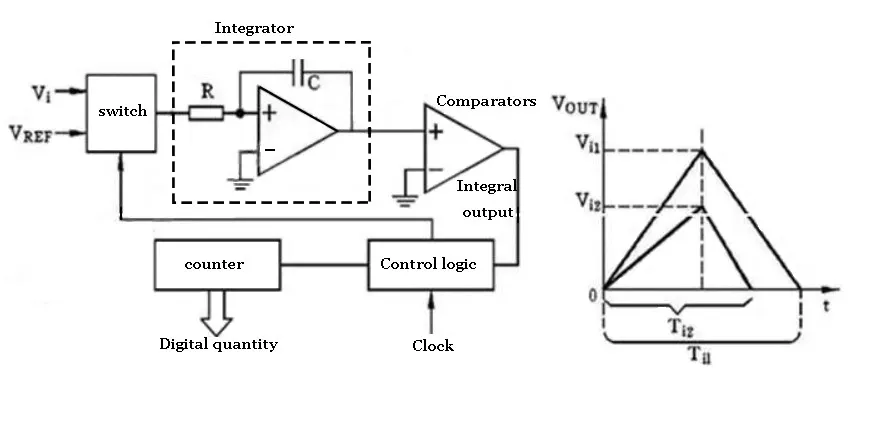
The basic operating sequence is as follows. From time 0 to t (time interval T, equal to twice Tcp), the input voltage to be converted, u_i, is applied to an integrator, producing an output voltage V_r(t). At time t, the integrator is driven by the inverted reference voltage ?Vref. At time t0 the integrator output returns to zero; in other words, the integral of the input voltage over 0–t equals the integral of the reference voltage over t–t0. During the interval 0–t0, because the integrator output (the integrated value) remains negative, the NAND logic output is 1.
Ultimately, the digital output D is proportional to Tcp. In operation, the dual-slope ADC converts the input analog voltage into a time interval proportional to that voltage via integration, then counts clock pulses at a fixed frequency during that time interval. The counted value is the digital conversion result.
Because of this operating method, the dual-slope ADC has strong noise rejection and therefore high conversion accuracy. Since the conversion cycle is relatively long, dual-slope ADCs are well suited to low-speed, high-precision measurement applications.
Step-by-step operation
1. Apply the analog input signal to an integrator and start timing.
2. During a fixed integration interval, the integrator integrates the input signal to form an integrated value.
3. When the integration interval ends, begin the re-integration (deintegration) phase. During re-integration, a known reference voltage (typically ?Vref) is applied to the integrator until the integrator output returns to its initial level.
4. Record the time required for re-integration; this time is proportional to the input signal during the initial integration.
5. Convert the re-integration time to a digital output, typically expressed in binary.
The dual-slope ADC inherently cancels input drift and certain types of noise, improving conversion accuracy and stability. It is suitable for applications that measure stable, slowly changing analog signals, such as sensors and environmental monitoring.
However, dual-slope ADCs have relatively slow conversion rates and are generally used where high accuracy is required but conversion speed is low. They also have limited dynamic range and are typically applied to low-frequency signals.
Circuit structure: advantages and disadvantages
Advantages:
1. Good noise rejection: The dual-slope integration process cancels input drift and added noise. By applying a reference voltage during the re-integration phase, the impact of input noise on the conversion result is reduced, improving accuracy and stability.
2. High accuracy: The use of integration and re-integration enables high-precision conversion.
3. Good linearity: Dual-slope ADCs exhibit good linearity and can provide accurate digital outputs.
Disadvantages:
1. Slow conversion speed: The integration and re-integration phases make conversion relatively slow, so dual-slope ADCs are not suitable for high-speed applications.
2. Limited dynamic range: Large amplitude changes or high-frequency components in the input can cause the integrator to saturate or distort, affecting accuracy.
3. Relatively complex: The circuit requires an integrator, reference drive for re-integration, timing control, and counting logic, which increases design complexity and cost.
Dual-slope ADCs are appropriate when high accuracy is required and conversion speed can be sacrificed. Their strengths are noise rejection, linearity, and precision, while their limitations lie in conversion speed and dynamic range. Selection of an ADC type should consider the specific requirements of the application.