1. Transfer function of a linear time-invariant system
The transfer function of a linear time-invariant system is given by the usual rational form:
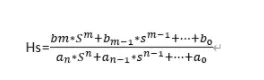
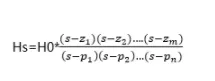
After factoring, the transfer function can be expressed in terms of its zeros and poles:
2. Physical meaning of zeros and poles
Zero: if the input amplitude is nonzero and an input frequency causes the system output to be zero, that input frequency is called a zero of the system.
Pole: if the input amplitude is nonzero and an input frequency causes the system output to become unbounded, that input frequency is called a pole of the system.
Notation: z1, z2, ... , zm denote the zeros of the transfer function; p1, p2, ... , pn denote the poles of the transfer function.
3. Effect of zeros and poles on magnitude and phase (real poles and zeros)
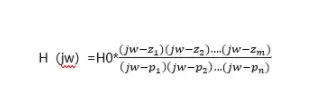
The log-magnitude decomposes as:
20 log H(jw) = 20 log(H0) + 20 log(jw - z1) + ... + 20 log(jw - zm) - 20 log(jw - p1) - ... - 20 log(jw - pn)
Definition of magnitude and phase for a complex number:
Consider a pole Px:
Express jw - Px with a constant factor: jw - Px = Px (j * w / Px - 1)
Considering only the imaginary factor in magnitude,
-20 log|H(jw)| = -20 log10| j * w / Px - 1 | = -20 log10 sqrt(1 + (w/Px)^2)
- If w is much less than Px, w/Px → 0, phase φ(jw) → 0.
- If w equals Px, w/Px = 1, phase φ(jw) = 45 deg.
- If w is much greater than Px, w/Px → ∞, phase φ(jw) = 90 deg (typically the phase approaches 90 deg for frequencies greater than about 10 times the pole frequency).
- If Px is positive (right-half-plane pole), the phase contribution is positive; if Px is negative (left-half-plane pole), the phase contribution is negative.
Therefore, for a left-half-plane pole:
- The magnitude decreases at -20 dB per decade.
- The phase decreases by 90 deg (for frequencies greater than about 10 times the pole frequency).
For a right-half-plane pole:
- The magnitude decreases at -20 dB per decade.
- The phase increases by 90 deg (for frequencies greater than about 10 times the pole frequency).
For a zero Zx:
- For a left-half-plane zero: the magnitude increases at +20 dB per decade; the phase increases by 90 deg (for frequencies greater than about 10 times the zero frequency).
- For a right-half-plane zero: the magnitude increases at +20 dB per decade; the phase decreases by 90 deg (for frequencies greater than about 10 times the zero frequency).