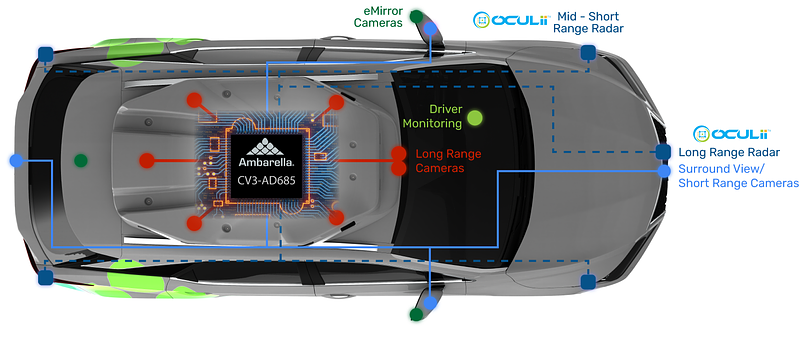
In recent years, the installation rate of ADAS (advanced driver assistance systems) in vehicles has grown rapidly. Across major manufacturers, these technologies are primarily implemented at SAE Levels 2–3. To support these functions, a vehicle's perception system typically uses five or more cameras. Where are these cameras installed and what are they called? This article reviews common camera types and typical in-vehicle placements.
Cameras can be classified in several ways: by number of CMOS lenses (monocular or stereo) or by field of view (wide-angle, fisheye). This article classifies cameras by installation location and field of view. Common categories are front, rear, surround, side, and interior cameras. The following summarizes typical in-vehicle applications for these camera types.
Front-facing cameras
Installation: Typically mounted on the windshield or at the interior rearview mirror. Front-facing cameras are used for forward driver assistance and are primarily for detecting the road, vehicles, and pedestrians ahead, with a field of view around 45 degrees. Image sensors combined with DSP-accelerated dual-core MCUs provide incoming video frames for image processing, enabling monitoring of the scene ahead and functions such as FAM, LDW, and ACC. Night-vision cameras are also often placed here.
Front cameras are commonly single or stereo; stereo provides better distance measurement but requires more complex algorithms and higher cost. The number of front cameras varies by manufacturer. For example, Tesla configures three front cameras:
- Narrow field front camera, maximum detection range 250 m
- Main field front camera, maximum detection range 150 m
- Wide field front camera, maximum detection range 60 m
Front cameras are central to ADAS, covering distance measurement, object detection, and lane-marking detection; the associated algorithms are therefore complex and technically demanding.
Surround-view cameras
Installation: A set of cameras mounted near the vehicle front and rear emblems and integrated into the left and right mirrors. Surround-view cameras, also called a 360-degree or bird's-eye monitoring system, detect parking guides, road conditions, and surrounding vehicles. They stitch images from multiple cameras to provide a 360-degree view of the vehicle perimeter. For perimeter monitoring, cameras are often mounted in the front emblem or grille areas.
Side-view cameras
Installation: On or under the left and right mirrors or lower on the vehicle sides. Side-view cameras are primarily used for blind-spot detection (BSD) and can function as front- or rear-looking cameras depending on mounting. Most OEMs install them under the side mirrors. In the future, optical mirrors may be replaced by camera-based electronic mirrors using CMS cameras.
Rear-view cameras
Installation: Typically mounted on the trunk or rear windshield. Rear-view cameras assist reversing and parking by providing the driver with an image of the area behind the vehicle.
Interior cameras
Installation: No fixed location; common placements include within the steering column area, above the interior rearview mirror, on the A-pillar, or integrated into the instrument display. Since current automated driving is limited to Levels 2–3 and still requires human intervention, driver monitoring systems (DMS) have been adopted in ADAS. Typical DMS solutions use near-infrared cameras with AI-based recognition to capture the driver's face. Some vendors extend DMS to occupant monitoring systems (OMS) to help prevent children being left in the rear seats.
An ADAS sensor suite is not limited to these five camera types. To provide redundancy and improve safety, OEMs typically fuse cameras with millimeter-wave radar, LiDAR, and ultrasonic sensors, and the total number of cameras is likely to increase.