Domain Controllers and Vehicle E/E Architecture
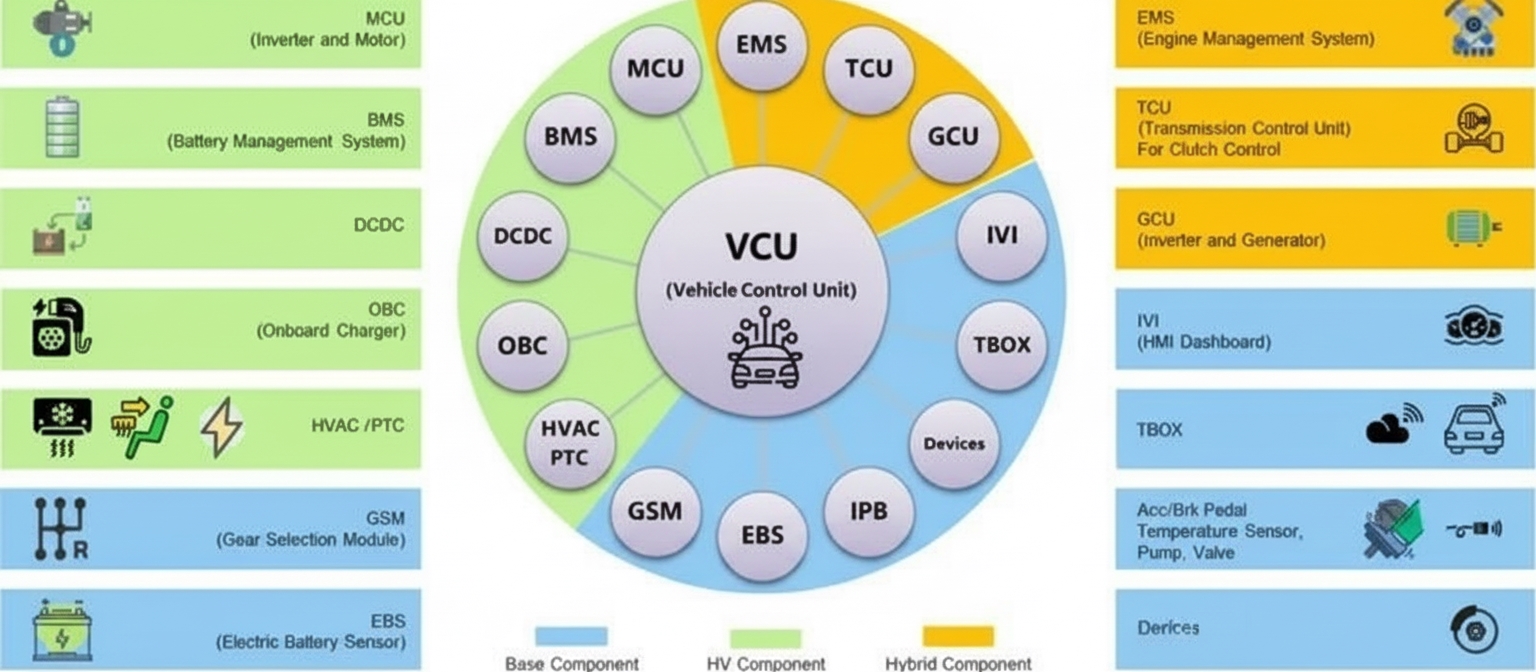
As vehicle electronic content has increased, the number of electronic control units (ECUs) has grown—from engine control and power steering to instrument clusters and infotainment. Traditional automotive electrical/electronic architectures (EEA) are distributed, with ECUs communicating over CAN or LIN buses.
The number of ECUs in modern vehicles can approach or exceed one hundred, increasing system complexity and exposing limits of distributed EEA. To address these challenges, functions with similar or related tasks are being consolidated onto more powerful processor-based hardware platforms. These platforms are referred to as domain controllers.
Domain controllers mark the evolution of vehicle EE architecture from a distributed to a domain-centralized model.
Domain Controller Composition
A domain controller is a vehicle core computing platform. It typically comprises three parts: the domain processor, the operating system and application software, and algorithms. By integrating functions that previously required multiple ECUs, the domain controller improves system integration and reduces development effort through standardized interaction interfaces.
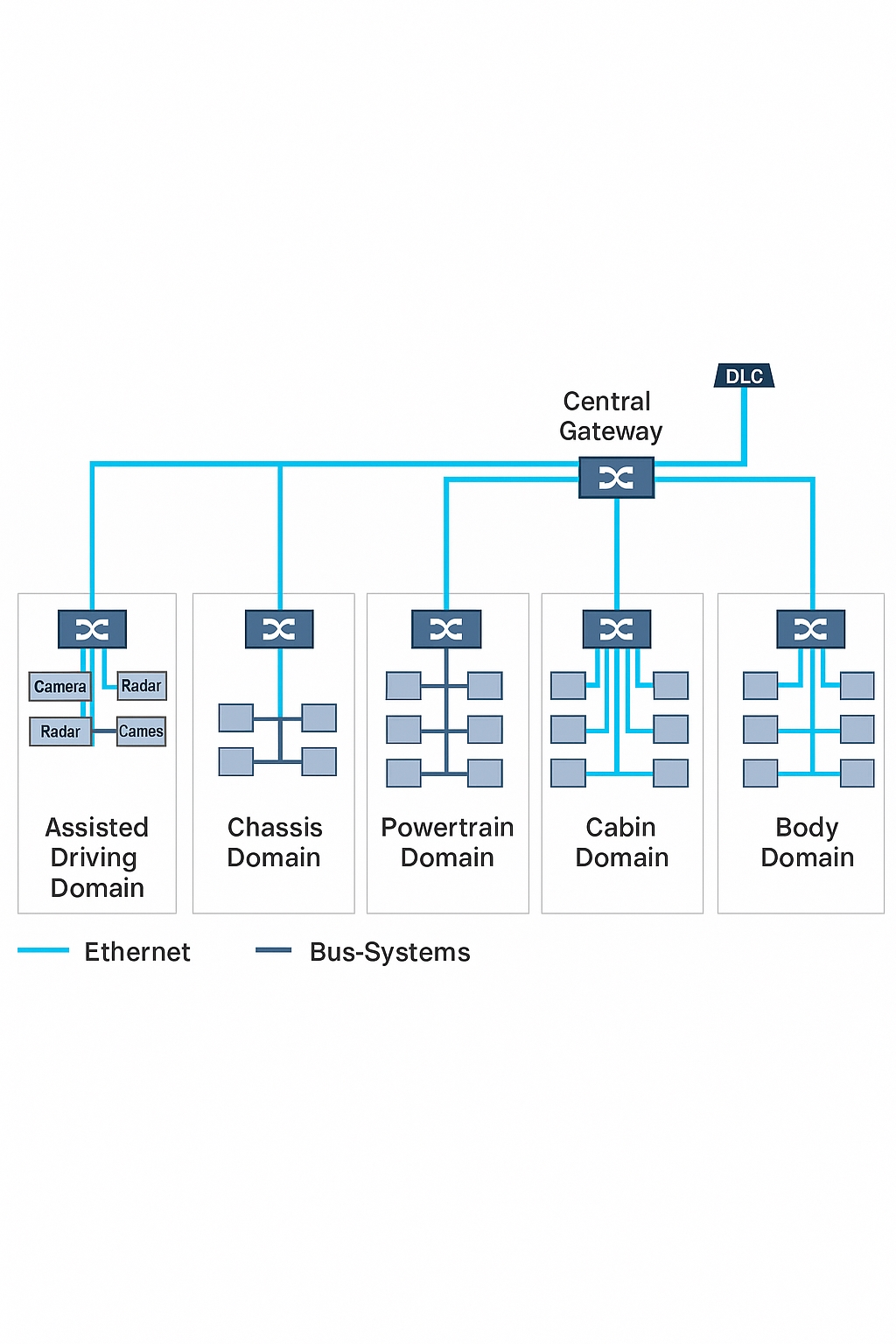
Domain partitioning varies by OEM. For example, Bosch divides domains into powertrain, chassis, body, cockpit, and automated driving domains, which reflects a classic five-domain centralized EEA.
ADAS Domain Controller
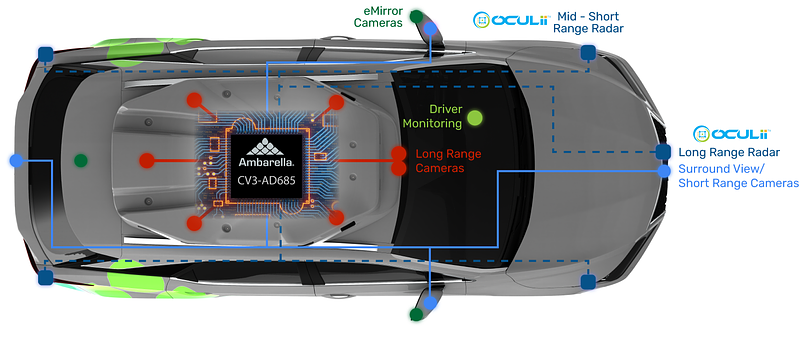
An ADAS domain controller must connect to multiple cameras, millimeter-wave radar, lidar, and other sensors. It must support sensor fusion, localization, and path planning, processing large volumes of sensor data in real time. Companies able to provide this class of compute include Huawei, Renesas, and Horizon.
Cockpit and Infotainment Domain
The cockpit domain covers HUD, the instrument cluster, and the in-vehicle infotainment system (IVI).
HUD
The head-up display projects ADAS information and navigation cues onto the windshield, such as adaptive cruise control alerts, pedestrian warnings, and routing prompts. With advances in augmented reality, AR HUD is a potential future development.
Vehicle human-machine interaction is increasingly focused on user experience. Future cockpit functionality may include preconditioning connected home devices before the driver exits, driver state monitoring (DSM), and multimodal interaction across use cases, which could redefine in-vehicle HMI design.
Instrument Cluster
Instrument cluster: omitted.
IVI
IVI covers audio and media features such as radio, music, and third-party applications.
Domain Controller Evolution
Visteon introduced the SmartCore domain controller, integrating entertainment, instruments, and ADAS functionality, which initiated commercial adoption of domain controllers. Tier 1 suppliers subsequently developed competing solutions, and the domain controller market expanded. OEMs and suppliers have pursued integrated domain control unit (DCU) solutions; some chipset vendors have also released DCU offerings. The shift to domain controllers challenges traditional MCU-centered architectures: control and compute have moved from numerous distributed MCUs toward high-performance, highly integrated heterogeneous processors at the domain level. Likewise, in-vehicle communication is migrating from CAN and LIN toward Ethernet because of its higher bandwidth, real-time capabilities, and reliability, making it a candidate for the vehicle-wide communication backbone.
Challenges to Traditional ECUs
Consolidating multiple ECUs into domain controllers shifts OEM core competencies from mechanical manufacturing toward software, hardware, and algorithms. Future OEM and Tier 1 relationships may evolve: Tier 1s and chip vendors could collaborate to supply complete solutions to OEMs, or Tier 1s might focus on hardware design and production while OEMs retain software development responsibilities.