Introduction
Technical information on the BYD Han high- and low-voltage systems.
01. Low-voltage system
The 12V battery is the first element to review. Figure 1 shows the 12V battery used in the Han EV; it is a lithium battery with a rated capacity of 25 Ah. BYD completed in-house development of its first 12V battery in 2011 and has iterated the design over multiple generations since then.
The 12V battery product line (Figure 3) covers various functional needs such as low-temperature cold start and balancing low-voltage loads. However, the capacity has become much smaller compared with traditional lead-acid batteries (for example, 25 Ah is about 20% of a 60 Ah lead-acid battery). Because the vehicle also has a high-voltage traction battery, the 12V battery can be charged from the traction battery when its state of charge is low.
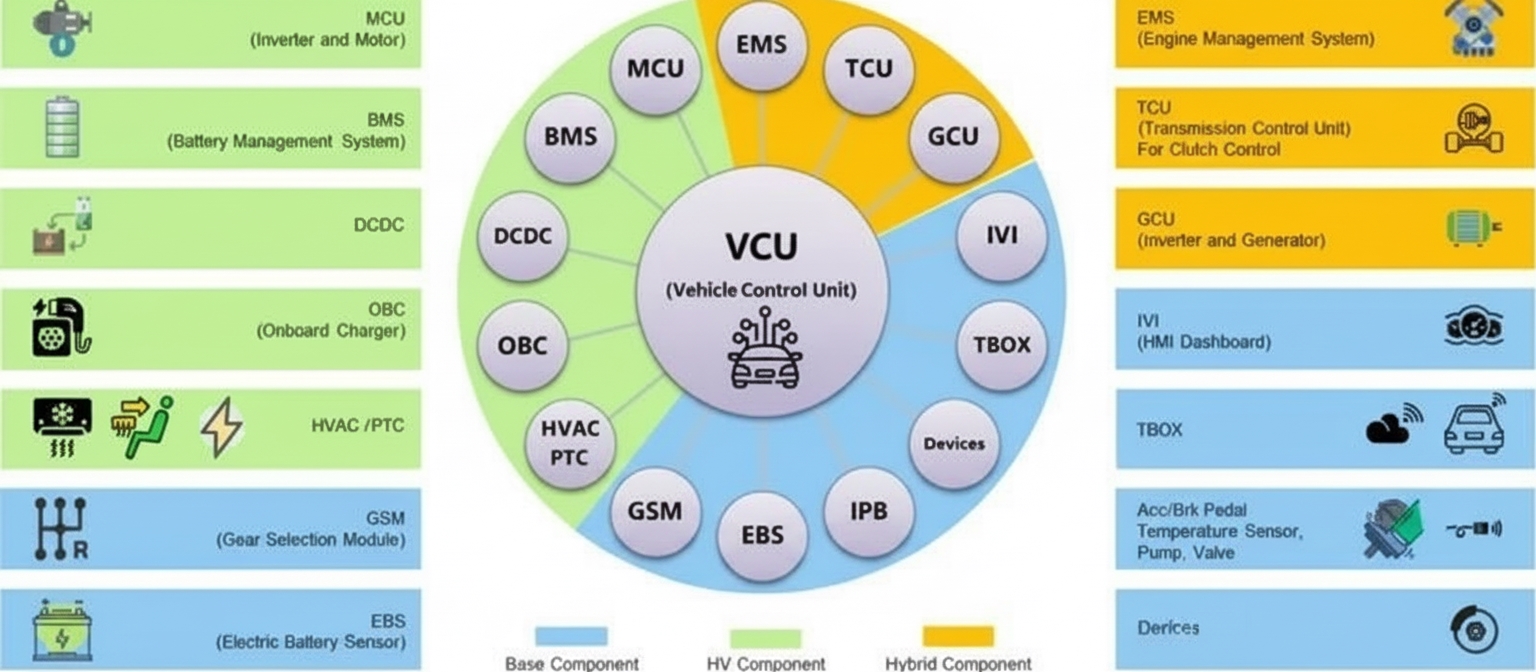
Beyond the 12V battery, the low-voltage system includes the power supply architecture for various controllers and the communication network architecture. The BYD Han EV uses a conventional distributed network architecture rather than a centralized or domain-based Ethernet architecture (Figure 5). Future platform updates such as the E3.0 platform could change this approach across vehicle lines.
The low-voltage architecture for the infotainment and the autonomous parking system is shown in Figure 6. Left side corresponds to the central control system; right side corresponds to the automatic parking system.
02. High-voltage system
The high-voltage system contains many components that BYD developed in-house, including the blade cell and the electric drive system. BYD began battery development in the early 2000s and has iterated its LFP (lithium iron phosphate) technology over the last two decades, arriving at the blade cell design.
The overall high-voltage system architecture is shown in Figure 8. The diagram lists key component parameters and high-voltage harness routing. Key component specifications include:
- Front motor three-in-one assembly: rated power/torque 60 kW / 130 Nm, peak 163 kW / 330 Nm, gearbox ratio 10.75.
- Rear motor three-in-one assembly: rated power/torque 60 kW / 130 Nm, peak 200 kW / 350 Nm, gearbox ratio 10.75.
- Integrated charging and power distribution module (three-in-one): includes DC-DC, OBC, and PDU. AC charging power 6.6 kW, DC charging power 100 kW.
High-voltage interlocks use both hardware and software methods. The battery pack and the charging/distribution circuit employ hardware interlocks, while other components use software interlocks.
The traction battery pack has a nominal voltage of 569.6 V, an energy of 76.9 kWh, a capacity of 135 Ah, and uses blade cells.
03. Summary
This article summarizes technical information on the BYD Han high- and low-voltage systems. The current Han network architecture is a relatively traditional distributed layout and does not use extensive Ethernet or domain controllers. BYD's E3.0 platform introduces four domain controllers and BYD OS; the power domain integrates VCU, BMS, inverter, PDU, DC-DC, and AC-DC control functions (an integrated multi-function power domain similar to seven-in-one controllers), along with CTP battery technology. Those platform-level changes indicate a direction for future vehicle electrical and electronic architectures.