Introduction
"Intelligent Chassis" is a series focusing on current trends in chassis intelligence and introducing mainstream chassis products.
This opening article examines the historical development of the chassis and outlines trends in intelligent chassis development.
1. Chassis development history
Since the birth of the automobile more than a century ago, chassis development has been closely tied to vehicle evolution. The chassis determines the vehicle's dynamic behavior across six degrees of freedom (three translational and three rotational) and is a necessary condition for vehicle operation. Broadly defined, the chassis includes many components beyond the driving, steering, and braking subsystems, such as body, throttle, and clutch. From the perspective of controlling the six degrees of freedom, the chassis can be refined into four subsystems.
The development of chassis systems can be summarized in three phases:
- Mechanical era
- Electromechanical hybrid era
- Intelligent era
Mechanical era
In early vehicles, which were lighter and slower, purely mechanical chassis systems met driver control needs. The driver directly controlled tire forces via steering wheel and pedals, indirectly affecting the vehicle's translational and rotational degrees of freedom.
With technological progress and the development of the automotive industry, especially military vehicle requirements, chassis systems made breakthroughs. The introduction of hydraulic steering and hydraulic brakes marked major innovations compared with the purely mechanical era. As vehicles became heavier, power assist devices became widely used to provide steering or braking assistance to the driver.
Typical products from this stage include mechanically driven hydraulic power steering systems and vacuum brake boosters. Mechanical hydraulic power steering uses the engine to drive a pump that provides hydraulic assist to the steering, reducing steering effort. Because the pump is driven by the engine, some engine power is consumed for the assist.
Vacuum brake boosters work as follows: when the driver depresses the brake pedal, lever action amplifies the pedal force and transmits it to the vacuum booster; the booster further amplifies the force and transmits it to the master cylinder; hydraulic pressure from the master cylinder pushes brake fluid into wheel cylinders, producing greater braking force that tightens calipers on the brake discs to achieve braking.
Vacuum boosters require a stable vacuum source. Gasoline engines generate high vacuum in the intake manifold due to spark ignition, which supplies the vacuum booster. Diesel engines use compression ignition (CI, Compression Ignition cycle) and cannot provide the same intake manifold vacuum level, so a vacuum pump is required to supply the vacuum source.
Despite the assistance provided by hydraulic systems, chassis control in the mechanical era remained fully dependent on driver input.
Electromechanical hybrid era
In the electromechanical hybrid era, traditional mechanical-hydraulic designs combined with microcontroller control to further reduce driver workload and enable software-controlled assistance for improved vehicle control. This greatly improved fuel economy, safety, and comfort.
One of the most notable innovations of this period is the Anti-lock Brake System (ABS). In emergency braking, excessive force on the brake can lock the wheels, causing poor vehicle behavior such as inability to stop within a safe distance or rear-end instability. ABS is a closed-loop control device in the braking system that prevents wheel lockup and preserves vehicle braking performance and stability.
By the late 1970s, with advances in digital electronics and hydraulic control, Bosch introduced a hydraulically based ABS and began mass production in 1978. Bosch's ABS launch initiated the era of electronic chassis stability systems. Suppliers such as Bosch, ITT Automotive, Kelsey-Hayes, and Wabco continued ABS development; performance improved while costs decreased. Today, ABS is standard on passenger and commercial vehicles.
Intelligent chassis era
Under the current trends of vehicle electrification and intelligence, traditional powertrains have been upgraded to three-in-one electric systems, and many mechanical chassis components have been simplified while electronic control has increased. At the same time, the proliferation of driver assistance features (such as ACC and AEB) and the gradual deployment of automated driving have created richer intelligent scenarios and new functional requirements.
Consumer expectations are also shifting: vehicles are increasingly viewed not only as transport, but as living space that enhances quality of life. This trend requires simultaneous improvements in comfort and driving quality to provide a more pleasant user experience.
Driven by these factors, chassis systems are expected to become more intelligent to meet the demands of electrification and automation. New requirements for intelligent chassis can be grouped into four categories:
- Personalization: provide customized settings based on driver habits
- High performance: more precise and faster system response
- Upgradability: self-learning capabilities and OTA support
- High safety: combined product safety and cybersecurity measures
According to Professor Zhang Junzhi of Tsinghua University, an intelligent chassis retains two major chassis functions:
- Load bearing
- Driving
However, the objects being borne and the means of achieving driving have changed. First, the intelligent chassis provides a platform to carry automated driving systems, cockpit systems, and power systems. Second, regarding the driving task, an intelligent chassis gains new capabilities in the vehicle-road and vehicle-human relationships.
In the vehicle-road relationship, the intelligent chassis can perceive, predict, and control interactions between the wheels and the ground. In the vehicle-human relationship, when vehicles become driverless, the driver's ability to perceive chassis anomalies and compensate with manual control disappears. The intelligent chassis must therefore manage its own operating state. These new capabilities serve driving tasks, so the intelligent chassis remains the system that achieves intelligent vehicle motion control.
2. Trends in intelligent chassis development
Although market penetration indicates the chassis is still largely in the electromechanical hybrid era, a clear transition toward intelligent chassis is underway.
Trend 1: Drive-by-wire (x-by-wire)
Drive-by-wire technology, originating from aircraft control systems, converts pilot inputs into electrical signals transmitted to actuators. Its main advantage is precise, rapid response, a benefit carried into automotive drive-by-wire.
Current chassis subsystems have achieved drive-by-wire at the control layer, but driver inputs via steering wheel and pedals remain mechanical. As automated driving evolves and the driver's role diminishes, steering and pedals will play a reduced role, and chassis drive-by-wire is trending toward full decoupling of mechanical linkages. A clear example is the regulatory progress for steer-by-wire. A few years ago, some OEMs introduced steer-by-wire products but could not mass produce due to regulations. Regulatory barriers are easing: for example, GB 17675-2021 "Steering systems for passenger cars — Basic requirements" removed the 1999 clause that prohibited full-power steering devices, effectively permitting physical decoupling between the steering wheel and steering actuator in China. Strong market demand for vehicles like the Cybertruck also indicates similar regulatory shifts in other countries.
In addition to steer-by-wire, regulations for brake-by-wire are also under development.
Trend 2: Personalization
Decoupling electronic control from the mechanical driver interface allows more flexible chassis tuning to satisfy personalized customer requirements. Active suspension systems exemplify this: by sensing vehicle status and road conditions precisely, active suspensions can adjust ride height, stiffness, and damping to improve both handling and comfort. These systems can also learn driver habits and adapt suspension control strategies accordingly, enabling broader deployment as more vehicles adopt active systems.
Trend 3: Multi-actuator integration
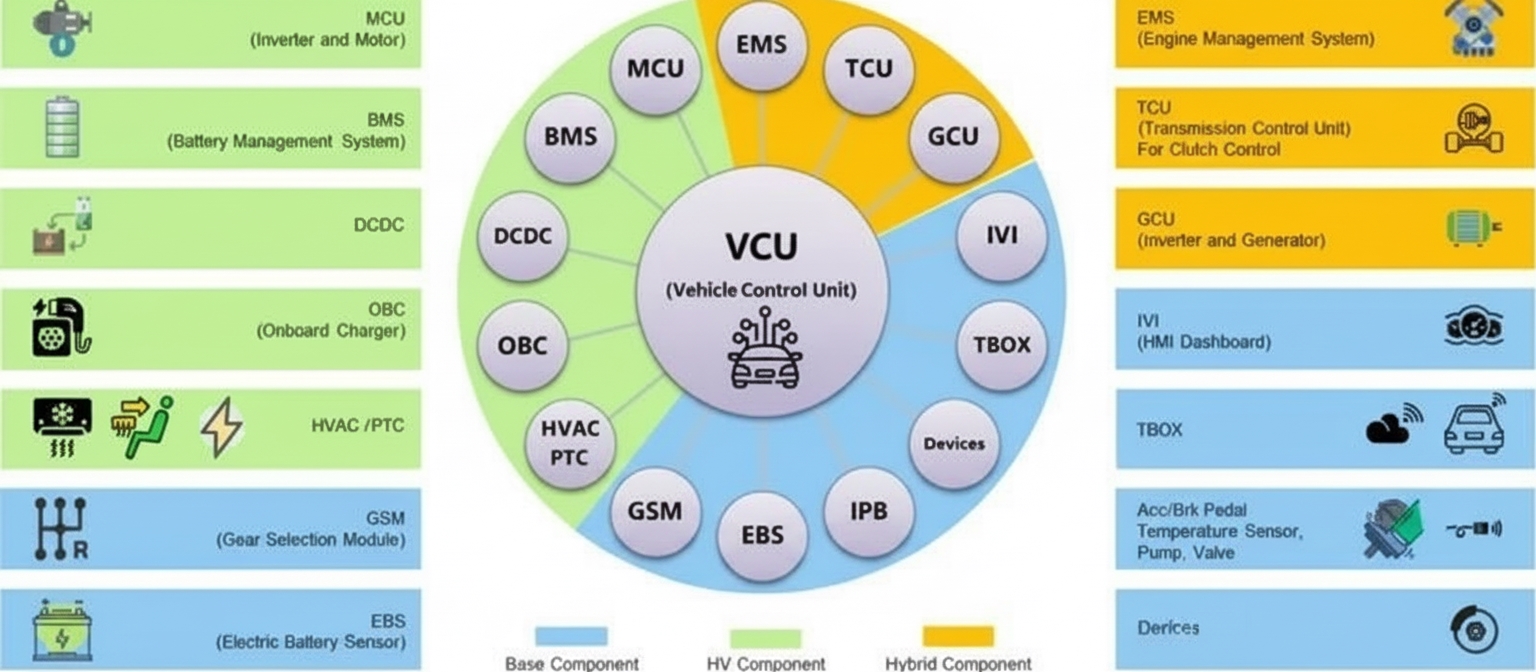
The evolution of vehicle E/E for intelligent driving is driving changes in chassis E/E. In the electromechanical hybrid era, the E/E architecture was an aggregation of simple subsystem ECUs. Although subsystems shared information, they operated largely independently, limiting coordinated control and responsiveness. A domain controller-based E/E architecture centralizes core intelligent control in a domain controller that performs real-time coordinated control across subsystems, enabling precise and fast responses and breaking the barrier of simple functional stacking.
OEMs and suppliers are actively adopting new E/E architectures for intelligent driving, and chassis integration trends are increasingly evident with many integrated functions already in production.
For example, Bosch's 2023 Vehicle Dynamics Control 2.0 (VDC 2.0) supports vehicles with split-axle three-motor and four-motor powertrains and coordinates control of drive motors and brake controllers. By combining torque vectoring and braking control, the system allocates torque across axles or wheels to maximize acceleration potential, exploit cornering limits, and optimize dynamic response. In vehicles equipped with steer-by-wire, VDC 2.0 can coordinate steer-by-wire wheel angles with braking control. With coordinated steer-by-wire, braking and steer-by-wire actuators work as an integrated system, fully utilizing the potential of chassis actuators. VDC 2.0 supports full-scenario customized driving experiences across vehicle types and powertrain configurations, integrating and coordinating vehicle dynamics and control through cross-domain drive-by-wire actuators and enabling flexible deployment of software functions in braking and other systems for safer, more comfortable, and more agile driving.
Trend 4: Higher safety requirements
Safety has always been a core consideration in chassis design. Vehicle intelligence introduces new safety topics for the intelligent chassis.
SAE J3016 levels of vehicle automation are well known. These levels can be grouped into two categories:
- Driver assistance (Level 1 and Level 2)
- Automated driving (Level 3, Level 4, Level 5)
The fundamental difference between driver assistance and automated driving is responsibility in the event of system failure:
- For driver assistance, if the system reports a fault correctly, subsequent safety depends on the driver's skill; the driver is responsible for any accident, not the vehicle manufacturer.
- For automated driving, when a system fails, the system must handle avoidance maneuvers itself (higher automation levels allow progressively later or no driver takeover). If an accident occurs, the vehicle manufacturer is responsible, not the driver.
For high-speed automated driving, if a single fault occurs, a commonly agreed safety state is for the vehicle to reach an emergency lane. To achieve this, the industry generally agrees that the system should include at least the following redundancies:
- Communication redundancy: seamless and safe information handoff when a single link fails
- Low-voltage power redundancy: backup power to support ECU safe degradation when the main power fails
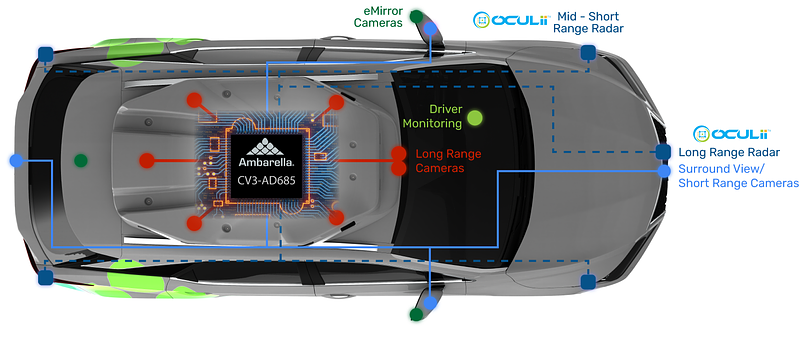
- Perception redundancy: multi-sensor data fusion to ensure accurate detection of objects and pedestrians
- Primary controller redundancy: two controllers supervise each other and act as mutual backups
- Brake redundancy: backup braking provides sufficient braking capability for stability if the main brake system fails
- Steering redundancy: if the safe state requires continued driving rather than stopping, a backup steering system must support subsequent turning maneuvers
These examples show the importance of redundancy design in intelligent chassis for functional safety in automated driving.
The industry consensus is that functional safety, intended functionality safety, and information security form the "three pillars" ensuring vehicle intelligence safety.
3. Conclusion
To meet the requirements of vehicle electrification and intelligence, the development path for intelligent chassis is becoming clearer. From an implementation perspective, intelligent chassis development is still at an early stage and will face many challenges.
Challenges also create opportunities. At the strategic level, intelligent electric vehicles have become a strategic direction for China's automotive industry, providing a favorable environment for intelligent chassis. Rising market demand for intelligent electric vehicles provides economic support for chassis development. Under new E/E architectures, new collaboration models and responsibility divisions between OEMs and suppliers also create opportunities for the Chinese market's local brands to grow.
Given these positive factors, intelligent chassis development has significant potential.