Introduction
As China has increased promotion of new-energy vehicles, the industry has experienced rapid growth and an increasing number of these vehicles are appearing in daily life. This article introduces the vehicle's central control subsystem: the electronic control system.
1. Composition of the electronic control system
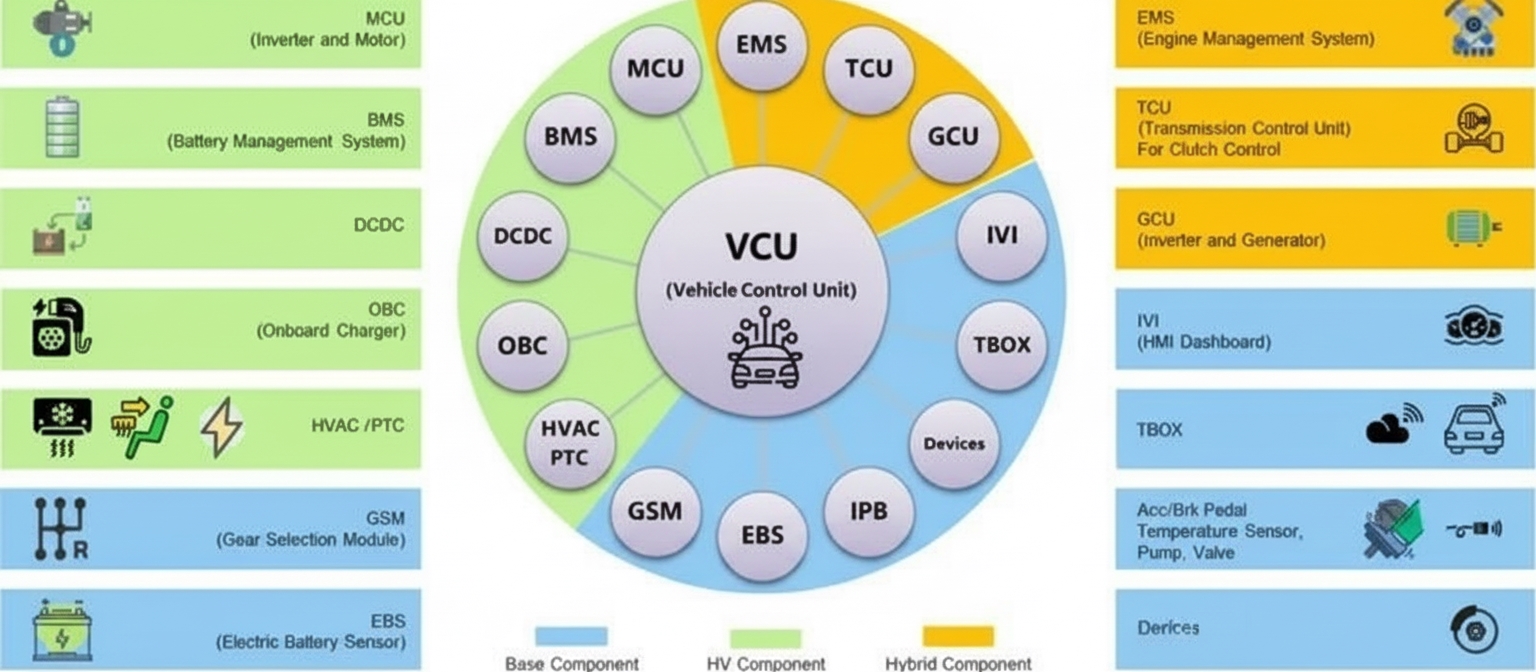
In a narrow sense, the electronic control system refers to the vehicle controller. In a broader sense, it includes the vehicle control unit, the battery management system, the drive motor controller, and related subsystems.
01. Vehicle Control Unit (VCU)
The vehicle control unit acts as the central control for the electric vehicle and is the core of the overall control system and the coordination center for subsystems.
The VCU coordinates and manages vehicle operating states. It collects motor and battery status, accelerator pedal signal, brake pedal signal, actuator and sensor signals, and based on an integrated analysis of driver intent, makes control decisions and supervises downstream component controllers.
02. Drive Motor Controller
The motor controller receives torque command messages from the VCU and controls the drive motor's speed and direction. During regenerative braking, the motor controller is also responsible for rectifying the alternating current generated by the motor and returning it to the traction battery.
03. Battery Management System (BMS)
Compared with the VCU and motor controller, the battery management system is relatively newer. Its main functions include real-time monitoring of battery physical parameters, online diagnostics and alarms, charge/discharge and precharge control, cell balancing management, and thermal management.
2. High-voltage electronic control system
The vehicle electronic control system is divided into high-voltage and low-voltage subsystems.
High-voltage components include the traction battery, high-voltage distribution unit (PDU), on-board charger (OBC), DC/DC converter, electric compressor, high-voltage wiring harnesses, and other components. These form the vehicle's high-voltage system.
The on-board charger, DC/DC converter, and the high-voltage distribution unit are three core components of the high-voltage system.
01. On-board Charger (OBC)
The on-board charger is fixedly installed in the vehicle and charges the traction battery. Based on data provided by the battery management system, the charger dynamically adjusts charging current and voltage parameters to complete the charging process.
The charger consists of two main parts: the power stage and the charger control board. The power stage converts single-phase 220 V AC or three-phase 380 V AC into the DC required by the traction battery. The charger control board controls, monitors, computes, corrects, and protects the power stage and handles external network communication and related functions.
Currently, in the Chinese market, common onboard charger power ratings are 3.3 kW and 6.6 kW; other ratings include 2 kW, 10 kW, 20 kW, and 40 kW.
02. DC/DC Converter
The DC/DC converter converts one DC voltage level to another. In electric vehicles it converts the high-voltage DC from the traction battery into 14V&28V low-voltage DC to supply vehicle low-voltage electrical equipment and to charge the auxiliary battery.
03. High-Voltage Distribution Unit (PDU)
The power distribution unit is the high-voltage power distribution module of the vehicle. It consists of multiple high-voltage relays and fuses and contains control chips to communicate with related modules and ensure safe high-voltage power distribution.
High-voltage components connected to the PDU include the traction battery, OBC, DC/DC converter, motor controller, and others.
04. Traction Battery
The traction battery supplies vehicle propulsion. Typical traction battery voltages range from 100 Vdc to 400 Vdc, and output currents can reach 300 A. Battery capacity affects vehicle driving range, charging time, and charging efficiency.
3. Low-voltage electronic control system
The low-voltage system consists mainly of the auxiliary battery and various low-voltage electrical devices.
Low-voltage electrical systems include lighting, instrument clusters, infotainment systems, and similar equipment.
Low-voltage systems typically use 12 V or 24 V DC as the vehicle low-voltage supply. They power conventional low-voltage loads such as lights and wipers and supply the vehicle control unit, motor controllers, battery management system, cooling pumps, and other auxiliaries.