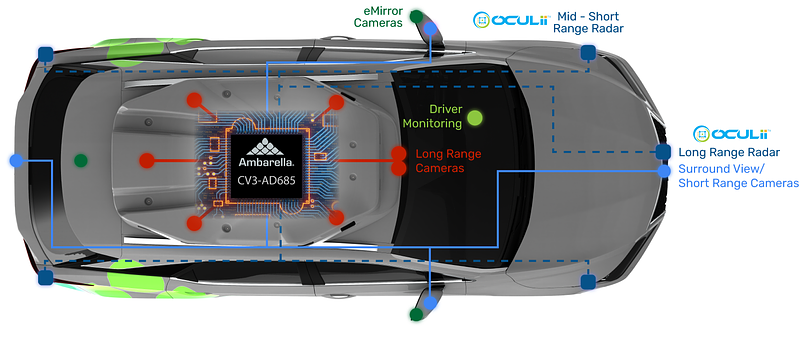
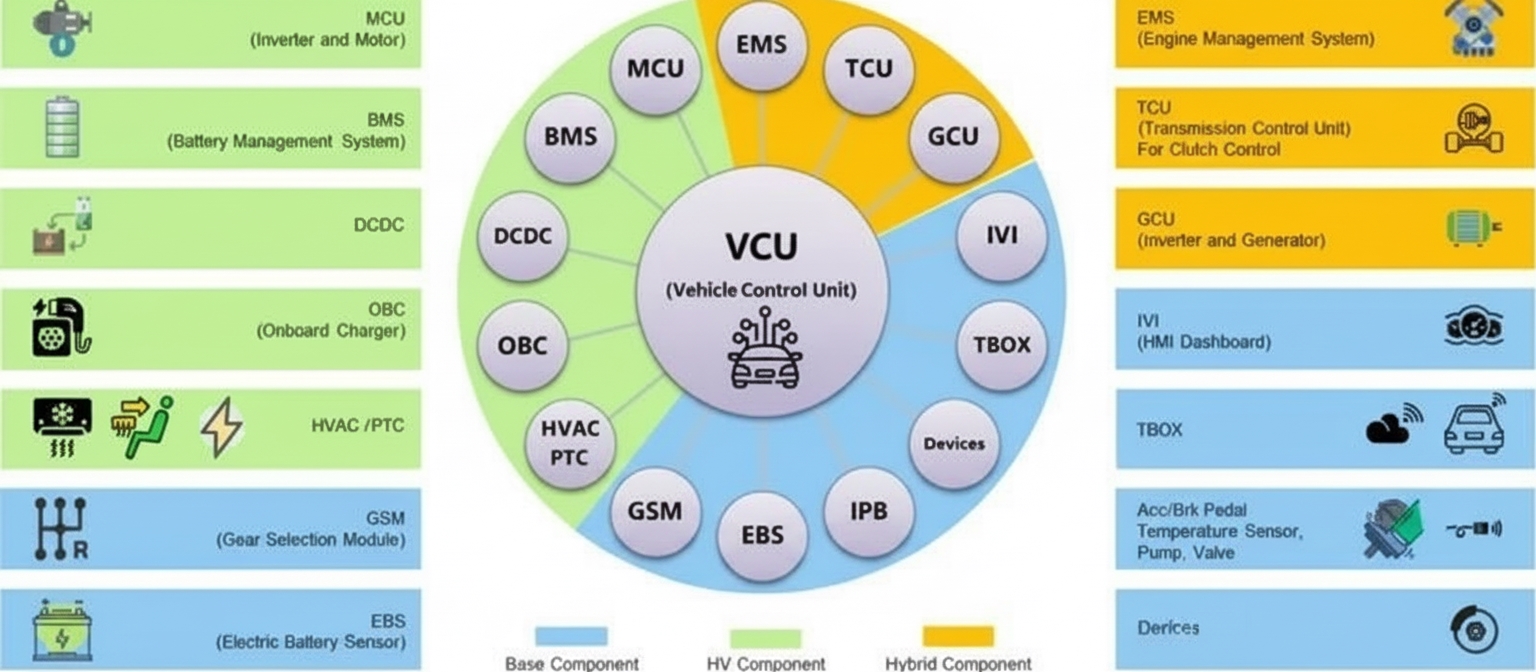
By integrating advanced sensors, controllers and actuators, vehicles can achieve partial or full automated driving. The function and scenario frameworks for intelligent driving are key to understanding and developing the technology. This article explains the main functions and how they relate to typical driving and parking scenarios.
01 Function framework
The function framework of intelligent driving is typically divided into two categories: driving functions and parking functions.
Driving functions: include adaptive cruise control (ACC), lane centering control (LCC), automatic lane change (ALC), traffic jam assist (TJA), and navigation-assisted driving (NOA). According to SAE levels, these functions range from L1 to L3 and cover longitudinal-only control up to more complex point-to-point automated driving.
- ACC: Automatically controls vehicle acceleration and deceleration to maintain a safe distance from the vehicle ahead.
- LCC: Keeps the vehicle centered in its lane, reducing lateral control effort for the driver.
- ALC: Executes lane changes automatically under driver command.
- TJA: In traffic congestion, combines ACC and LCC to achieve low-speed following and lane keeping.
- NOA: Uses navigation information to perform automated driving from one point to another on highways or urban roads.
Parking functions: include automatic parking assist (APA), remote parking (RPA), smart summon (SS), housing parking assist (HPA), and autonomous valet parking (AVP). These functions range from L2 to L4, providing solutions from assisted parking to fully automated parking.
- APA: Automatically detects a parking space and performs the parking maneuver.
- RPA: Allows the driver to park the vehicle remotely using a remote control device.
- SS: Uses a smartphone app or similar remote control to drive the vehicle to a specified position.
- HPA: Remembers specific parking spaces in a parking facility and completes the parking process automatically.
- AVP: Searches for a parking space and parks autonomously in an unknown parking facility; the driver can leave the vehicle.
In addition to driving and parking functions, intelligent driving includes a range of active safety functions such as forward collision warning (FCW), automatic emergency braking (AEB), forward cross-traffic alert (FCTA), forward cross-traffic braking (FCTB), lane departure warning (LDW), lane keep assist (LKA), door-open warning (DOW), blind spot detection (BSD), rear cross-traffic alert (RCTA), rear cross-traffic braking (RCTB), and rear collision warning (RCW).
These features address hazards relative to the vehicle's position:
- FCW: Issues a warning when a frontal collision risk is detected.
- AEB: Automatically brakes when a frontal collision risk is detected.
- FCTA: Alerts when there is a collision risk in a forward cross-traffic area.
- FCTB: Automatically brakes for collision risk in a forward cross-traffic area.
- LDW: Alerts when the vehicle departs its lane unintentionally.
- LKA: Provides automatic lateral control to keep the vehicle in its lane.
- DOW: Warns if opening a door would create a collision risk.
- BSD: Monitors the driver's blind spots in real time to avoid risks.
- RCTA: Warns when there is a collision risk in rear cross-traffic areas.
- RCTB: Automatically brakes for collision risk in rear cross-traffic areas.
- RCW: Issues a warning when a rear collision risk is detected.
These functions provide various safety effects, helping drivers to detect risks and respond in time to reduce accident probability.
02 Scenario framework
The scenario framework for intelligent driving is organized around user travel experience and mainly covers three areas: highways, urban areas, and parking facilities.
Driving scenarios: include driving within the current lane, lane changes, intersections, and ramps. In these scenarios, the intelligent driving system must balance comfort, safety, responsiveness and perception capability to provide a smooth and safe driving experience.
- For driving within the current lane, users focus on comfort and how well the vehicle remains centered. Comfort is reflected in acceleration and deceleration behavior, while lane keeping is evaluated by the distance between the vehicle and lane markings.
- For curves, the system's cornering capability affects user confidence, and the comfort and safety of following behavior are also important. At intersections, the system's recognition of traffic elements and understanding of traffic signals influence perceived safety. Ramps test the system's merging and diverging strategies and speed control.
Parking scenarios: involve driving within parking facilities, searching for parking spaces, parking in and exiting spaces. In these scenarios, parking capability and comfort are the key user experience factors. While driving inside a parking facility, the system must accurately detect static and dynamic obstacles to ensure safe movement. During parking-space search, the ability to recognize available spaces directly affects parking efficiency and user experience.
By understanding the relationship between functions and scenarios, developers can better plan performance metrics for intelligent driving, ensuring that user experience and feature development proceed in parallel. This alignment helps improve product competitiveness and supports safer, more reliable and more user-friendly intelligent driving systems.
The functions and scenarios are closely related. For example, ACC and LCC mainly apply to driving within the current lane, while ALC applies to lane-change scenarios. TJA and NOA involve more complex scenarios, including lane driving, lane changes and ramps. Parking functions such as APA and RPA are primarily applied within parking facility scenarios.
Summary
Developing a clear function framework and mapping it to real-world scenarios is essential for designing and validating intelligent driving systems. Understanding these relationships enables more effective performance planning and contributes to safer, more reliable and user-friendly systems as the technology and regulations evolve.