Introduction
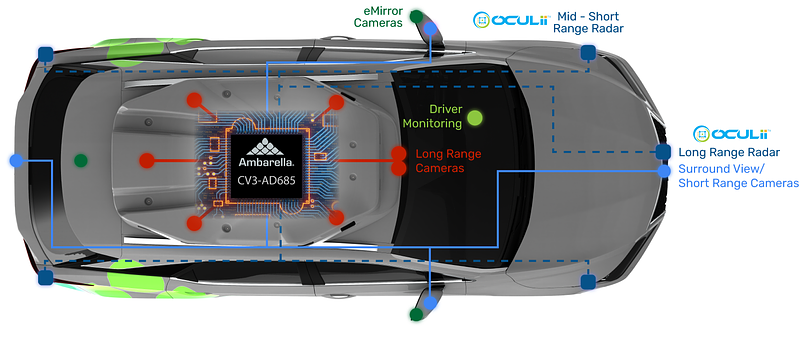
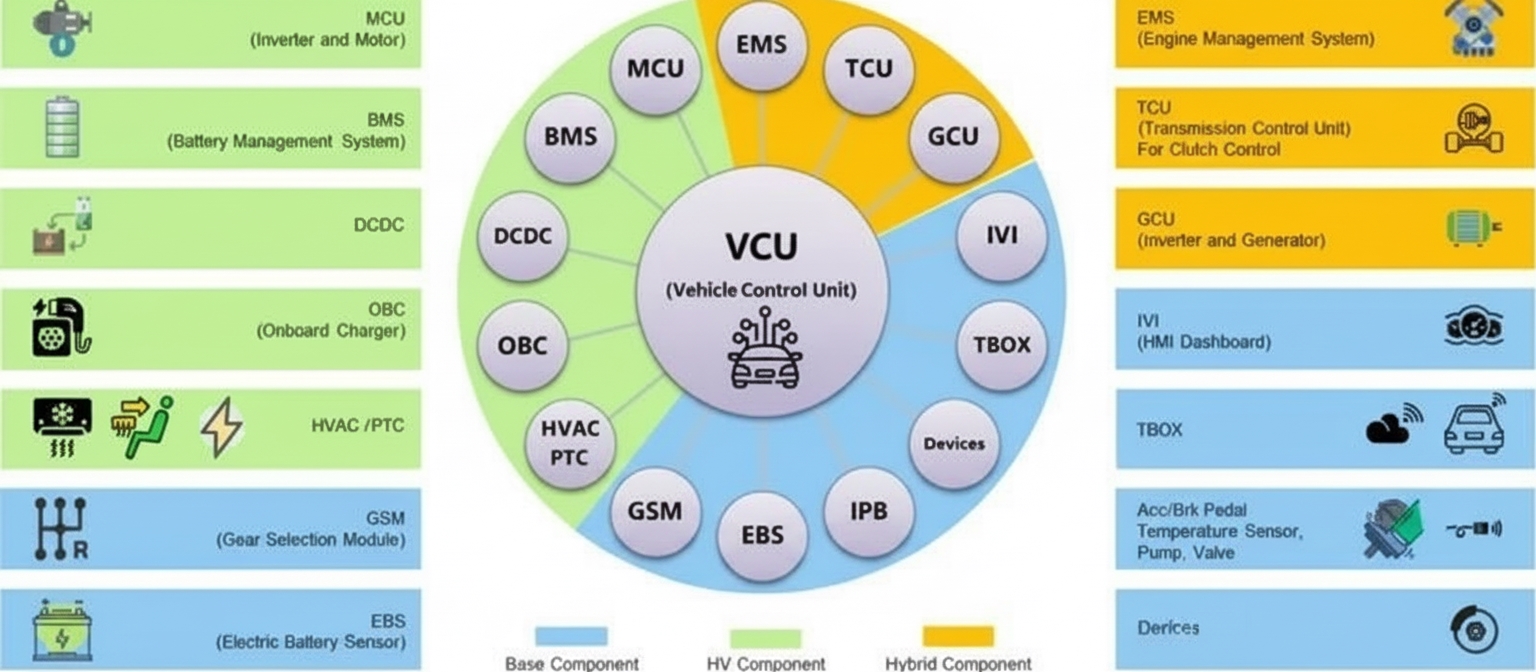
Since their invention, automobiles were primarily evaluated by horsepower. Over a century of development, the car has gradually shifted from a production tool to a "third space." Increasing numbers of electronic features require growing support from chips. As vehicle electrical and electronic architectures have evolved, chips have moved from single-function devices to high-performance SoCs (system on chip). This article examines the foundational element that enables many of those features: compute capability.
Definition and classification of compute
Compute, simply put, is the ability to perform calculations. A modern SoC typically includes CPU, GPU, NPU, and DSP compute units. Think of them like a student who is strong in language, art, mathematics, and science. The CPU mainly handles logical computations and is measured in DMIPS. The GPU focuses on image processing and is measured in FLOPS, indicating floating-point operation capability. The NPU, as a neural network processor, primarily handles neural network inference; mainstream medium- and high-compute NPUs can reach the TOPS level, meaning trillions of operations per second. The DSP is a flexible compute unit that can provide both fixed-point and floating-point computation. As a result, a well-balanced SoC should perform well across multiple domains. What functions can compute support, and how much compute is required for different levels of driving automation?
Compute requirements by autonomous driving level
Autonomous driving is categorized from Level 0 to Level 5, with Level 3 as a common dividing line: levels below Level 3 are considered driver-assist or advanced driver assistance, while levels at or above Level 3 are considered automated driving. Currently, production vehicles are still predominantly below Level 3. Perception in driver-assist systems relies heavily on vision, which has driven the prominence of convolutional neural network accelerators, i.e., NPUs, in the intelligent driving domain.
Why automakers emphasize compute
As driving automation levels increase, so do compute requirements. Compute has become an important parameter alongside traditional vehicle metrics. The rapid increase in the number and variety of in-vehicle sensors, and their improving precision to enable more complex functions, places higher demands on chip compute. At the same time, algorithm models continue to evolve, with larger models applied in practical solutions, further increasing compute needs. Interestingly, flagship models from automakers are being equipped with increasingly large compute budgets, often hundreds to thousands of TOPS, while chip vendors are also investing more in mid-range compute solutions. Sensor and compute reuse techniques are being applied in production projects, and compute sizing appears to be trending toward more pragmatic choices.
More compute is not always better
Although chip compute capabilities have grown rapidly, market expectations are becoming more rational. With advances in software and algorithms, compute utilization rates are improving. Another important concept is frame rate, which more accurately reflects a chip's actual processing capability in real operation. Compute, as a theoretical value, indicates a chip's raw capability, while frame rate indicates the chip's real-world computational efficiency. Higher frame rates are desirable only if the corresponding algorithm models and resolutions are actually useful for the driving function. Without specifying the algorithm model and its input resolution, stating a frame rate alone does not provide a meaningful measure of a chip's practical compute capability.
Huashan series chip platform
Black Sesame Intelligent's Huashan series driving chips are presented as a platform-level SoC solution. A single chip is reported to reach 58 TOPS and is described as platformized with a focus on performance and power efficiency. The design is built on two core IP blocks developed in-house: an automotive-grade image signal processor (ISP) and an automotive-grade deep neural network accelerator (NPU), intended to support perception tasks. The platform supports fusion of forward and surround cameras, front and corner radar, and ultrasonic sensors. It is described as the first platform in China that meets automotive-grade requirements and has reached production status as a single-SoC parking-and-driving integrated domain controller. The solution provides multiple sensor interfaces and is positioned to support L2+ and L3 autonomous driving configurations.