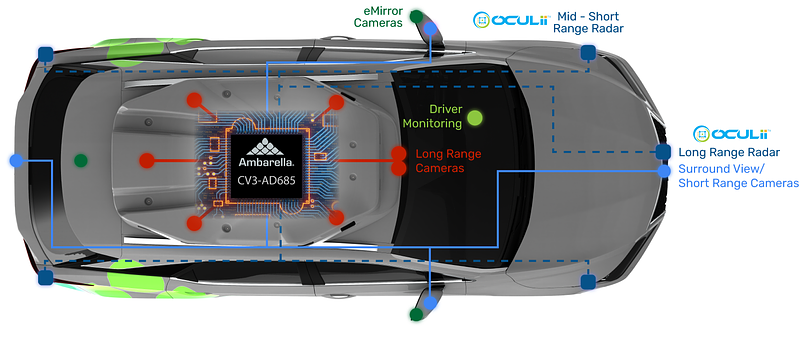
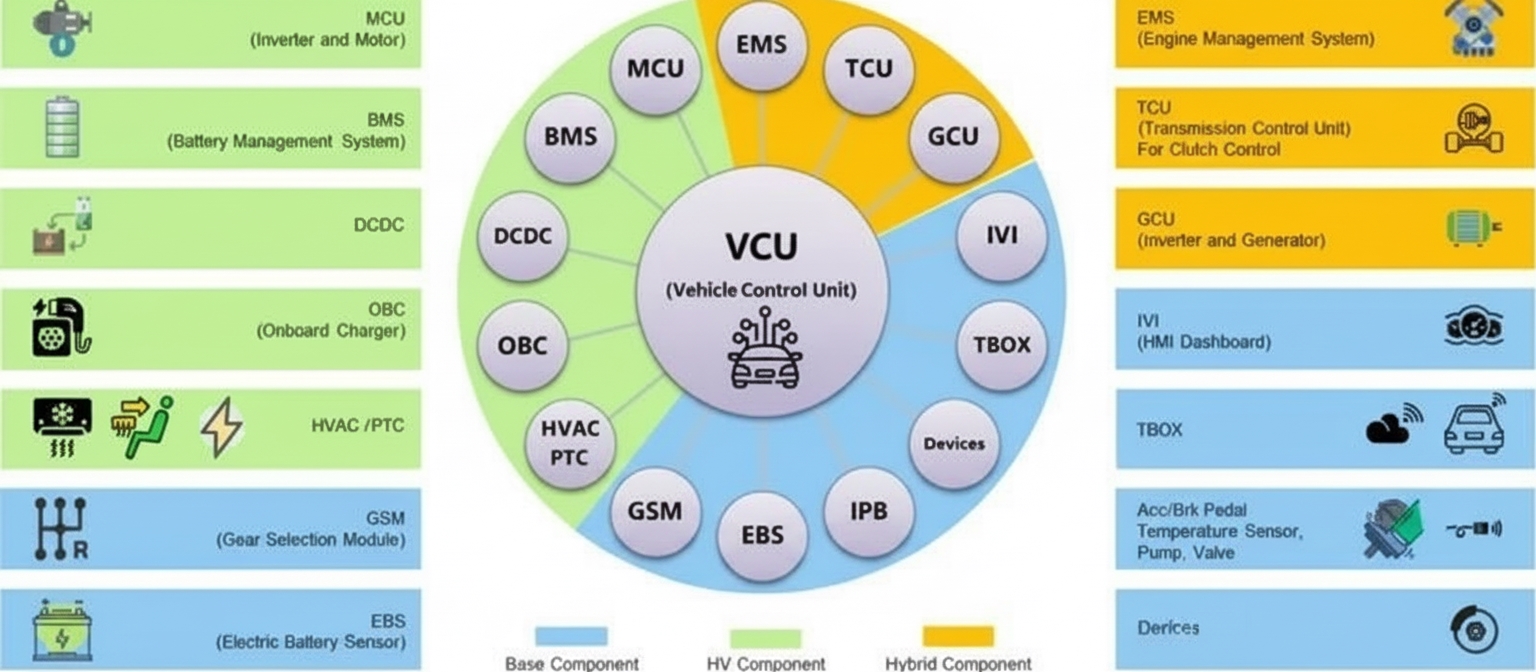
With rapid advances in automotive technology, system-on-chip (SoC) designs play an increasing role in automotive electronics. From advanced driver assistance systems to autonomous driving, NoC (network-on-chip) technology introduces new capabilities and design challenges for the automotive sector.
Two important concepts are microcontroller units (MCUs) and system-on-chip (SoC) devices. Although both are used to build embedded systems, they differ significantly in design and application.
Part 1: Differences between MCU and SoC
MCU (microcontroller unit)
An MCU is usually an integrated single chip that contains a processor core, memory, programmable input/output (I/O), peripherals, timers, counters, and related functions. MCUs are designed for simple control applications such as home appliances and industrial instruments.
MCUs typically include a limited set of peripherals and small memory capacity, often measured in kilobytes. Due to their low cost and low power characteristics, MCUs are well suited for resource-constrained, low-power applications.
SoC (system on chip)
An SoC integrates multiple functional units into a single chip package, and can implement functions that previously required multiple chips. An SoC may include one or more CPUs, larger memory, microcontrollers, digital signal processors (DSPs), accelerators, and other specialized blocks.
SoCs provide richer and more diverse peripherals, making them suitable for applications that require more complex processing, such as smartphones and network routers. Compared with MCUs, SoCs generally have higher cost and power consumption because they require more resources to execute complex computation.
- Peripheral count and type: MCUs have fewer peripherals; SoCs offer a wider variety of peripheral types.
- Scope and complexity: MCUs are suitable for simple tasks; SoCs are intended for more complex functions.
- Cost and power: MCUs are lower cost and lower power; SoCs tend to be higher cost and higher power.
- Memory capacity: MCUs have limited memory; SoCs provide much larger memory capacity.
- Compute width: MCUs typically have narrower compute width; SoCs support wider compute capabilities.
- Application range: MCUs are used in simple devices such as appliances; SoCs target higher-end devices like smartphones and advanced vehicle domains.
Part 2: Arm processor lineup
Rapid development in artificial intelligence and software-defined vehicle (SDV) architectures is driving higher requirements for performance, efficiency, safety, and reliability in automotive compute systems.
Arm provides a range of processors and supporting software targeted at automotive compute. These include processors designed for in-vehicle compute that offer AI acceleration, aiming to balance performance, power, security, scalability, and flexibility for automotive SoC designers. The Arm AE IP portfolio includes server-class Neoverse CPUs, new Armv9 A-class CPUs, a new R-class CPU, and a dedicated image signal processor (ISP).
Arm also supplies critical system IP such as interconnects, the generic interrupt controller (GIC), and memory management units (MMU) to support a variety of automotive computing architectures.
These technologies help automotive partners design a range of compute systems, from zonal controllers to digital cockpits and infotainment, and from advanced driver assistance systems (ADAS) to autonomous driving platforms. Arm additionally offers virtual platforms and software stacks intended to accelerate development and integration of new capabilities.
Summary
As technologies evolve, the boundary between MCUs and SoCs may become less distinct. In automotive electronics, the overall trend is toward greater centralization of compute, with more functions consolidated into higher-capability SoCs while MCUs continue to serve lower-level control roles.