Overview
NIO is a frequent topic when discussing the Chinese electric vehicle market. While public attention has focused on management and business issues, the first production ES8 has accumulated 100,000 km in real use. That mileage approaches common battery warranty limits and raises questions about battery safety and durability. As a new energy vehicle high-voltage safety engineer, I am more interested in whether the ES8 reveals any high-voltage safety issues after long-term use.
Recently, a teardown of an ES8 with 100,000 km was conducted and presented online. I reviewed the recorded material. Although I reserve judgement on the teardown team's overall professionalism, the documented observations still provide useful information for discussion.
1. High-voltage safety design requirements for electric vehicles
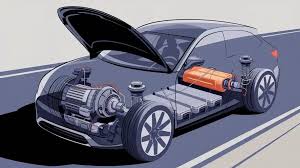
Electric vehicle powertrains differ significantly from conventional vehicles. The main distinction is that EVs rely on a high-voltage battery system and high-voltage drive systems for propulsion. Many onboard devices, such as the A/C compressor, PTC heater, power distribution unit, and AC charger, are high-voltage components.
High voltage in this context typically ranges from 300 V dc to 500 V dc (safety threshold: voltages below 60 V dc are generally considered safe). The currents for these devices can reach several hundred amperes (human tolerance is below 0.023 A). Given these high voltages and currents, inadequate high-voltage protection or improper use can lead to insulation degradation, short circuits, battery thermal events, or fires during long-term operation, posing serious risks to people and property.
Therefore, EV safety design must go beyond traditional vehicle requirements and focus on high-voltage protection measures to keep HV electrical risks within controllable limits. A 100,000 km ES8 teardown can help reveal how the vehicle performs in this regard.
2. Observed high-voltage safety design status of the ES8
Functionality determines whether a product works and how well it performs in daily use. Safety and durability determine whether a product will present problems over time. Teardown of a high-mileage vehicle provides practical insight into long-term behavior and design choices.
2.1 Structural layout and integrity
A reasonable vehicle and HV system layout greatly affects HV safety and reliability. If HV system layout or body structural strength is inadequate, long-term use may result in body deformation, shifting of HV component mounting points, or reduced sealing integrity. Ingress during rain or water exposure could cause HV circuit shorting, heating, and fire risk.
From the teardown images that I reviewed, the HV battery pack interfaces, the power distribution unit, and other key HV components showed no signs of water ingress, corrosion, or mechanical deformation.
High-voltage battery connector area showed no abnormal abrasion or deformation.
High-voltage power distribution unit interior appeared clean, with no water stains or mold.
The ES8's structural reliability benefits from a fully forward-engineered development approach. Forward engineering allows protection of critical components such as the traction battery and drive systems by placing them within the vehicle's core crash and crush protection zones. The load paths and protective structures around these components are relatively regular and reliable.
2.2 Redundancy in design
Design for consumer products should not rely on "just enough" margins, particularly for high-voltage systems in EVs. EVs include many high-power HV components, HV harnesses, and HV connectors. These devices often carry tens to hundreds of amperes for extended periods. According to the heat generation relation Q = I2 R t, higher conductor resistance R leads to increased heating for the same current, and excessive heating can cause component burnout or fire.
To mitigate this risk, component selection and design must include adequate margins and redundancy. Examples include selecting harness conductors with sufficient gauge, ensuring low harness resistance, reliable HV connector and contact design, and correct torque on HV busbar bolts.
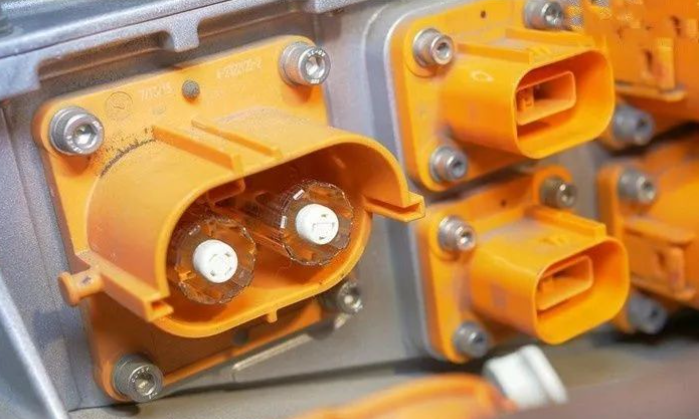
From the teardown, even after 100,000 km, the external condition of all HV harnesses was intact, HV connector interfaces were clean, and HV busbar bolt connections showed no signs of arcing, burning, or discoloration. These observations indicate that the ES8 incorporates significant design margins and redundancy for HV durability and safety.
Note: Redundancy here means providing design margins above expected maximum usage. For example, choosing harnesses rated at 150 A when the expected maximum current is 100 A. Proper redundancy improves reliability but increases cost.
2.3 Harness routing and retention
HV and LV harnesses run throughout the vehicle and create a complex network. Harness routing, diameter, and operational conditions vary, and failure of any harness can lead to serious system issues. Fire statistics indicate a substantial portion of vehicle fires are related to electrical faults; harness fixation and protection play a major role in preventing abrasion, interference, shorts, and thermal incidents.
Vehicles undergo vibration and durability testing to validate harness retention against high-speed, rough, and gravel road conditions. However, user driving patterns can be more severe. The teardown vehicle averaged over 200 km per day to reach 100,000 km in about a year and a half, which is a demanding real-world usage case.
After disassembly, the ES8 shows comprehensive protection for HV and LV harnesses. On average there is a secure mounting point or clip every 100 mm, which helps prevent damage from vibration or impact. Multi-layer insulation, corrugated conduit, and felt protection are used in wear-prone areas. At fixation points, enhanced insulating anti-cut materials are wrapped around harnesses to reduce abrasion risk. Based on the teardown, under the high daily usage scenario, harnesses showed no outer-sheath breaches or interference; harness fixation appears reliable.
3. Summary of ES8 high-voltage safety design status
Safety is a non-negotiable requirement and a primary principle for new energy product development. EV safety development is a complex, system-level effort. It requires thorough consideration of system characteristics and comprehensive failure mode analysis across expected use scenarios to validate safety across the product lifecycle. High-voltage safety, crashworthiness, thermal runaway prevention, and water ingress resilience are among the many aspects that must be addressed.
The teardown of a 100,000 km ES8 offers a transition from early impressions to a mid-term understanding of the vehicle's real-world durability. While questions and debates may continue, the observed status across several HV safety categories suggests that the ES8 incorporates robust design practices and redundancy aimed at HV safety and durability. Current observations do not guarantee future performance, but they provide evidence of intentional design choices relevant to long-term safety.