The rapid adoption of high-voltage architectures in electric vehicles, particularly 800V platforms, has dramatically increased the demands on printed circuit board (PCB) technology. From battery management systems (BMS) to high-voltage power distribution and integrated powertrains, modern EV PCBs must handle high currents, fast switching, stringent isolation requirements, and harsh automotive environments while maintaining safety and reliability. At Aivon, we specialize in engineering robust high-voltage PCBs that enable efficient, safe, and high-performance electric vehicle systems for leading OEMs and Tier 1 suppliers.
High-Voltage Battery System Architectures and PCB Implications
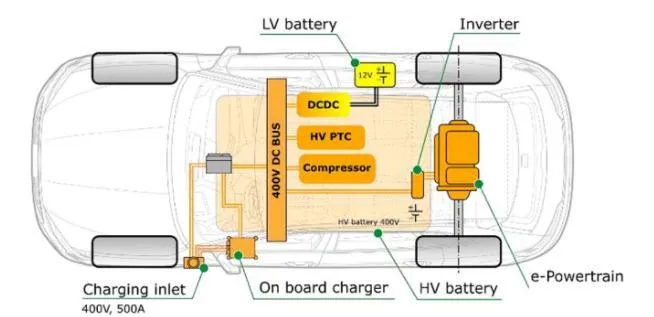
Modern EV battery systems operate at 400V to 800V nominal voltages, with peak voltages exceeding 900V during charging. This shift from traditional 400V platforms to 800V architectures brings significant advantages in charging speed and efficiency but creates major challenges for PCB design.
Key PCB considerations include:
- Thick Copper Layers: Heavy copper (3oz to 6oz or more) or copper busbar integration is essential for handling hundreds of amps with minimal resistive losses and heat generation.
- High-Voltage Isolation: Increased creepage and clearance distances between high-voltage and low-voltage sections require careful layout planning and specialized material selection to prevent arcing.
- Power Distribution Networks: Sophisticated PDNs with multiple isolated domains to support battery packs, inverters, DC-DC converters, and onboard chargers.
Platforms like NIO's 900V architecture and BYD's integrated high-voltage powertrains exemplify the need for advanced multilayer PCBs capable of managing complex power flow while maintaining signal integrity for control systems.
800V High-Voltage Platforms: PCB Design Advantages and Challenges
800V architectures reduce current levels for the same power output, enabling thinner high-voltage wiring and improved system efficiency. However, they impose stricter requirements on PCB technology:
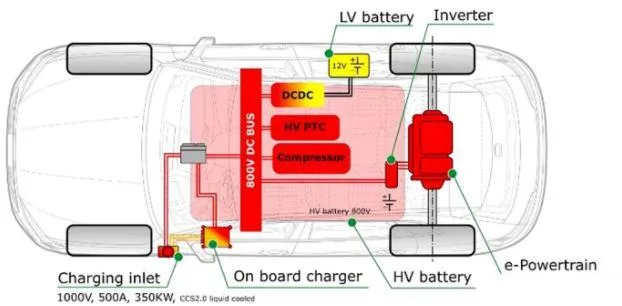
- Faster Switching and EMI Control: Higher voltage systems often use SiC or GaN power devices with rapid switching speeds. This demands excellent EMI/EMC mitigation through ground plane stitching, via fencing, and strategic component placement to suppress conducted and radiated emissions.
- Thermal Management: Despite lower currents, localized heating at power semiconductors and busbars requires advanced thermal solutions such as thermal vias, copper coins, and metal-core or insulated metal substrate (IMS) constructions.
- Material Selection: High-Tg, high-CTE-stability laminates with strong dielectric strength are critical to withstand voltage stress and thermal cycling in automotive conditions.
These platforms place greater emphasis on hybrid stack-ups that combine thick copper power layers with fine-pitch high-speed digital layers for BMS communication.
High-Voltage Wiring and Power Distribution on PCBs
High-voltage wiring design in new energy vehicles extends directly into PCB-level power distribution. Modern systems integrate power distribution units (PDUs) with complex switching and protection circuits.
PCB engineering solutions include:
- Busbar-Embedded Designs: Integrated copper busbars within multilayer PCBs for low-inductance, high-current paths between battery packs and inverters.
- Isolation Barriers: Reinforced dielectric materials and physical slots to maintain required creepage distances while optimizing board space.
- Current Sensing and Monitoring: Precise shunt resistor layouts and Hall-effect sensor interfaces with low-noise analog sections for accurate battery current measurement.
Examples from BYD Han and NIO ES8 highlight sophisticated high-voltage safety designs that rely on robust PCB grounding, redundant monitoring paths, and fail-safe isolation strategies.
Battery Management Systems (BMS) and Vehicle Control Integration
The BMS serves as the brain of the high-voltage battery system, requiring tight integration with vehicle control units.
PCB design challenges for BMS include:
- High-Precision Analog Front-Ends: Multi-channel voltage and temperature monitoring with excellent noise isolation from high-voltage power sections.
- Communication Interfaces: Reliable CAN, Ethernet, or isoSPI links with controlled impedance routing for real-time data exchange.
- Functional Safety: ASIL-rated designs featuring redundant microcontrollers, watchdog timers, and independent power domains to ensure safe operation under fault conditions.
Effective separation of high-voltage power planes from sensitive low-voltage control circuits is essential to prevent noise coupling that could compromise measurement accuracy or safety.
Manufacturing and Reliability Considerations for High-Voltage EV PCBs
Producing reliable high-voltage automotive PCBs requires specialized processes:
- Thick Copper Processing: Advanced etching and plating techniques to maintain uniform thickness and adhesion on heavy copper layers.
- High-Voltage Testing: Partial discharge and hipot testing to verify insulation integrity after assembly.
- Thermal and Mechanical Reliability: Enhanced lamination processes and materials engineered for wide temperature ranges (-40 degrees Celsius to 125 degrees Celsius+) and severe vibration.
- Failure Mode Mitigation: Addressing risks such as copper migration, dielectric breakdown, via cracking under thermal stress, and solder joint fatigue in high-current areas.
Aivon implements rigorous automotive qualification (AEC-Q100, IATF 16949) and environmental stress screening to ensure long-term durability in high-voltage environments.
Conclusion
High-voltage architectures are redefining EV performance, but their success depends fundamentally on advanced PCB engineering. From 800V power distribution and BMS integration to thermal management and functional safety, every design decision at the PCB level directly impacts system efficiency, charging speed, safety, and vehicle reliability.
Aivon delivers specialized high-voltage PCB solutions that empower next-generation electric vehicles. Our expertise in material science, power integrity, isolation design, and automotive-grade manufacturing helps customers overcome the complex challenges of modern EV platforms while accelerating time-to-market with superior quality and performance.