Introduction
Light sensors have become essential PCB components in consumer electronics, industrial controls, automotive systems, and IoT devices. Selecting the correct sensor type directly affects power consumption, response time, accuracy, and overall system cost. Common options include photoresistors, photodiodes, phototransistors, ambient light sensors, and dedicated infrared detectors. This guide compares their operating principles, electrical characteristics, and practical applications to help engineers make informed decisions during component selection and schematic design for different types of PCBs.
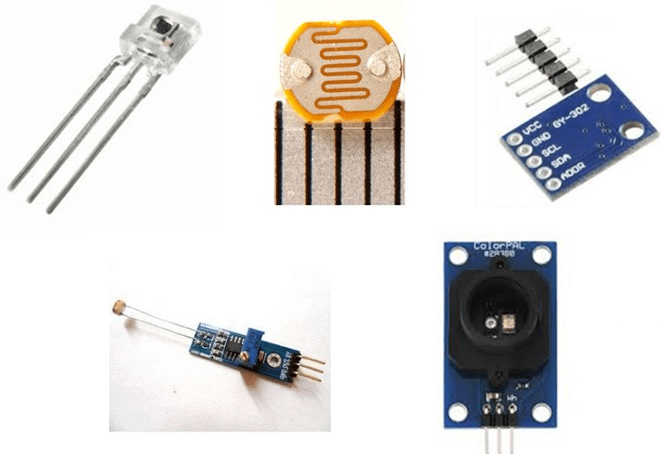
Major Light Sensor Types and Operating Principles
Photoresistor (LDR or CdS Cell)
A photoresistor changes resistance with light intensity. Higher illumination reduces resistance dramatically. Typical dark resistance exceeds 1 MΩ while bright light drops resistance below 1 kΩ.
Photodiode
Photodiodes operate in reverse bias and generate photocurrent proportional to incident light. They offer fast response (nanoseconds) and linear output over several decades of illumination.
Phototransistor
Phototransistors combine a photodiode with built-in amplification. They provide higher current gain than photodiodes but sacrifice speed and linearity.
Ambient Light Sensor (ALS)
Modern digital ambient light sensors integrate photodiode, amplifier, ADC, and I²C interface in a single package. They output lux values directly and include automatic gain control.
Infrared and Proximity Sensors
Dedicated infrared emitters and detectors enable proximity detection, gesture recognition, and remote control functions.
Photodiode vs Photoresistor: Detailed Comparison
| Parameter | Photodiode | Photoresistor (LDR) |
|---|---|---|
| Response Time | < 1 µs to ns | 10–100 ms |
| Spectral Response | 400–1100 nm (peak ~900 nm) | 400–700 nm (visible focus) |
| Linearity | Excellent | Poor |
| Temperature Stability | Good | Poor (resistance drifts) |
| Output Type | Current | Resistance |
| Typical Applications | Optical communication, precision measurement | Simple on/off lighting control |
Photodiodes dominate high-speed and precision applications. Photoresistors remain popular for cost-sensitive, non-critical light detection.
Ambient Light Sensor Characteristics
Digital ALS devices mimic human eye response using dual photodiodes with infrared filtering. Leading parts achieve 0.001 lx to 100,000 lx dynamic range with 16-bit resolution. They consume microamperes in continuous mode and support interrupt outputs to wake host processors only when light levels change significantly.
Practical Applications and Selection Guidelines
Backlight Dimming in Displays
Ambient light sensors provide the most accurate solution. Their logarithmic response and human-eye spectral matching deliver natural brightness adjustment.
Simple Light/Dark Detection
Photoresistors or basic phototransistors work perfectly for automatic night lights, garden lamps, or basic occupancy triggers.
Proximity and Gesture Detection
Dedicated infrared proximity sensors with integrated emitter and detector offer 2–200 mm range with excellent ambient light rejection.
Optical Encoder and Tachometer
Phototransistors or photodiodes with interruptor wheels provide reliable speed and position feedback.
UV Index Monitoring
Specialized UV photodiodes with appropriate filtering measure UVA/UVB intensity for wearables and weather stations.
Circuit Design Considerations
Photoresistor Interface
Use simple voltage divider with microcontroller ADC pin. Add 0.1 µF capacitor across the photoresistor to reduce noise.
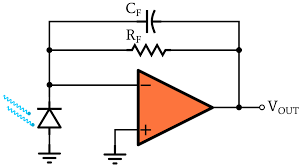
Photodiode Circuits
- Transimpedance amplifier for precision current-to-voltage conversion
- Reverse bias (5–20 V) improves speed and linearity
- Shield from stray light with dark epoxy or metal can
Phototransistor Connection
Connect as common-emitter with pull-up resistor. Current gain typically 100–1000× photocurrent.
Digital Ambient Light Sensors
Connect via I²C bus. Place close to display aperture. Follow layout guidelines for minimum trace length to reduce noise pickup.
Package and PCB Layout Tips
- Place sensor away from LEDs and switching regulators
- Orient sensor perpendicular to incoming light path
- Use solid ground plane beneath analog sensor circuits
- Provide light pipe or window in enclosure for consistent performance
- Consider spectral filter requirements (visible-cut for IR, IR-cut for visible)
Conclusion
Light sensor selection depends primarily on required speed, accuracy, power budget, and cost constraints. In compact and high-density designs such as layouts for the HDI PCB, these factors become even more critical due to limited board space and tighter routing constraints. Photoresistors remain viable for simple on/off detection. Photodiodes and phototransistors serve precision analog applications. Digital ambient light sensors provide the best solution for display brightness control and smart lighting. Always verify spectral response matches the target light source and consider temperature coefficients during final selection.
FAQs
Q1: Which light sensor responds fastest for optical interruption applications?
A1: Photodiodes offer the fastest response times (nanoseconds) making them ideal for optical encoders, tachometers, and high-speed light barriers.
Q2: Are photoresistors still used in modern PCB designs?
A2: Yes, photoresistors remain common in cost-sensitive consumer products requiring only basic light/dark detection where response time and accuracy are not critical.
Q3: How do ambient light sensors achieve human-eye response?
A3: They use dual photodiode structures with optical filters that block infrared while matching the photopic luminosity function curve of human vision.
Q4: Can I use a regular photodiode as an ambient light sensor?
A4: Possible but not recommended. Regular photodiodes have strong infrared response causing inaccurate lux readings under common indoor lighting conditions.
References
IPC-A-610H — Acceptability of Electronic Assemblies. IPC, 2020.
JEDEC JESD51-2A — Integrated Circuits Thermal Test Method Environmental Conditions – Natural Convection. JEDEC, 2008.
IEC 62471 — Photobiological Safety of Lamps and Lamp Systems. IEC, 2006.