This article summarizes a smartphone-integrated surface plasmon resonance imaging (SPRi) system developed to enable simultaneous, sensitive detection of multiple acute kidney injury (AKI) biomarkers in urine. AKI detection benefits from high-sensitivity assays for early tubular injury markers, and noninvasive urine sampling makes such assays attractive for point-of-care use.
Background: AKI biomarkers and the need for sensitive urine tests
Changes in living environments have increased the incidence of kidney injury, which poses significant health risks. Several urinary biomarkers for early AKI have been identified, including liver-type fatty acid-binding protein (L-FABP), kidney injury molecule-1 (KIM-1), retinol binding protein (RBP), interleukin-18 (IL-18), and neutrophil gelatinase-associated lipocalin (NGAL). NGAL, RBP, and IL-18 are tubular markers whose elevated expression indicates injury to proximal and distal tubules. Specifically, NGAL, originating from human neutrophils, can serve as an early predictor of AKI in urine or serum. RBP functions as a vitamin transport protein in blood and reflects early tubular injury; urinary RBP increases significantly shortly after AKI onset. IL-18 is synthesized by monocytes, macrophages, and proximal tubular epithelial cells and is considered one of the urinary markers predictive of AKI. Because urine collection is convenient and noninvasive, high-sensitivity detection of multiple urinary proteins could enable earlier assessment and screening of kidney injury.
Surface plasmon resonance imaging (SPRi)
Surface plasmon resonance (SPR) is an optical phenomenon used for real-time tracking of biomolecular interactions without labels or damage to the analytes. SPR has been applied across catalysis, optoelectronic devices, and biosensing to detect toxins, proteins, bacteria, and DNA. SPR imaging (SPRi) is a high-throughput biosensing platform that, compared with conventional SPR, can evaluate interactions involving multiple biomolecules in parallel.
A research team led by Yi Wang at Wenzhou Medical University constructed a smartphone-integrated SPRi system capable of simultaneous, high-sensitivity detection of multiple AKI biomarkers. The system uses a smartphone LED flash as the light source to excite a prism-coupled gold dot-array sensing chip; the smartphone camera collects reflected light signals. The system chassis and mounts were produced by 3D printing. The measured refractive index resolution reached approximately 1.78 x 10^-5 RIU. By combining magnetic nanoparticle (MNP)-enhanced sandwich immunoassays with the gold dot-array smartphone SPRi chip, the system achieved urine limits of detection (LOD) of 0.19 ng/mL for NGAL, 0.51 ng/mL for IL-18, and 0.70 ng/mL for RBP. The work was published in Lab on a Chip under the title "Smartphone surface plasmon resonance imaging for the simultaneous and sensitive detection of acute kidney injury biomarkers with noninvasive urinalysis."
Constructing the smartphone SPRi system
The system was implemented on an Android smartphone. The smartphone LED flash served as the light source and was coupled via an optical fiber. Light passed through a bandpass filter centered at 632.8 nm and two lenses (f = 40 mm and f = 30 mm). After mirror reflection and transmission through an additional lens (f = 100 mm) and a p-polarizer, the beam became p-polarized and illuminated the gold dot-array chip. The chip parameters were: gold thickness 47 nm, dot diameter 1 mm, and period 2 mm. The chip was prism-coupled to an LASFN9 glass prism (90-degree prism, n_p = 1.845) to achieve attenuated total reflection. Reflected light from the sensor chip passed through a lens and was captured by the smartphone CCD; the resulting sensor images were stored on the phone. Video data were processed in ImageJ to extract intensity-versus-time curves and 3D intensity maps of the gold dots.
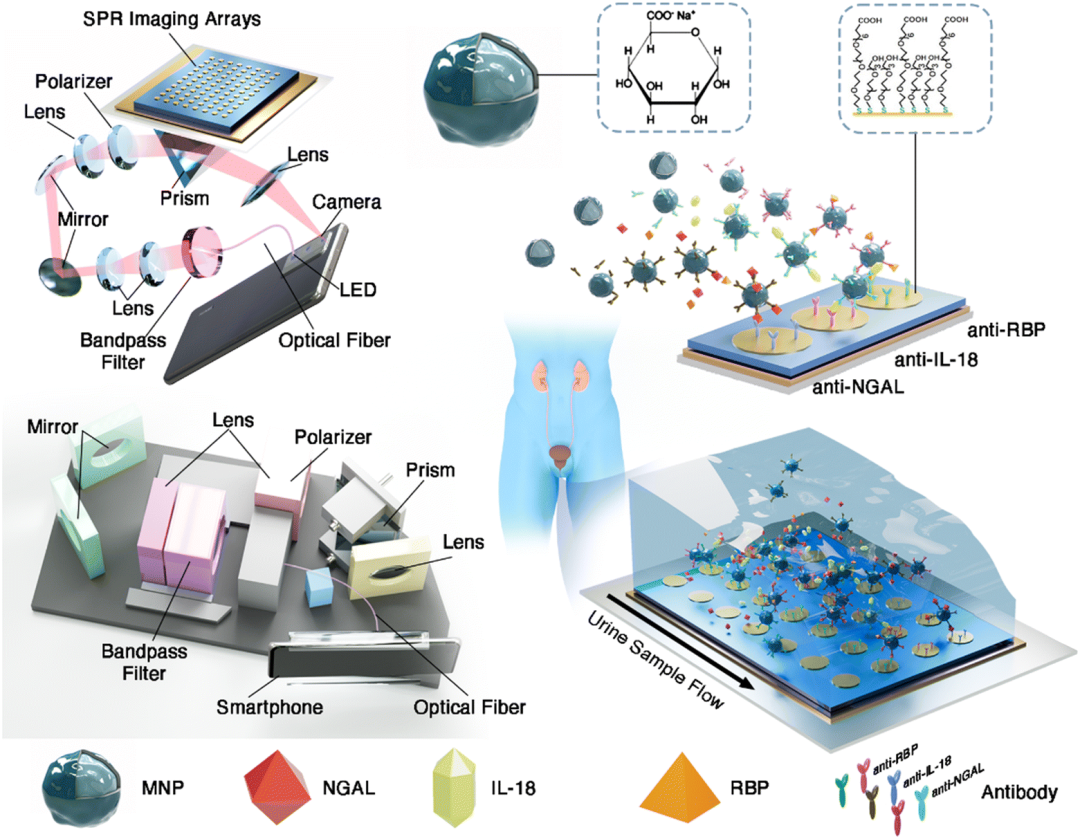
Figure 1. Schematic of the smartphone SPRi system combined with an MNP-enhanced sandwich immunoassay for detecting urinary AKI markers (NGAL, IL-18, RBP). The inset shows the internal optical layout of the smartphone SPRi system.
Simultaneous, noninvasive detection of multiple AKI markers
The smartphone SPRi system was applied to detect NGAL, IL-18, and RBP in PBST buffer and in urine samples (50% PBST). Standard curves were generated by spiking different concentrations of the three biomarkers into PBST and urine. In PBST, the sandwich immunoassay produced LODs of 100 pg/mL for NGAL, 188 pg/mL for IL-18, and 84 pg/mL for RBP. In urine, the smartphone SPRi platform achieved LODs of 0.19 ng/mL for NGAL, 0.51 ng/mL for IL-18, and 0.70 ng/mL for RBP.
Three urine samples with different concentrations of NGAL, IL-18, and RBP underwent sandwich immunoassays on the gold dot array, producing 3D intensity maps. The assays yielded an average recovery of 99.86% +/- 5.12% relative to spiked standards. The system was also used to analyze real urine samples from AKI patients and healthy volunteers. For healthy volunteers, sensor responses for NGAL and IL-18 were negligible, and RBP averaged 1.22 +/- 0.28 ng/mL. For one AKI patient sample, reflection intensities for NGAL, IL-18, and RBP were 9.47, 1.1, and 5.47, corresponding to concentrations of 33.2 ng/mL, 6.7 ng/mL, and 38.2 ng/mL, respectively. These results indicate substantially higher biomarker concentrations in AKI patient urine compared with healthy controls, supporting the feasibility of the smartphone SPRi approach combined with MNP-enhanced immunoassays for detecting AKI biomarkers in clinical samples.
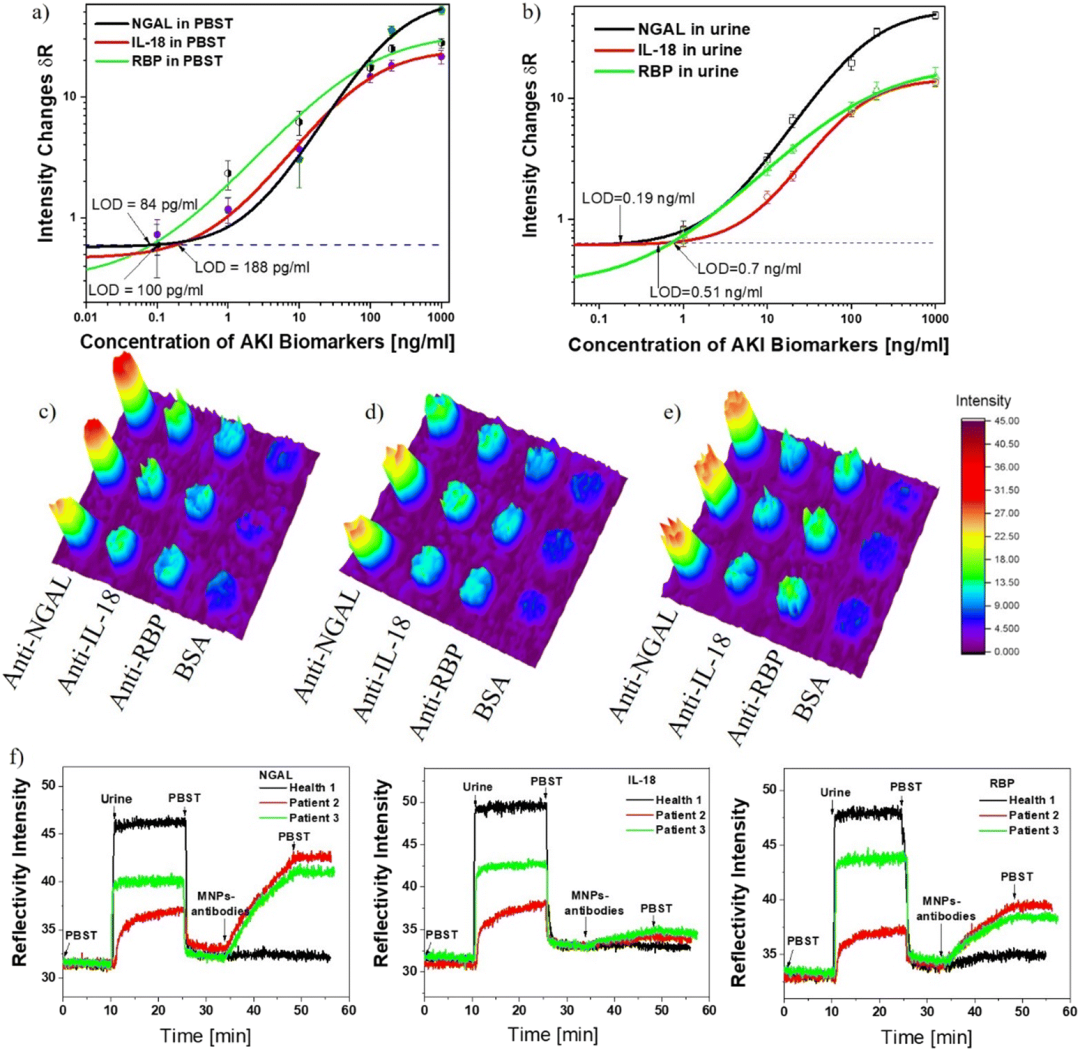
Figure 2. (a) Standard curves for NGAL, IL-18, and RBP measured in PBST; (b) standard curves measured in urine; (c-e) 3D intensity maps from three urine samples with different concentrations of NGAL, IL-18, and RBP obtained by sandwich immunoassay on the gold dot array; (f) reflection intensity traces from the smartphone SPRi system showing simultaneous monitoring of NGAL, IL-18, and RBP in urine from AKI patients and healthy volunteers.
Conclusion
The study describes a smartphone-integrated SPRi system combined with MNP-enhanced sandwich immunoassays that simultaneously detects three AKI urinary biomarkers with high sensitivity. The sensor demonstrated specificity and resistance to fouling in urine matrices. The platform represents a portable option for multiplexed, sensitive biomarker detection applicable to point-of-care testing and home healthcare screening.