It has been three years since the chip supply chain entered a high-tech conflict in 2020. In that time, China’s chip self-sufficiency has increased significantly, from under 5% to more than 20%. To reduce exposure to sanctions, high-tech products in China have been progressively removing U.S.-origin technologies.
Chinese smartphone manufacturers have launched a wave of in-house chip development and have achieved preliminary results. Recently, research firm Techanarei released teardown analyses of the Xiaomi 12T Pro and the vivo X90 Pro/Pro+, finding that the share of China-developed chips is rising year by year.
01. Teardowns: Xiaomi and vivo
Xiaomi 12T Pro
The Xiaomi 12T Pro was released in October 2022. Like the 12S series, it uses the Qualcomm Snapdragon 8+ Gen 1 chipset manufactured on TSMC 4 nm process.
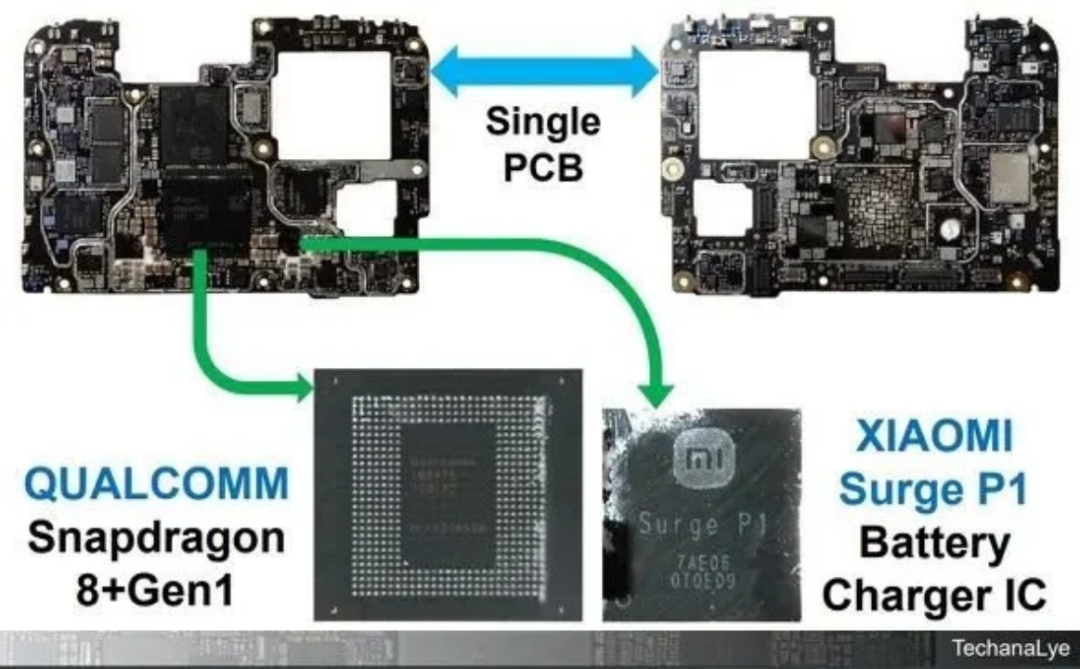
The mainboard is partitioned by function, and each functional area is covered with a metal shield for electromagnetic and thermal management. With the shields removed, components populate both sides of the board. The left side concentrates the processor area, while the right side supports the processor with the power system on the rear. The main processor is implemented in a PoP (package-on-package) arrangement, with DRAM on top and the processor beneath. The main SoC is the Qualcomm Snapdragon 8+ Gen 1. DRAM sits directly above, with memory and communication transceivers nearby.
A notable feature of the 12T Pro is the inclusion of Xiaomi’s in-house Surge P1 chip. Xiaomi has also developed and used its own battery charging IC and a camera AI processor, among other chips, which helped shorten fast-charging times.
vivo X90 Pro / Pro+
The same research group also tore down the vivo X90 Pro, released in December 2022, and found its internal structure to be nearly identical to the Xiaomi 12T Pro. The vivo X90 Pro differs by using two battery cells. Its circuit board is a two-layer structure separated by a gasket, with a sub-board connected to the rear. Like the Xiaomi model, functions are partitioned and shields are used for electromagnetic and thermal control.
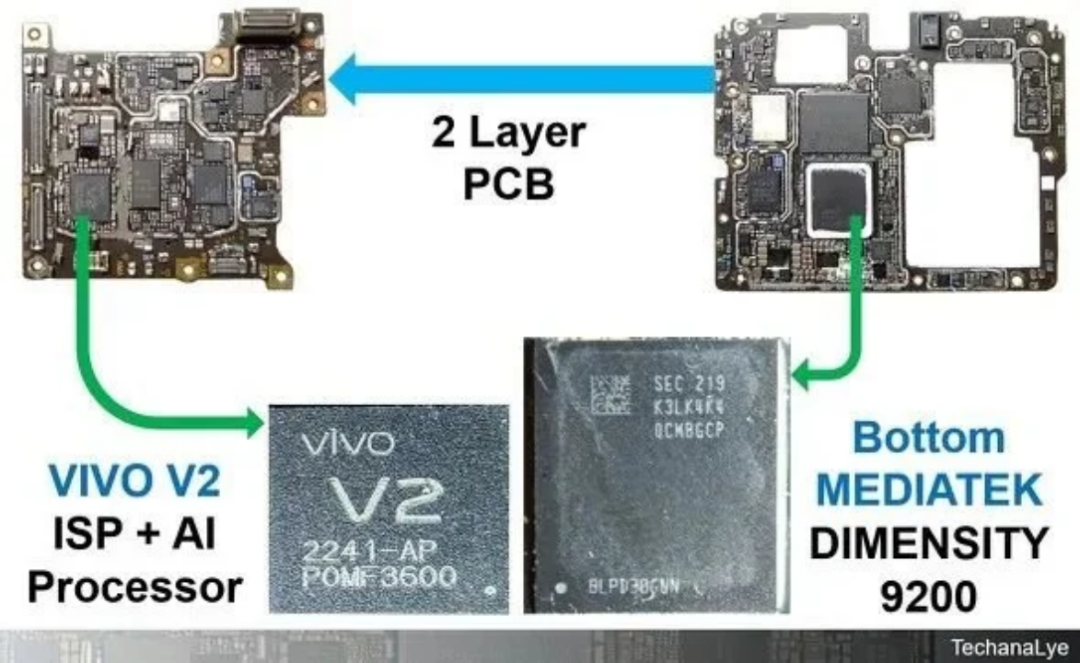
Notably, the X90 Pro includes vivo’s in-house V2 processor on the secondary board. V2 is vivo’s second-generation self-developed chip, combining AI and camera ISP functions. The vivo V2 is manufactured on TSMC 6 nm and offers approximately 18 TOPS of compute. Analysis of vivo V1 and V2 indicates that their development and commercialization mark a clear move by vivo into semiconductors.
Previous TechInsights teardowns of Huawei phones show that, beyond the core Kirin SoC, various smaller chips—RF chips, logic control chips, power management chips, and WiFi chips—have been replaced by HiSilicon’s in-house designs.
Overall, Chinese smartphone manufacturers’ in-house chips are being integrated into products at an accelerating pace.
02. Progress in in-house chips
Since 2021, Chinese phonemakers have seen a wave of in-house chip development.
In September 2021, vivo introduced its self-developed independent ISP chip V1, intended to supplement general-purpose processors where users require customized or heavy imaging performance. vivo has since released two self-developed chips.
In March 2021, Xiaomi released the Surge C1 ISP, followed by the Surge P1 fast-charge chip and the Surge G1 battery management chip. The P1 and G1 form Xiaomi’s Surge battery management system, enabling interaction between self-developed chips.
OPPO’s chip development also started with imaging. The MariSilicon X, released in December 2021, is an imaging NPU focused on AI algorithms, AI denoising, and real-time RAW processing. In December 2022, MariSilicon Y targeted lossless audio trends as a Bluetooth audio SoC, using higher transport rates and lossless compression codecs to support high-resolution streaming.
Among Xiaomi, OPPO, and vivo, only Xiaomi’s Surge S1 was a full SoC, but due to multiple defects and average performance it was discontinued. OPPO and vivo have taken a similar route: starting from ISP chips and then moving toward SoC development.
03. Why prioritize ISP chips over SoCs?
SoC, or system-on-chip, integrates many functions—CPU, GPU, NPU, storage, baseband, ISP, DSP, and more—soits scale and design complexity are much higher than dedicated ASICs. Deep submicron process challenges, design difficulty, and wafer costs all make SoC development expensive.
Currently, only a few companies—Apple, Google, Huawei, and Samsung—have proven capabilities to design full SoCs. On the supplier side, Qualcomm, MediaTek, and UNISOC are established SoC vendors.
By contrast, ISP chips have lower technical barriers and require less investment, allowing more trial-and-error. Because ISP modules can be updated independently of SoC upgrades, and because imaging quality varies across SoC platforms, a self-developed ISP enables phonemakers to deliver consistent, product-specific imaging performance and to decouple camera performance from the chosen SoC.
Reports indicate that OPPO’s IC design subsidiary in Shanghai has begun development of application processors (AP) and mobile SoCs, with AP chips expected in 2023 on TSMC 6 nm, and a combined AP+modem SoC targeting TSMC 4 nm in 2024. A recent online digital blogger also claimed that OPPO’s AP has taped out on TSMC 4 nm with an external MediaTek 5G modem, targeting late-2023 mass production and a 2024 product launch.
Xiaomi’s ISP architect has stated the company plans to use the Surge C1 as a starting point to return to SoC design and manufacturing.
04. What makes SoC development difficult?
SoC development is difficult for multiple reasons. It requires concurrent work across baseband, ISP, AI, CPU, GPU, and other processors. Baseband is a particular bottleneck: Qualcomm holds many essential 5G modem patents and remains the dominant supplier for high-performance mobile modems.
Time is another constraint. Major vendors iterate AP/SoC designs roughly annually as process nodes advance. Starting SoC development from scratch and catching up with market standards can take many years before reaching production volume.
There is also an ecosystem issue. To justify SoC development, a manufacturer needs sufficient product volume to support the ecosystem. Globally, only large vendors such as Apple, Samsung, and Huawei have the combined technology and product scale to sustain in-house SoC ecosystems.
Apple and Huawei have achieved high-end positions in part due to self-developed SoCs that enable deep hardware-software integration and improved user experience. Apple’s A-series and M-series chips demonstrate performance and power-efficiency advantages over some competitors, while Huawei’s Kirin chips helped the company expand market presence and supply-chain influence.
Over the past decade, smartphone manufacturers in China have pursued globalization, and moving upmarket is now a common objective. Given current technical capabilities and investment limits, many manufacturers start in-house chip development with power management and imaging chips, then move toward main SoCs as capabilities mature. In future, more in-house and domestically produced components are likely to appear in Chinese phones.
Beyond phonemakers’ efforts, the broader supply chain is advancing. Chinese CMOS image sensors, memory chips, and 5G RF chips have begun mass production, and the combined efforts of the supply chain and phone companies are gradually assembling a more complete industry ecosystem.