Coupons
Help
  • FAQ
    browse most common questions
  • Live Chat
    talk with our online service
  • Email
    contact your dedicated sales:
0

Actuator Technology for Process Automation

April 27, 2026


Overview

Actuators play a central role in modern production process automation. They are the elements that implement process control: receiving control signals from regulators in the control system and automatically changing manipulated variables to regulate process parameters such as temperature, pressure, flow, and level so that production proceeds as required.


Definition and Main Components

An actuator consists of two parts: the driving mechanism and the regulating mechanism. The driving mechanism converts the controller output signal into thrust or displacement. The regulating mechanism changes energy or material flow based on the driving mechanism output; a common example is a control valve.

signal-actuator process


Actuator Types by Power Source

Actuators are commonly classified by the energy used in the driving mechanism: pneumatic, electric, and hydraulic.


Actuator Structure

Servo amplifier: includes pre-stage magnetic amplifiers, trigger circuits, thyristor main circuit, and power supply. Function: combine input and feedback signals, amplify the result to provide sufficient power to drive the servo motor. Operating principle: the amplifier outputs a signal whose polarity corresponds to the combined signal polarity, thereby controlling motor rotation direction.

Driving components:

  • Servo motor: the power unit of the driving mechanism.
  • Gearbox: converts high speed/low torque into low speed/high torque.
  • Position transmitter: based on the working principle of a differential transformer, it uses output-shaft displacement to change the core position in the differential coils, producing feedback and position signals.
  • Operator: switches between manual and automatic modes, provides remote operation and automatic tracking or non-disturbing switching.


Regulating Mechanisms

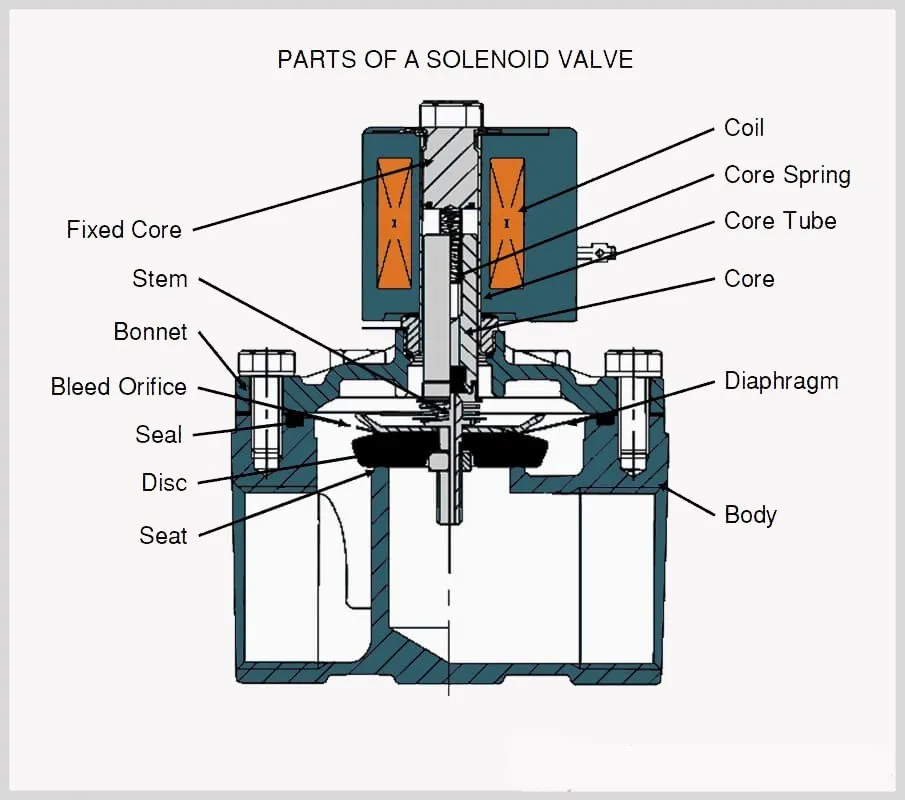
Control valve: changes flow by varying the valve plug travel according to the direction and magnitude of the control signal. From a fluid-dynamics perspective, a control valve is a throttling element whose local resistance can be varied.

Basic fluid assumptions and principles:

  • Ideal fluid: incompressible and non-viscous.
  • Steady flow: the flow velocity at each point in space does not change with time.
  • Bernoulli equation: relates pressure and velocity for steady motion of an ideal fluid.

Globe (single-seat) valve

When the stem rises, the valve opening increases and flow increases; when it lowers, flow decreases. Characteristics: tight shutoff, reliable performance, simple structure, low cost. However, stem thrust is relatively large, so actuator torque requirements are higher. Typical applications: places requiring tight shutoff and small pressure differentials, such as air-conditioning units, fan coils, and heat exchangers.

Globe double-seat valve

Contains two seats and two plugs; the stem moves to change positions. Characteristics: lower torque requirement for actuation during opening and closing, but shutoff tightness is inferior to single-seat valves; cost is relatively higher. Typical applications: control with large pressure differentials where tight shutoff is less critical, for example differential-pressure control valves on chilled-water supply/return lines.

Globe double-seat valve

Three-way valve

Three-way valves have three ports and are classified as mixing or diverting types. Characteristics: they generally maintain a constant total flow, making them suitable for constant-flow systems. Typical temperature limits are below 150°C. Common uses include bypass control for heat exchangers and simple proportioning control.

Three-way valve

Butterfly valve

The closure element is a disk that rotates about an axis in the valve body. Characteristics: compact size, light weight, easy installation, and it can tolerate large allowable pressure differentials during opening and closing. However, regulation performance and shutoff tightness are poorer. Typical use: applications with large pressure differentials and low regulation accuracy requirements.


Actuator Classification by Function and Signals

By control medium: pneumatic, electric, and hydraulic. By output displacement: rotary and linear. By action type: on/off, integral, and proportional. By input control signal type: pneumatic pressure signals, DC current signals, electrical contact signals, pulse signals, etc.


Pneumatic Actuators and Applications

Pneumatic actuators use compressed air as power. Advantages: simple structure, reliable operation, stable performance, easy maintenance, intrinsically safe against fire/explosion, capable of producing large thrust, low cost, and good environmental adaptability. Disadvantages: require dedicated air supply piping; double-acting types cannot return to a preset position if air is lost, while single-acting types rely on a spring to return when air is lost. Pneumatic actuators are usually classified by the mechanism that converts air pressure to displacement: diaphragm type, piston type, and rack-and-pinion type.


Diaphragm actuator

Diaphragm actuators are the most common type. They have simple structure, reliable action, easy maintenance, and low cost. They come in air-to-open and air-to-close configurations. In an air-to-open actuator, increasing input signal creates a force beneath the diaphragm that overcomes the spring and opens the valve. In an air-to-close actuator, increasing input signal creates a force above the diaphragm that overcomes the spring and closes the valve.


Diaphragm actuator

Piston pneumatic actuator

Piston actuators use control air to drive a piston in a cylinder, producing rotary or linear displacement. They can sustain higher control pressures than diaphragm actuators, so they can be designed for larger thrusts or torques while maintaining a more compact size.

Piston pneumatic actuator

Rack-and-pinion (double-piston) pneumatic actuator

Rack-and-pinion actuators are compact, responsive, stable in operation, and long-lived. Components receive corrosion-resistant treatment for harsh environments. High- and low-temperature and special-stroke versions perform well across application areas.

single-acting

double-acting

Operation example: when compressed air enters port A, the double pistons move outward, driving the rack to rotate the pinion 90 degrees counterclockwise and opening the valve; air at the other side exhausts via port B. When compressed air enters port B, pistons move inward, driving the rack to rotate the pinion 90 degrees clockwise and closing the valve; the central air exhausts via port A.


Electric Actuators and Applications

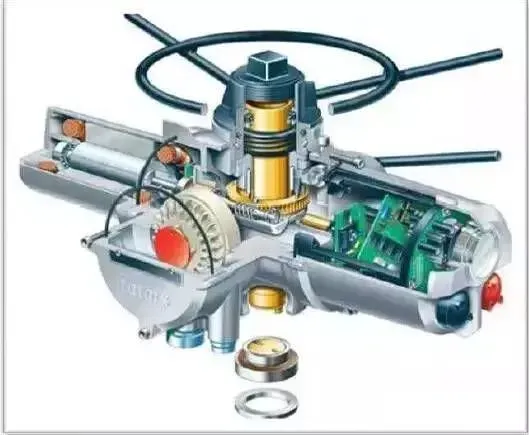
Electric actuators are important execution units in industrial control systems. They generally consist of a control circuit and a driving mechanism that are electrically independent. They accept control signals from systems and linearly convert them into mechanical rotary or linear motion to operate dampers, valves, and other regulators. Advantages: convenient power source, fast signal transmission over long distances, conducive to centralized control, high sensitivity and accuracy, and easy integration with electric control instruments. Disadvantages: more complex structure and higher average failure rate than pneumatic actuators; suitable where explosion-proof requirements are moderate and compressed-air supply is lacking. Electric actuators are available with linear or rotary output motion.

Rotary electric actuators provide torque and normally operate through a fraction of a full rotation, commonly 90 degrees for valve open/close control. Linear electric actuators produce linear travel and are rated by thrust.

inner structure of electric actuator

outer structure of electric actuator

Application scope: electric actuators are widely used in thermal power plant equipment automation where electric motors are the power source.


Hydraulic Actuators and Applications

Hydraulic actuators use hydraulic oil to perform actuation. They are the least commonly used among electric, pneumatic, and hydraulic actuators, typically reserved for large-scale applications.

Advantages:

  • Higher output thrust than pneumatic or electric actuators; torque can be precisely adjusted as required.
  • Smoother, more reliable transmission with cushioning rather than impact; suitable for demanding transmission environments.
  • High regulation accuracy and fast response, enabling high-precision control.
  • The incompressibility of hydraulic fluid provides good resistance to deviation; hydraulic actuation avoids sparking seen in electric drives, offering higher intrinsic safety.

Disadvantages:

  • Requires an external hydraulic system with hydraulic fluid supply and piping, increasing initial investment and installation complexity. For this reason, hydraulic actuators are generally used only in larger systems and certain DEH systems.

oil actuator


Operation example: high-pressure oil enters the lower chamber of the hydraulic piston, the piston moves against the spring and, via lever or linkage, opens the valve. When high-pressure oil is released from the lower chamber, spring force moves the piston down and closes the valve.


Trends in Electric Actuators

Advances in power electronics, computing, and communications are driving rapid development in electric actuators. Mechatronic designs are replacing split systems, digital communication is replacing analog signals, control precision is improving, and application environments are expanding. Expected trends include bus/network interfaces, digital intelligence, and miniaturization.

1. Bus and Network Integration

Factory automation built on industrial LAN technologies has progressed substantially. To integrate with this trend, electric actuators should provide standard serial communication interfaces (for example, RS-232 or RS-422) and dedicated fieldbus interfaces so multiple actuators can be connected to a host computer via a single cable or fiber. Fieldbus provides a serial, digital, multipoint data bus between field devices/instruments and control-room systems, enabling remote monitoring of status, faults, and parameters, and supporting remote parameterization. Widely used fieldbuses include PROFIBUS, Foundation Fieldbus (FF), HART, and CAN. Intelligent electric actuators with fieldbus interfaces are common internationally, and China has also developed some intelligent actuators with fieldbus interfaces.

2. Digitalization and Intelligence

Intelligence is a prevailing trend for industrial control equipment. Low-cost microcontrollers and high-speed microprocessors will replace analog-dominated control units, enabling fully digital control. Digital control converts hardware control into software control, allowing advanced control algorithms (such as optimal control, fuzzy control, neural networks) to improve performance. Since many actuator parameters change during operation, techniques such as gain scheduling and model-identification-based adaptive control can significantly improve performance. Intelligent electric actuators with simple wiring, strong functionality, and high reliability will continue expanding their application scope relative to pneumatic and hydraulic actuators.

3. Miniaturization and Mechatronics

Highly integrated power electronics, microcontrollers, and multifunction modules are driving smaller, lighter actuator designs. Typical intelligent electric actuators now integrate the entire control loop within a field instrument, combining servo motor and controller in one unit. This integration simplifies installation and commissioning and reduces signal leakage and interference, improving system reliability.

Internationally, electric actuators are evolving rapidly toward smaller, integrated, digital, intelligent, and networked designs. There remains a gap in product variety, control precision, process maturity, reliability, intelligence, and networking compared with leading international products; high-performance actuators with independent intellectual property are relatively scarce in the Chinese market.

Related Tags


2026 AIVON.COM All Rights Reserved
Intellectual Property Rights | Terms of Service | Privacy Policy | Refund Policy