Overview
Coordinate measuring machines (CMMs) are precision measurement instruments developed over the past five decades. Their development was driven by the need for fast, reliable measurement tools to match high-efficiency automated machine tools and CNC machining for increasingly complex part geometries, and by advances in electronics, computer technology, numerical control, and precision manufacturing.
Modern CMMs perform complex measurements under computer control, exchange information with CNC machine tools for process feedback, and support reverse engineering based on measured data. CMMs are widely used in mechanical manufacturing, the automotive industry, electronics, aerospace, and defense, and have become essential equipment for industrial inspection and quality control.
Basic Measurement Principle
Geometric measurement is based on the coordinates of points and can be one-, two-, or three-dimensional. The basic principle of a CMM is to place the part within the machine's measurement volume and accurately determine the X, Y, Z coordinates of measured points. Computer processing fits measurement elements such as circles, spheres, cylinders, cones, and surfaces to those points, and mathematical calculations yield form, positional tolerances, and other geometric data.
CONTURA G2 RDS: Composition and Features
1) Probe system:
The probe system includes the probe, probe holder, stylus, readout head, and linear encoder.
2) Hardware control system:
The C99 control cabinet provides computer-assisted error compensation and can perform real-time dynamic corrections for the CMM and sensors to ensure accurate results.
The electrical drive system includes motors, friction rollers, steel belts, belts, air bearings, pneumatic lines, filters, pressure gauges, and pressure regulators.
3) Other mechanical components:
These include a granite table, three-axis guides, vibration damping pads, support frame, Z-axis balance cylinder, solenoid valves, and other components.
Data processing uses Calypso measurement software. The software converts CAD data into measurement programs to produce reliable inspection routines.
Application in Precision Inspection
Using a CONTURA G2 RDS CMM, the flatness of a surface containing multiple narrow slots was measured. The workpiece is shown below.
Program creation used Calypso's open offline programming capability. Benefits include direct import of CAD drawings into the measurement software, allowing program development before part completion and improving efficiency. After program creation, the program can be simulated in the CAD environment to verify probe paths and sampling points, identify potential errors, and reduce risks during actual measurement.
For offline programming, set the measurement software to offline mode and import the prebuilt CAD model. The software provides a graphical interface with basic CAD functions such as zoom, pan, rotate, and shading. Calypso's direct CAD interface supports major CAD formats without introducing tolerance or accuracy loss.
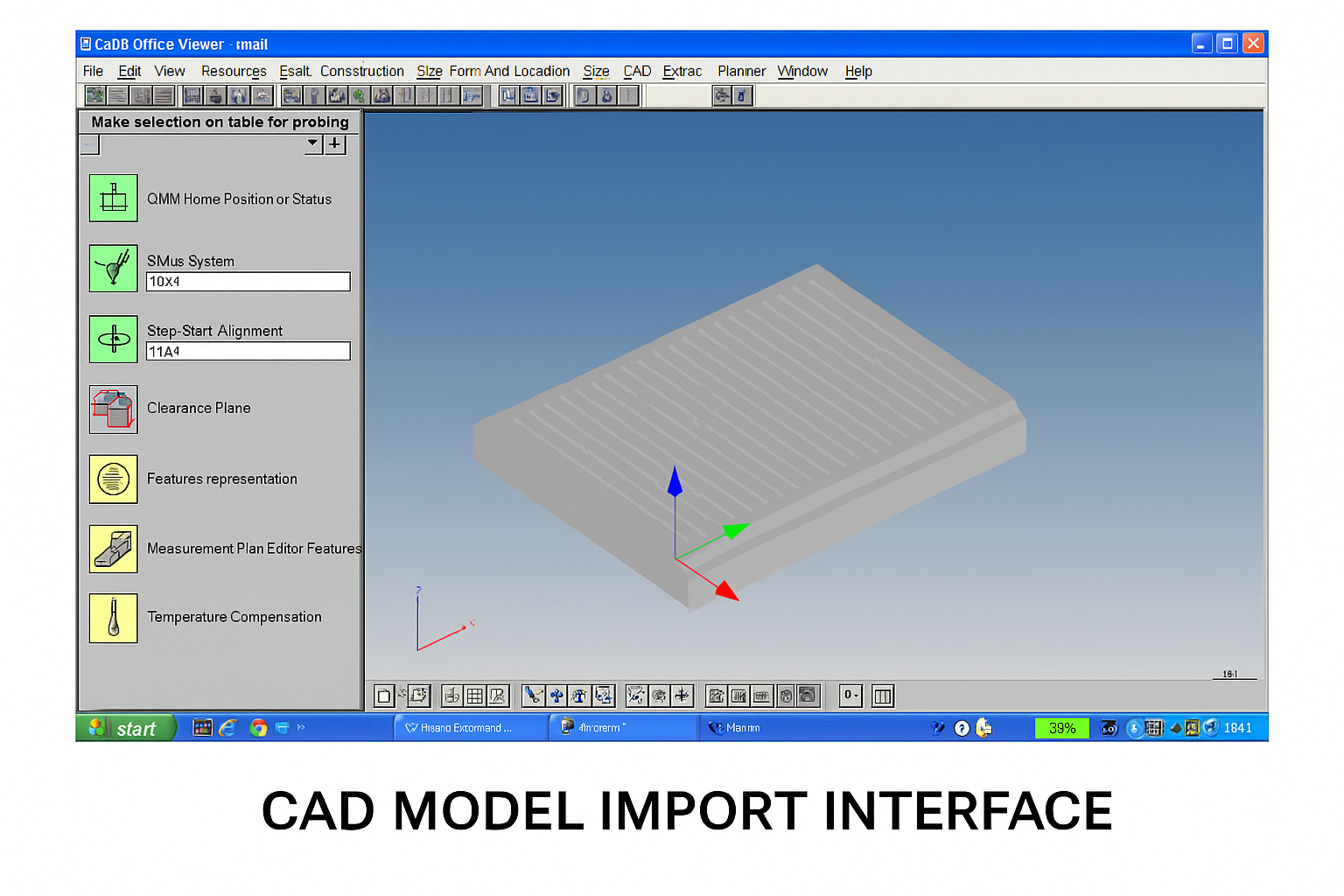
The next step is establishing the part coordinate system and starting measurement. The coordinate system is typically established using the common 3-2-1 method. Select the plane measurement element and configure the measurement strategy. For a plane with multiple adjacent narrow slots, flatness deviations are more likely. To obtain comprehensive results, choose a polyline measurement path that distributes sampling points evenly across the surface so that collected points cover the entire plane. Click on the part model to place sampling points; the model displays the sampling positions and probe vectors. Multiple points can be collected as needed. After selecting the required points, confirm in the sampling window; the system will drive a virtual probe to collect points and fit the geometric element.
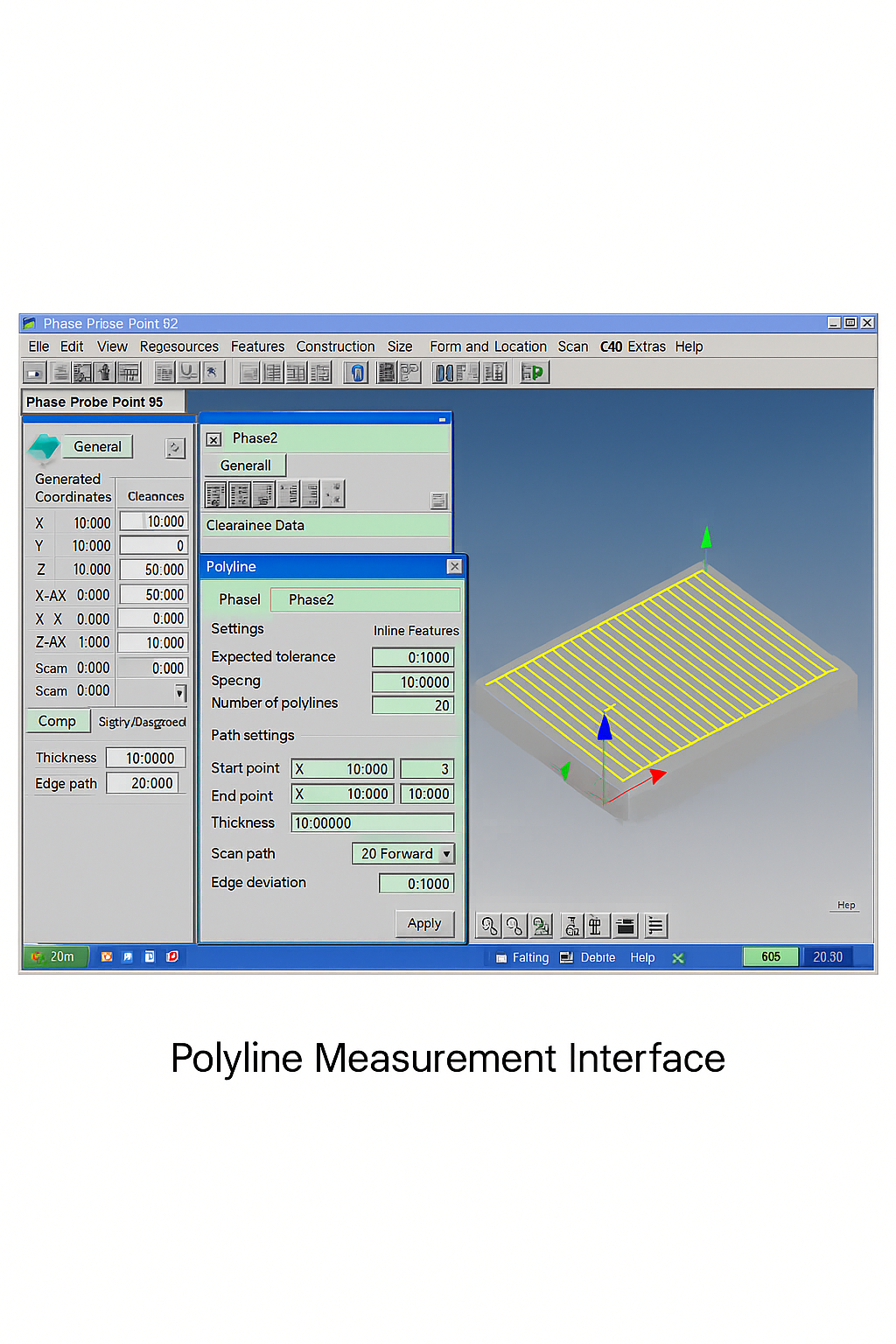
Then configure the polyline measurement path in detail, including probe speed and the number of points to collect. Modify the plane evaluation method to least-squares fitting and enable removal of gross errors as required.
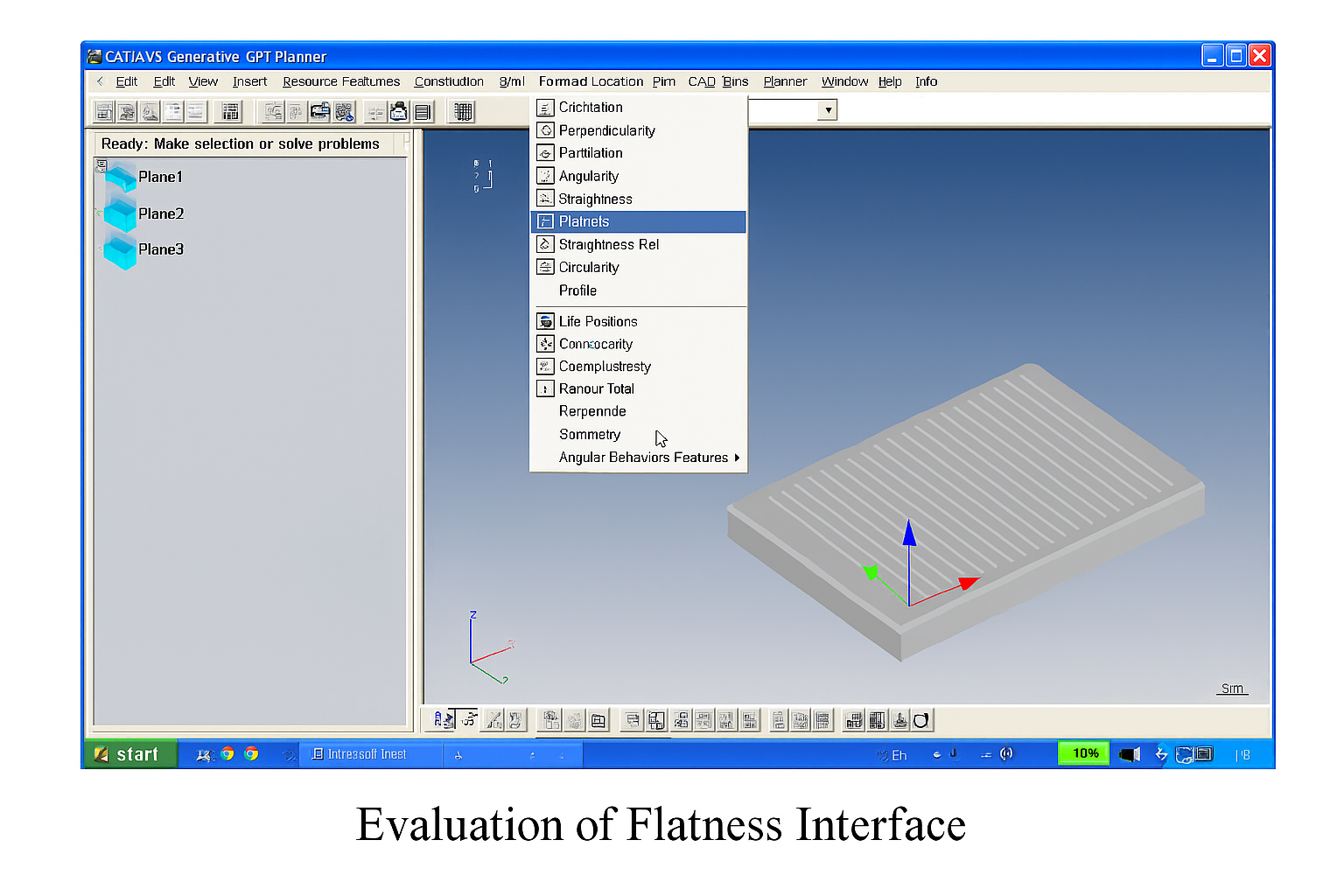
After element measurement is complete, evaluate flatness. Choose flatness from the shape and position tolerance menu, select the measured plane element, and enter the design tolerance to complete the evaluation. The flatness evaluation interface is shown below.
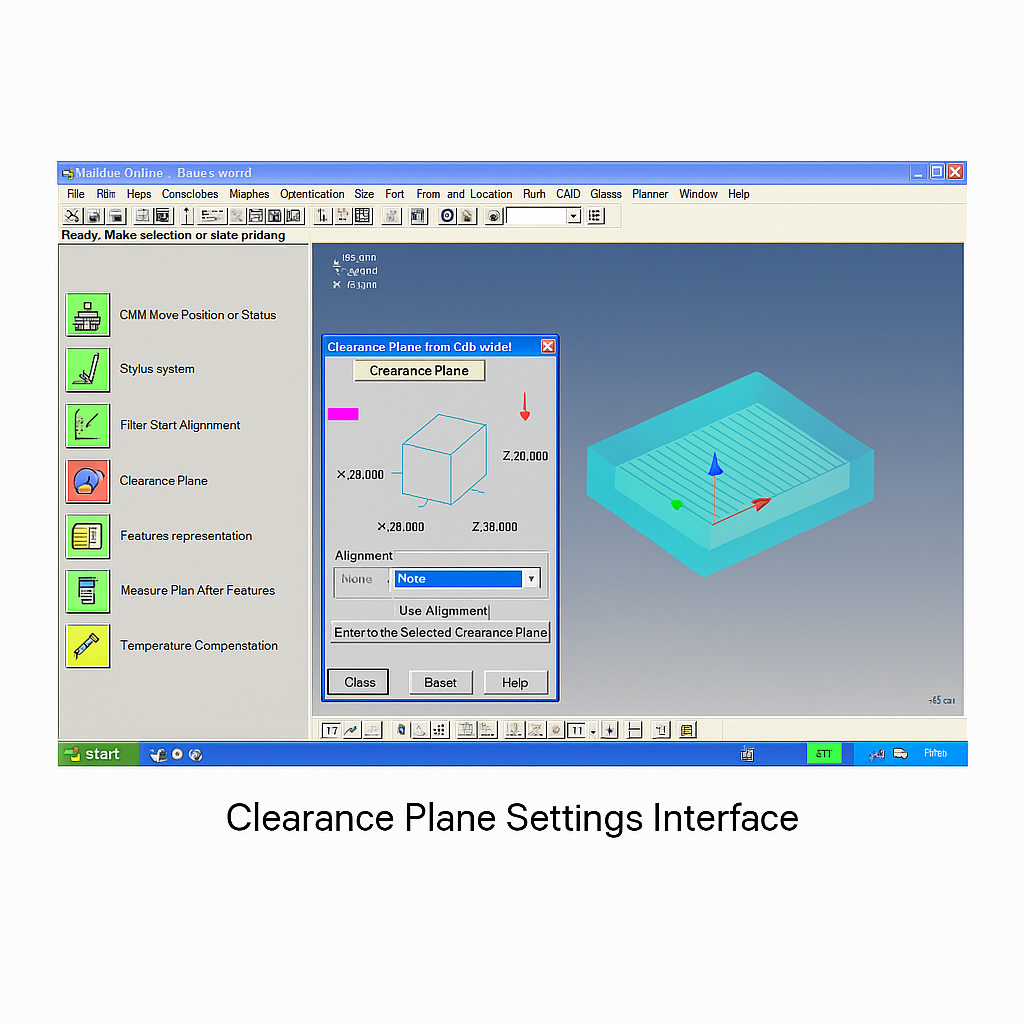
Before running the measurement program automatically, define a safety plane to prevent accidental collision between the probe and the part.
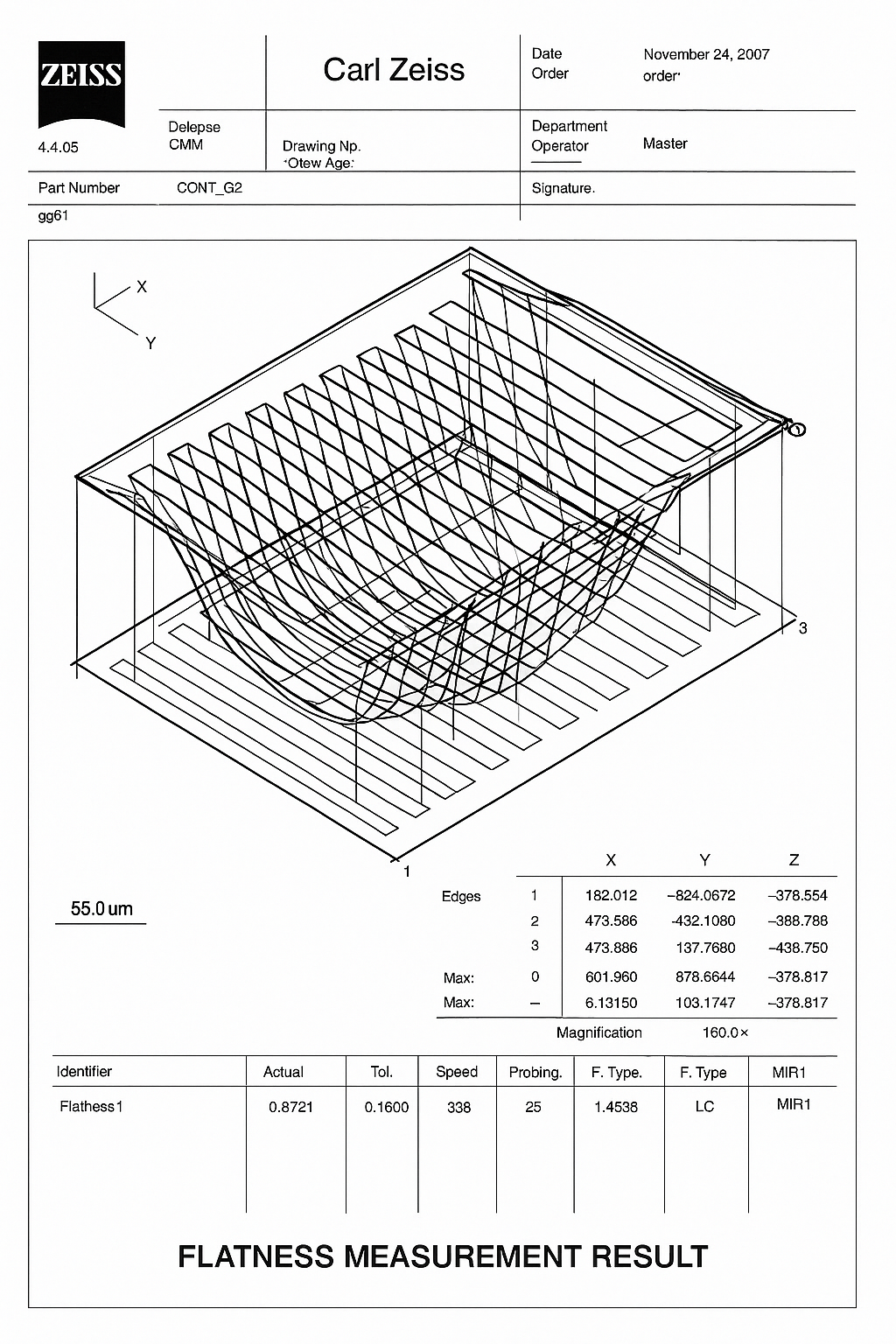
Save the completed measurement program and run it online to obtain a flatness measurement report. The report provides the measured elements, coordinate values, and all measurement data. The user can include actual dimensions, tolerances, deviations from theoretical values, and nonconformance details; report headers can be customized and saved for later review.
Using a CMM for part inspection enables efficient collection of large quantities of precise measurement data and accomplishes tasks that are difficult or impossible with traditional tools such as straightedges. CMMs provide high accuracy, flexibility, and strong digital capabilities. Applying precision CMM inspection in high-quality manufacturing reduces measurement error and ensures product accuracy and quality, supporting design and production needs and improving the quality control of precision components.
International CMM Manufacturers
Hexagon Metrology:
Hexagon Metrology is a business unit of Hexagon. It includes brands such as DEA, Brown & Sharpe, Leitz, Romer, Cimcore, Sheffield, Starrett, CEJ, and Leica, covering high-, mid-, and low-end product segments and holding a leading market share in the Chinese market.
Carl Zeiss, Wenzel, Tokyo Seimitsu, and Mitutoyo:
These manufacturers have production bases in China, mainly in Shanghai and Suzhou, and produce mid- to small-size automated and manual CMMs, holding a notable share of the Chinese market.
Other brands:
Italy's COORD3, Germany's MORA (acquired by AEH), and the UK's LK are mainly represented by agents; they have strong recognition in their home countries but limited shares in the Chinese market.
CMM Manufacturers and Suppliers in the Chinese Market
Taiwan Zhita:
Founded in 1996, the company has production bases in Shenzhen and Kunshan and produces instrument analyzers, CMMs, and vision measurement systems.
Xi'an Edward:
A China-invested operation of Germany's AEH Measurement, established in the mid-1990s, producing mid- to small-size production CMMs including CNC automatic and manual types, positioned in the mid-to-low price range.
Qingdao Forti:
A company started by experienced CMM engineers during state-owned enterprise reforms in Qingdao, with around a decade of production experience. It produces mid- to small-size CNC automated and manual CMMs, holds CMM R&D and production patents, and operates a regional CMM training and testing base.
Institute 303, Beijing:
A state research institute and one of the earliest domestic units to study CMMs. Its main products include aviation-class measurement machines and CNC machine tools.
Other distributors:
The CMM industry is an emerging sector within the instrument and metrology field. In recent years, the number of CMM distribution and trading companies in the Chinese market has increased, and their qualifications vary widely; many focus on distributing mid- and low-end products.
As large precision instruments, CMMs are increasingly important and have broad development prospects. They facilitate three-dimensional spatial measurement and can be integrated into online inspection and automated measurement systems.