Overview
Interlayer excitons generated within van der Waals (vdW) heterojunctions enable infrared (IR) detectors that overcome several limitations of two-dimensional photodetectors. Van der Waals heterojunctions formed from transition metal dichalcogenides (TMDCs) provide an advanced platform for producing interlayer excitons and can be used to detect wavelengths beyond the individual cutoff of the constituent TMDCs.
Study and Fabrication
A research team from the Korea Research Institute of Chemical Technology, Chungnam National University, and Ulsan National Institute of Science and Technology published a paper in Advanced Functional Materials titled "High-Performance Infrared Photodetectors Driven by Interlayer Exciton in a Van Der Waals Epitaxy Grown HfS2/MoS2 Vertical Heterojunction." The paper reports the development of an interlayer-exciton-driven infrared photodetector fabricated from a vdW heterojunction grown by chemical vapor deposition (CVD).
The researchers selected HfS2 and MoS2 to form a van der Waals heterojunction platform for interlayer-exciton-driven IR detection. This choice is enabled by the selective growth characteristics of HfS2 and the favorable band offset between HfS2 and MoS2. In a two-step CVD process, HfS2 selectively grows only on MoS2, producing a vertical heterojunction with a large interfacial area that promotes interlayer-exciton formation.
Structural and Optical Characterization
Raman spectroscopy and photoluminescence (PL) measurements were used to investigate the structural features and optical properties of pristine MoS2 and the HfS2/MoS2 heterostructure, as shown in Figures 2a–2c. X-ray photoelectron spectroscopy (XPS) was used to identify the chemical composition of HfS2/MoS2, with results shown in Figures 2d–2f.
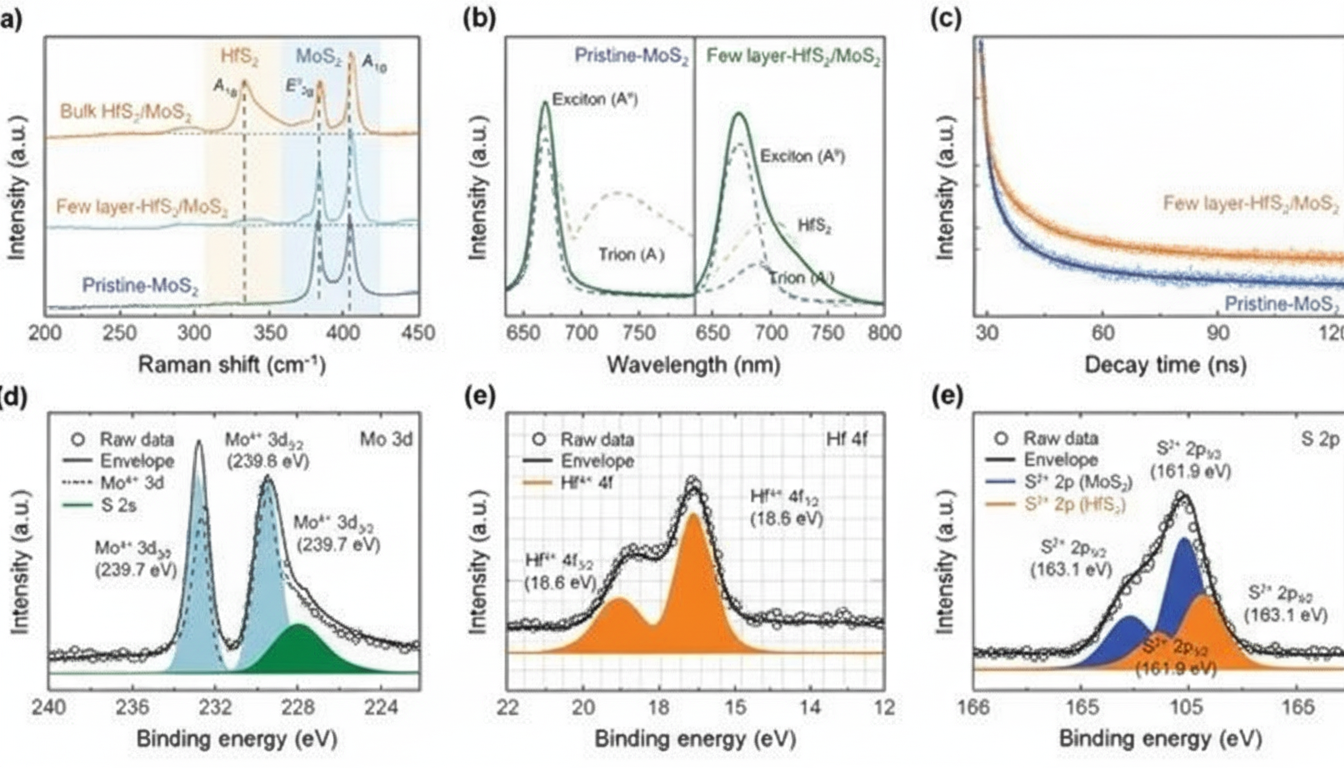
Figure 1. Spectroscopic results for pristine MoS2 and HfS2/MoS2, and XPS measurements for HfS2/MoS2.
High-resolution transmission electron microscopy (HRTEM) imaging and corresponding fast Fourier transform (FFT) analysis were acquired to directly confirm the vertical heterojunction between HfS2 and MoS2. The HRTEM images and FFT analysis are shown in Figure 3.
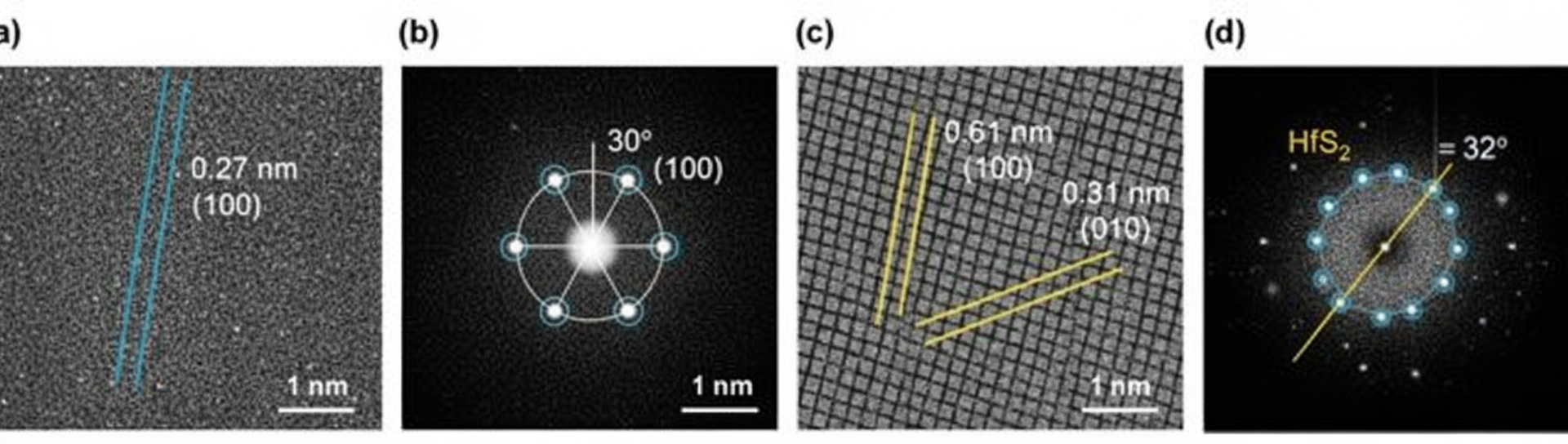
Figure 2. HRTEM images and FFT analysis of the HfS2/MoS2 vertical heterojunction.
Summary
This work demonstrates a photodetector based on a CVD-grown HfS2/MoS2 heterojunction that promotes interlayer-exciton formation through a selectively grown vertical interface. In the two-step CVD process, HfS2 grows only on MoS2, forming a vertical heterojunction with a large interfacial area that supports interlayer-exciton generation. The HfS2/MoS2 photodetector shows strong performance: at 470 nm the specific detectivity D* = 5 x 10^14 Jones, which is 36 times higher than that of a MoS2-only photodetector. Notably, at 1550 nm—beyond the individual detection ranges of HfS2 and MoS2—the HfS2/MoS2 device exhibits a responsivity R = 600 A/W, D* = 7 x 10^13 Jones, and fast rise and decay times of 60 us and 71 us, respectively. This study reports the use of CVD-grown TMDCs to realize interlayer-exciton-driven infrared detectors, providing a pathway for scalable development of two-dimensional material IR photodetectors.