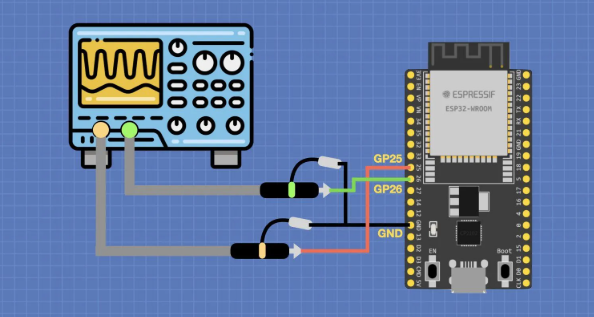
A digital oscilloscope is a modern electronic measurement instrument used to observe how the voltage amplitude of time-varying signals changes over time. It converts electrical signals into digital data and presents them as visual waveforms. Digital oscilloscopes offer high resolution, ease of use, and a range of measurement functions, and they have gradually replaced traditional analog oscilloscopes.
Working principle
The basic working stages of a digital oscilloscope are:
- Sampling: The oscilloscope samples the input signal using a built-in analog-to-digital converter (ADC).
- Quantization: The sampled signal is quantized into binary values.
- Encoding: The quantized values are encoded as digital data.
- Storage: The digital data are stored in the oscilloscope memory.
- Display: The stored digital data are converted as needed and displayed on a screen or other display device as a waveform.
Main uses
Common applications of digital oscilloscopes include:
- Measuring waveforms and parameters of various electrical signals.
- Analyzing faults in circuits.
- Debugging electronic equipment.
- Testing the performance of electronic devices.
Basic operation
Typical steps to use a digital oscilloscope:
- Connect the power supply and the signal source.
- Select an appropriate trigger mode and acquisition mode.
- Adjust the vertical gain and offset controls to obtain a clear waveform.
- Adjust the time base and vertical scale to set the correct time and voltage axes.
- Save and export data as required.