Overview
When equipment has been in service for a long time or wiring labels are unclear, engineers often need to trace the relationship between cables and circuit breakers before repairing a fault. This troubleshooting can be time consuming and depends on both field experience and appropriate tools. A wire tracer can identify corresponding conductors in energized or de-energized harnesses, simplifying repetitive tests and improving safety and speed.
Required equipment
Transmitter and receiver wire tracer unit.
01. Procedure for de-energized circuits
Connect the transmitter positive lead to the conductor to be identified. Tie all other conductors to the transmitter negative lead and also connect the negative to ground. Use the receiver to trace the cable route and determine the matching conductor by signal presence.
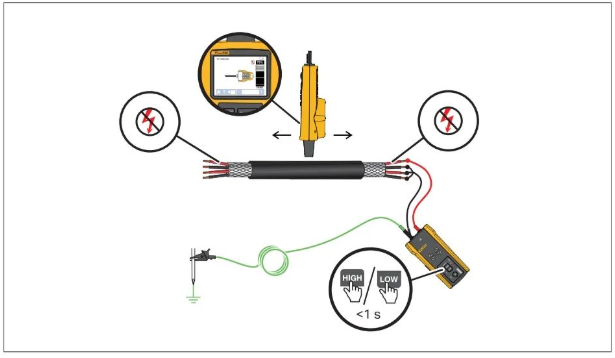
02. Procedure for energized circuits
Connect the transmitter positive lead to the conductor to be identified and connect the transmitter negative lead to ground. Use the receiver to locate the conductor. While tracing, separate the test conductor from parallel conductors by a small distance to reduce interference from adjacent wires. The conductor with the strongest signal corresponds to the transmitter connection.
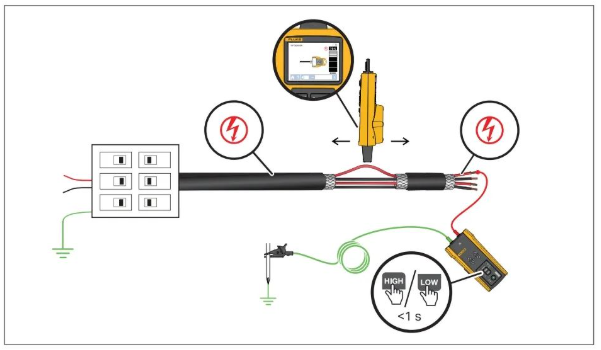
03. Field case
Case summary: A cable short occurred during construction and required repair. Before repairing, the corresponding circuit breaker had to be located. Equipment labels were unclear and several abandoned circuits existed. The site had two distribution panels with more than 30 breakers each.
Method: The transmitter was connected at the fault point on the cable, with the positive lead on one phase and the negative lead to ground. In the distribution panels, the receiver was used to scan breakers; the breaker associated with the cable was identified by the strongest signal at its termination.
Notes on tracer features
Some advanced tracer kits, such as the Fluke F2052/F2062 series, are rated to CAT IV 600 V and support testing on both energized and de-energized conductors. Typical features include rapid cable localization, short/open fault location, breaker and fuse identification, and NCV non-contact voltage detection. These features provide audible and visual indications of cable location and faults.