In low-voltage distribution systems, common methods for measuring current include ammeters, multimeters, and clamp meters. Clamp meters are often the most convenient. To measure current with a clamp meter, set the meter to the appropriate range and clamp it around the conductor under test. The image below shows an example of measuring the phase conductor current.
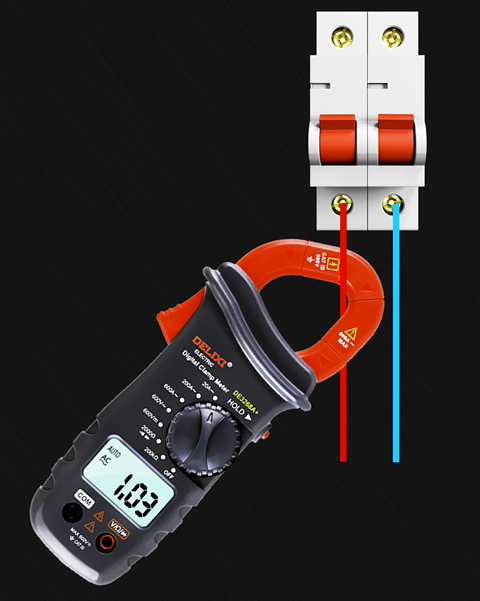
Measuring leakage in single-phase circuits
Clamp meters can also measure leakage current directly. For a single-phase circuit, clamp the meter so it encloses both the live and neutral conductors at the same time. If the meter reads zero, there is no leakage; a nonzero reading indicates leakage in the circuit.
Measuring leakage in three-phase three-wire circuits
For three-phase three-wire systems, measure leakage by clamping the meter around all three phase conductors simultaneously. A zero reading indicates no leakage; a nonzero reading indicates leakage in the circuit.
Measuring leakage in three-phase four-wire circuits
In a three-phase four-wire system, clamp the meter around the three phase conductors and the neutral conductor (four conductors) at once. A zero reading indicates no leakage; a nonzero reading indicates leakage. Even if the three phases are unbalanced, this method still measures leakage current; it does not measure the imbalance currents themselves.
Principle behind clamp meter leakage measurement
The measurement is based on the transformer coupling principle. Consider all loads connected through a circuit breaker as a single generalized node. With no leakage, the current entering the node via the live conductor equals the current leaving the node via the neutral conductor. If leakage exists, the live conductor current equals the neutral conductor current plus the leakage current leaving the node.
When a clamp meter encloses live and neutral conductors and there is no leakage, the two currents are equal in magnitude and opposite in direction, so their magnetic fields cancel. The meter core then has no net magnetic flux and produces no induced signal. If leakage is present, the live conductor current is greater than the neutral conductor current, producing a net magnetic field in the meter core. This net field generates an induced signal that the meter converts to the displayed leakage current reading.