Overview
With ongoing advances in laser and infrared technology and the widespread use of electro-optical reconnaissance, early warning, and protection systems, electro-optical countermeasures have become one of the fastest-developing and most prominent technical fields. The primary objective is rapid, accurate localization of electro-optical devices at range (such as laser rangefinders, infrared thermal imagers, and laser, infrared, and television guidance systems) and then countering these devices. Technically, this encompasses target detection and localization, mechanisms and processes of target damage, and related effects. This article analyzes key technologies including detection and precise localization of electro-optical targets in complex backgrounds, engagement range of countermeasure systems, and high-precision stable tracking.
Cat's-Eye Effect and Target Localization
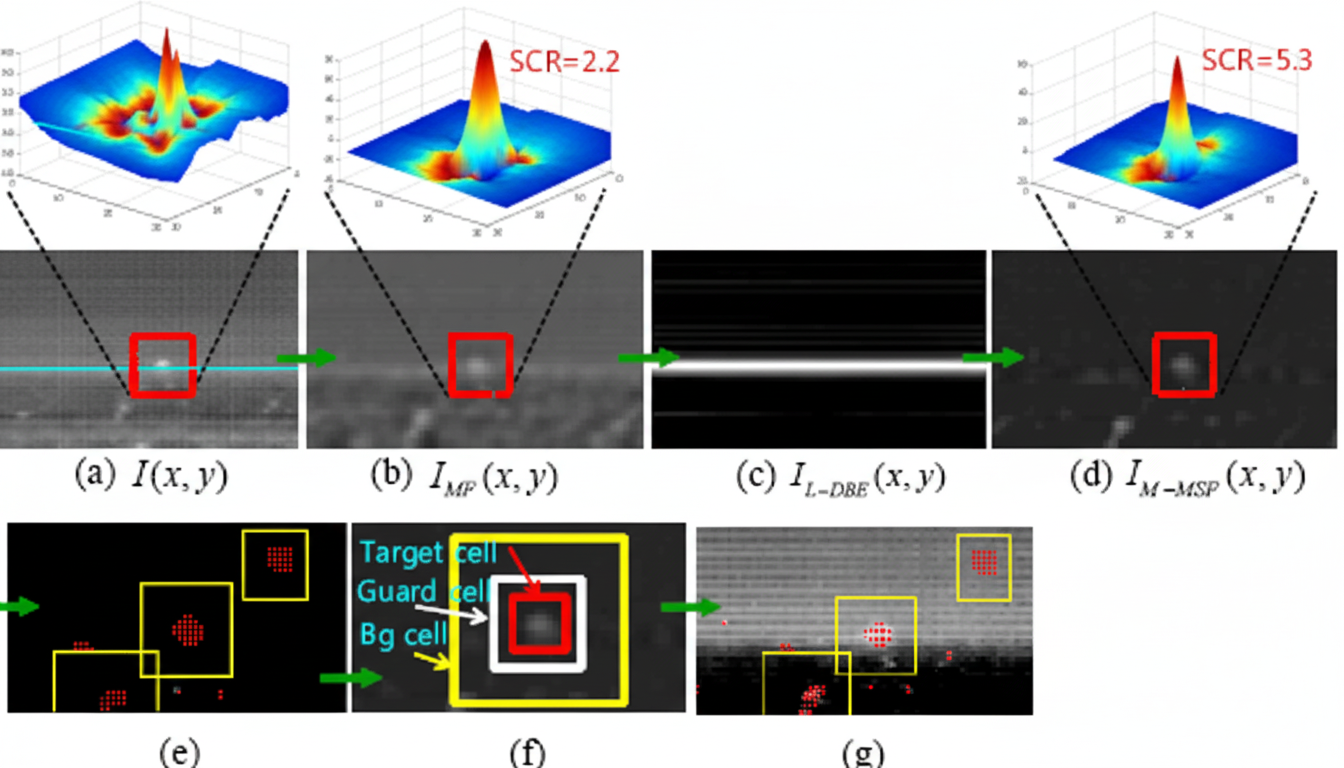
In cluttered terrain and background, relying only on target diffuse reflection to determine its position is extremely difficult. The basic theory for precise detection and localization of targets in electro-optical countermeasure systems is based on the "cat's-eye effect." When a target contains an optical system, within the operating wavelength band, if a narrow laser beam enters the target optical system field of view, the target's lens group or reflective elements on the focal plane (such as aiming optics, the photosensitive surface of an electro-optical sensor, or a cathode-ray tube) will reflect back toward the focus. During detection, the incident light returns along the original path; this specific phenomenon is called the cat's-eye effect.
DIRCM System Principles
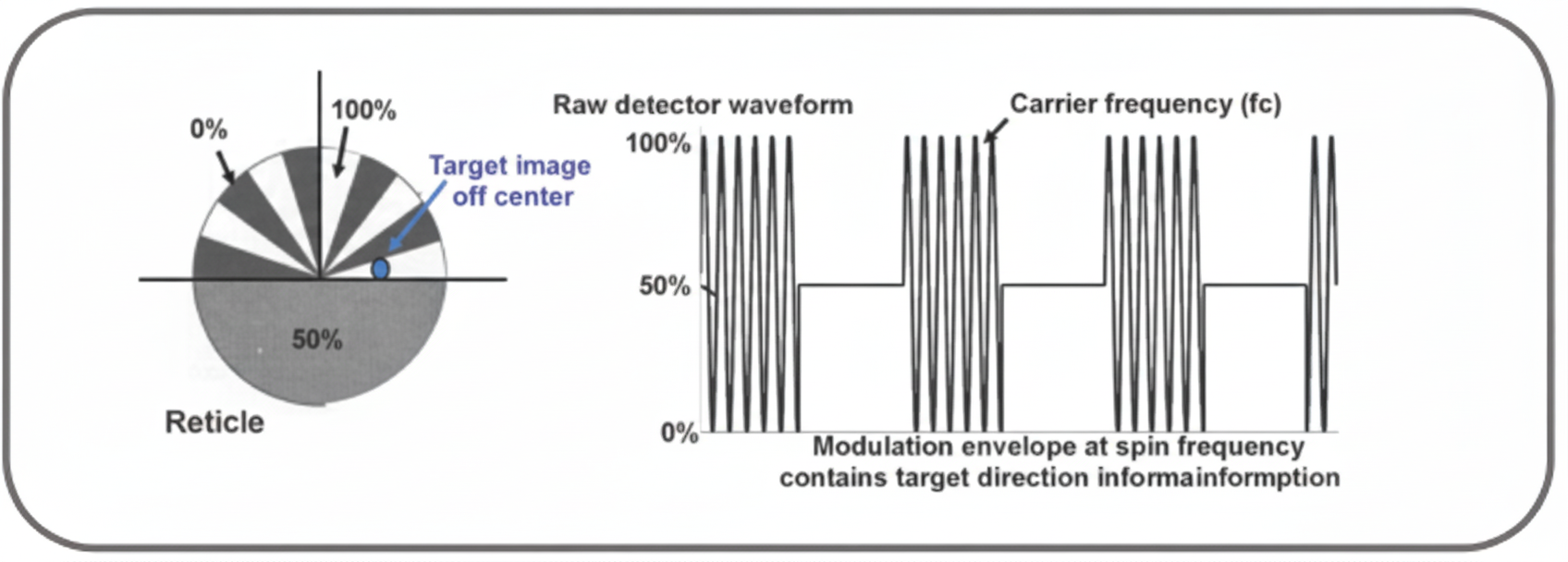
Directed infrared countermeasures (DIRCM) are intended to defeat surface-to-air infrared threats that use first-, second-, or third-generation infrared seekers. These seeker types are often called signal-processing seekers because they determine target direction by demodulating signals generated by a rotating reticle placed in front of the infrared detector (for multispectral seekers, in front of the detector array). Figure 1 shows an example of such a signal: the target direction is given by the signal phase, while the amplitude provides an estimate of the distance from the seeker field-of-view center. To effectively confuse a seeker demodulation system, a DIRCM must inject a modulation signal (a so-called jamming code) into the seeker's infrared detector that the seeker will interpret as a valid target location.
Laser Requirements and Wavelength Bands
A modulated infrared laser beam is the means by which a DIRCM injects the jamming code into a seeker detector. For successful operation, the laser must meet the following requirements:
- Its wavelength must fall within the detector band of the seeker.
- It must be strong enough to cover the platform's infrared signature.
DIRCM laser emitters typically operate in the SWIR and MWIR bands. Recent developments have explored long-wave infrared and ultraviolet sources to extend the effectiveness of these systems. Laser power defines the class of platform a DIRCM can protect. Small helicopters have relatively low infrared emission, so limited laser irradiance can mask their infrared signature. For wide-body transport protection, DIRCM systems require higher-power infrared lasers to achieve sufficiently high J over S (the ratio of jamming power to platform signature).
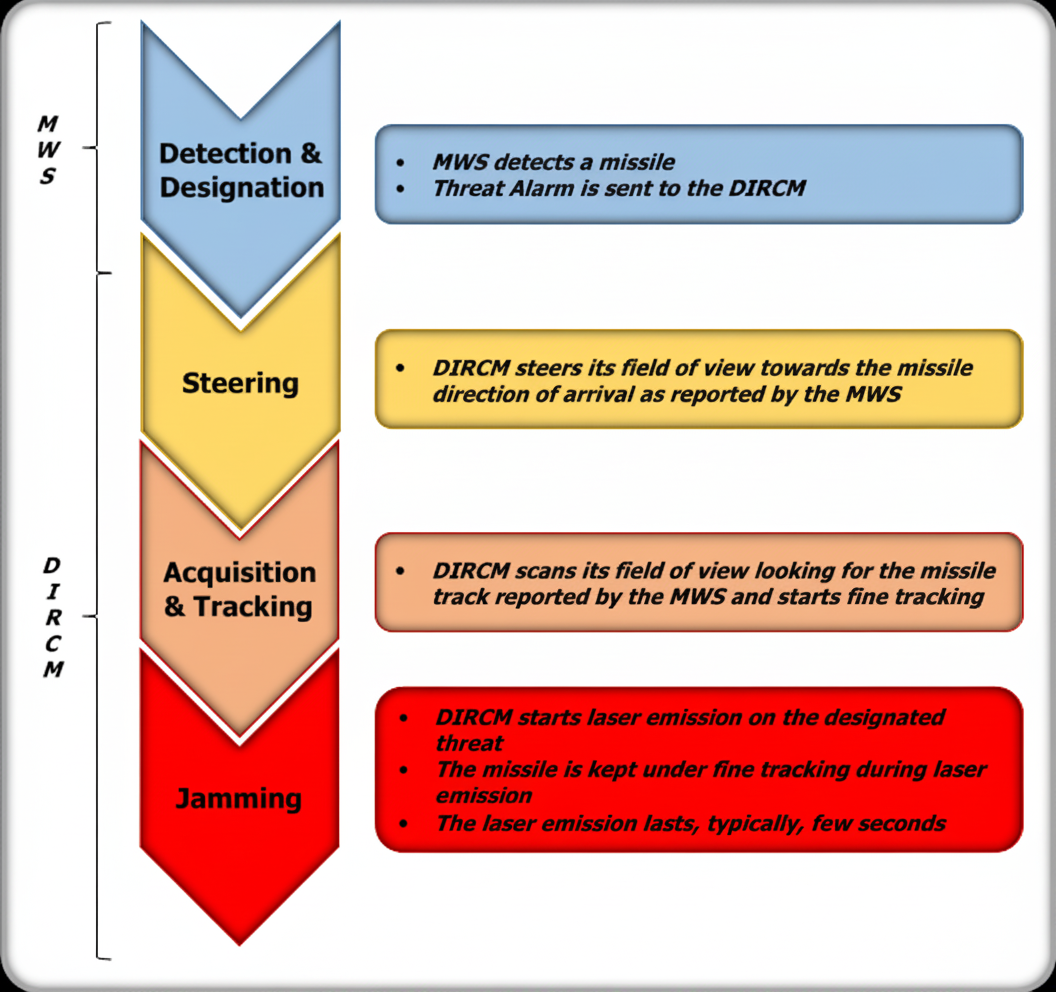
Figure 4. Northrop Grumman CIRCM
Engagement Timing and Sequence
Typical infrared-guided surface-to-air missiles launch at distances of about 2 to 5 km from the target platform. Within this interval, engagement can last from 3 to 10 seconds. Incoming missiles are usually detected by missile warning systems (MWS), which consume roughly 2 seconds of the total time budget (this is typical for UV-based sensors; IR-based sensors often have longer detection range but higher false alarm rates).
Figure 2 shows the four stages of a DIRCM engagement sequence initiated by target detection from an MWS:
- The MWS detects the target and cues the DIRCM by providing the approximate arrival direction of the approaching missile.
- Once cued, the DIRCM directs its field of view toward the probable target.
- When positioned, the DIRCM scans its field of view to locate and begin tracking the target designated by the MWS.
- If the target is located and confirmed, the DIRCM begins jamming by activating the laser and maintaining fine tracking on the target.
Notably, the entire process from MWS designation to DIRCM laser activation on the target (steps 2, 3, and 4) takes less than 1 second.
Multi-Turret Configurations and Coverage
DIRCM systems can be installed in multi-turret configurations to expand the system's coverage and protect platforms from threats coming from any direction. Multi-turret arrangements can avoid blind spots, which is especially important for large aircraft installations.
Representative DIRCM Systems
Northrop Grumman's CIRCM is designed to protect rotorcraft and medium fixed-wing aircraft against infrared-guided missiles. The system is based on an open architecture to simplify integration with existing hardware, upgrades, and lifecycle management. It employs a compact pointer/tracker, lightweight commercial-off-the-shelf processors, and quantum cascade laser technology to improve reliability and scalability.
Elbit Systems' Mini-MUSIC is a compact, lightweight DIRCM system intended to protect various rotary- and fixed-wing aircraft from infrared-guided shoulder-fired missiles. It integrates fiber laser technologies with precision, high-rate thermal trackers and small, high-dynamic mirrors to provide effective protection suitable for small platforms.
Leonardo's Miysis DIRCM draws on experience from more than 2,500 DIRCM pointer/trackers supplied for over 50 rotorcraft and fixed-wing platform types. The Miysis design targets favorable size, weight, and power characteristics while preserving proven self-protection jamming capability. Its open-architecture concept allows use as a standalone DIRCM installation or as part of an integrated defensive aid suite.
Elettronica S.p.A.'s ELT/577 QUIRIS is a compact DIRCM system intended for easy installation on platforms ranging from small helicopters to wide-body transports. QUIRIS uses high-power quantum cascade laser emitters. Quantum cascade laser technology offers high output power and beam quality in a compact, lightweight, and energy-efficient form factor. QUIRIS supports single-, dual-, or triple-turret configurations to extend protection on large platforms and incorporates multi-turret management and flare-coordination functionality to address next-generation infrared imaging threats.
DAIRCM, developed by DRS Technologies (now Leonardo DRS), is an aircraft protection system that combines missile detection, hostile fire indication, situational awareness, and missile defeat capabilities. Originating from technology developed by the U.S. Naval Research Laboratory (NRL), it uses a single sensor for dual-band infrared missile warning and employs a wide-field gimbal for laser-based DIRCM engagement. The AN/AAQ-45(V) DAIRCM system represents an advanced aircraft self-protection technology developed by Leonardo DRS.