Objective
At the end of every design cycle for switch-mode power supplies (SMPS), conducted emissions testing must be performed. Developers must verify that the product meets applicable standards before introducing it to the market. Comprehensive compliance testing normally requires a laboratory and a suitable EMI receiver. If a product exceeds standard limits, the power supply design may need modification, which can significantly affect many SMPS elements such as EMI input filters, printed circuit board layout, and conceptual choices like switching frequency. These changes can increase time to market and often require partial redesign. Performing conducted emission tests earlier in the development cycle can greatly reduce this risk. For pre-compliance testing you do not necessarily need a laboratory, but you do need suitable instruments to measure the spectra on power input and output lines in a comparable way. For this purpose, use a spectrum analyzer or an oscilloscope.
Test and Measurement Approach
Rohde & Schwarz oscilloscopes provide FFT analysis capabilities that measure the amplitude of frequency components while simultaneously displaying time-domain correlated signals. This correlation allows unwanted spectral emissions to be linked to specific time-domain events. Consequently, an oscilloscope can act as a standalone instrument to perform early conducted emission testing during power-electronics design. Oscilloscopes are especially useful when an EMI receiver and other lab-grade equipment are not available for pre-compliance measurements.
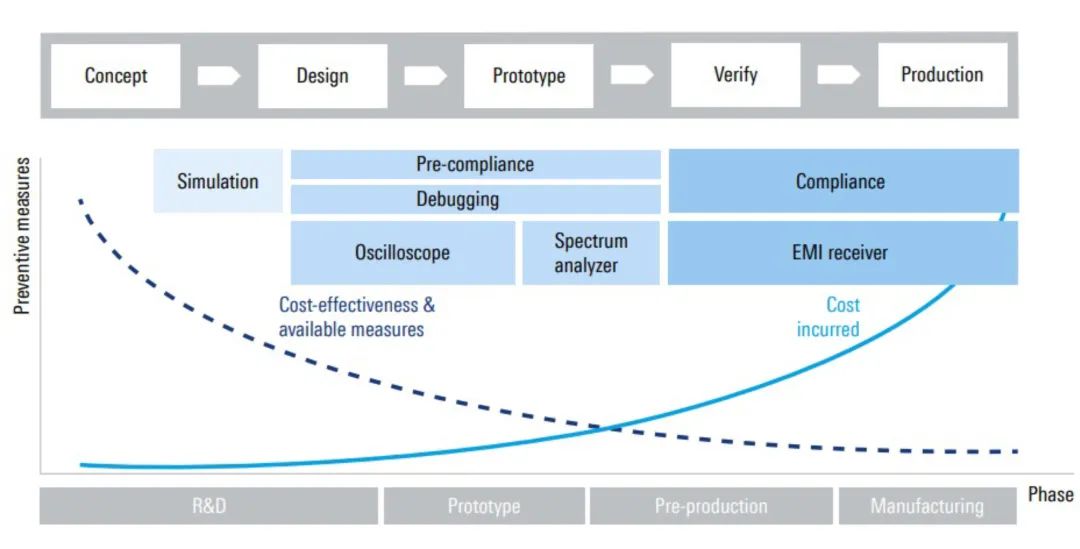
Considering EMI compliance early reduces the likelihood of encountering EMI issues late in development. Early detection lowers cost and simplifies corrective actions. Because oscilloscopes are standard instruments in hardware development and system testing, they can serve as reliable EMI-related test tools during design.
Test Setup
To measure conducted emissions from a power supply, use a line impedance stabilization network (LISN) to decouple the device under test from the external mains. Connect the LISN's coaxial output to the oscilloscope with a coaxial cable, and set the oscilloscope input to 50 ohms for proper matching. The oscilloscope should perform the following steps to measure the spectrum:
- Activate the FFT, and configure the minimum and maximum frequencies and the resolution bandwidth.
- Adjust the vertical sensitivity of the time-domain window to ensure the input channel does not overload when the device under test is powered.
- Power down the device to take a reference measurement. This reveals the noise floor and confirms that observed noise is not coming from the device.
- Power the device again and measure. Verify the device against known conducted emission limits while accounting for any additional attenuation introduced by the LISN.
Case Study: EMI Filter Effectiveness
The following screenshots show conducted emission measurements made with an R&S MXO4 oscilloscope, first without an EMI input filter and then with an EMI input filter installed.
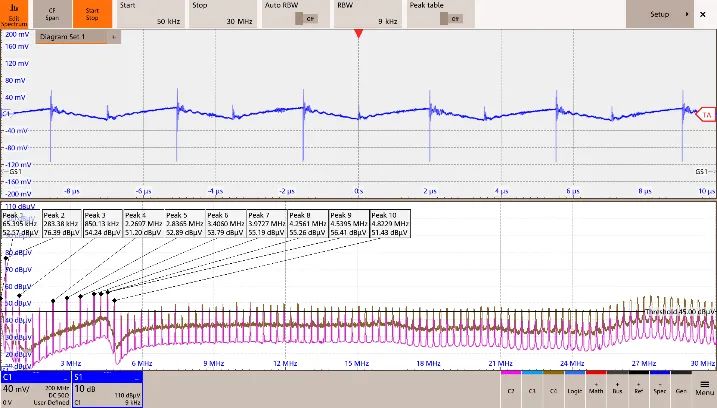
EMI Spectrum Without Input Filter
Channel 1 shows the measured time-domain signal connected to the LISN. The LISN introduces 10 dB of attenuation, so this factor must be considered when comparing measurements to emission limits. The lower window displays the spectrum at the power input terminal in dBuV. Without an EMI input filter, the noise spectrum generated at the DC-DC converter input is clearly visible.
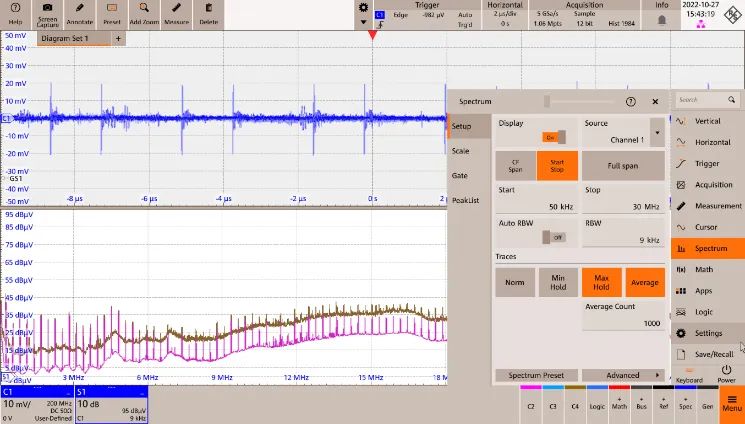
EMI Spectrum With Input Filter
With the input filter installed, the measurements show effective attenuation of conducted emissions on the input line. At some frequencies, up to 30 dB of attenuation is observed. To evaluate emissions in lower frequency ranges, repeat measurements with emphasis on those lower frequencies.
Summary
Rohde & Schwarz oscilloscopes with FFT capability help designers debug conducted emissions from power supplies. Because oscilloscopes are standard measurement instruments in power-electronics design, they are suitable for early EMI assessment, which can save time and cost. Early evaluation increases the likelihood of meeting EMI standards and helps avoid costly redesign after failing compliance testing.