Overview
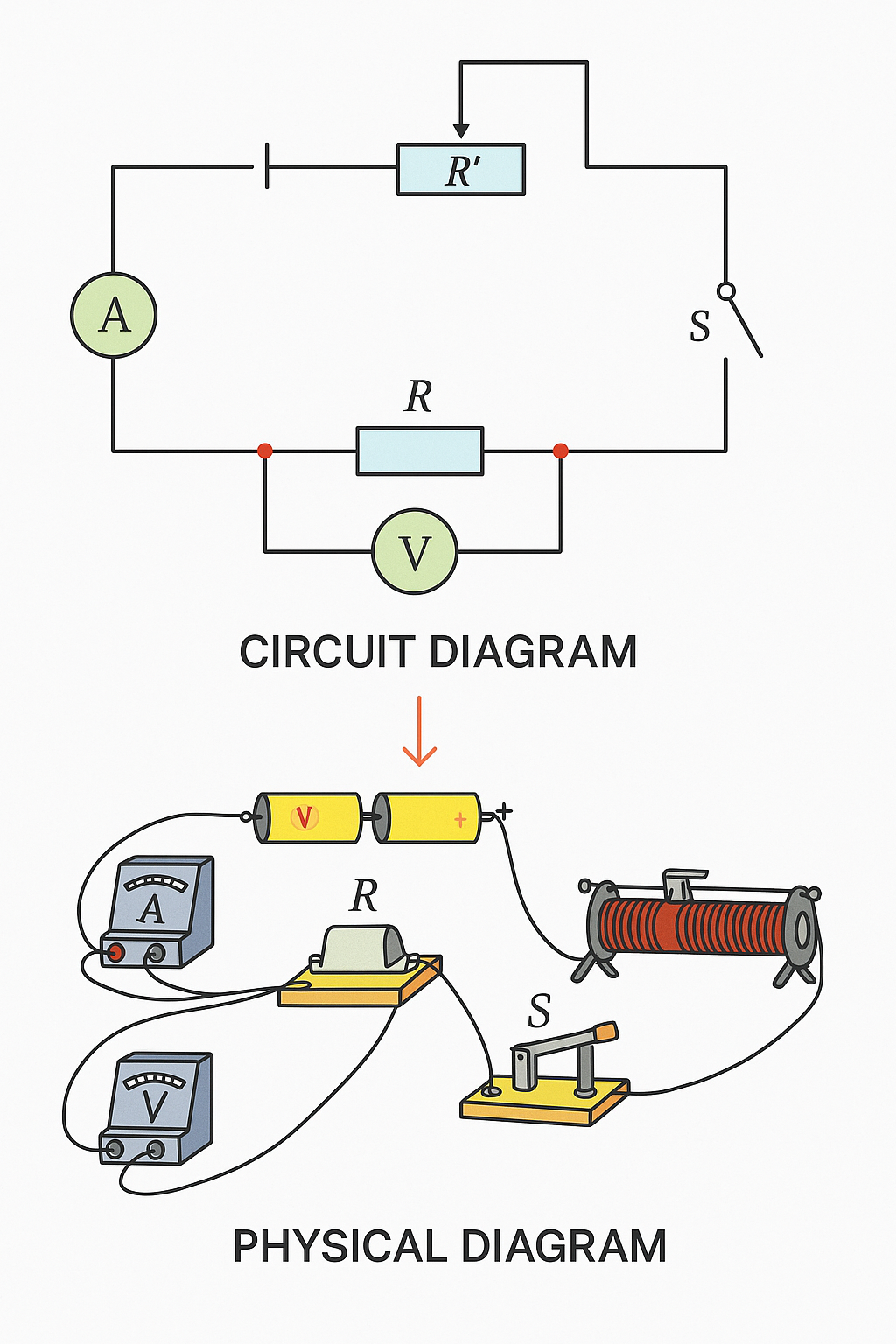
This tutorial explains how to measure a resistor's value using the volt-ampere method. Draw the circuit diagram according to the experimental principle, assemble the circuit, and then measure the resistance.
Principle
Use the formula R = U / I to calculate the resistance value.
Method
For an unknown resistor, measure the voltage U across it with a voltmeter and the current I through it with an ammeter. Apply Ohm's law in the form R = U / I to obtain the resistance. This measurement method is called the volt-ampere method.
Equipment
Power supply (bench power supply, rechargeable battery, or dry cell), voltmeter, ammeter, sliding rheostat, switch, resistor under test Rx, and connecting wires.
Procedure
- Draw the circuit diagram based on the experimental principle and assemble the physical circuit. When connecting the circuit, connect the series main circuit first, then connect the voltmeter. Keep the switch open during assembly.
- Prepare a table to record measured data.
- After verifying the circuit is correct, adjust the sliding rheostat so its slider is at the maximum resistance position. This ensures the current is minimal when the switch is closed.
- Close the switch. Use the sliding rheostat to adjust the circuit current and thus change the voltage across the resistor under test. Record three sets of corresponding voltage and current readings and enter them in the table.
- Calculate the resistance value for each of the three data sets and compute the average to reduce experimental error.
Notes on Wiring
- When wiring the circuit, follow the circuit diagram. Start from the positive terminal of the power supply and connect the main circuit elements in series. Connect the voltmeter in parallel across the resistor under test.
- Keep the switch open while assembling the circuit. Before closing the switch, set the sliding rheostat slider to the maximum resistance position.
- Connect the ammeter in series with the resistor under test and the voltmeter in parallel with the resistor under test.
- Use a preliminary test to select the meter ranges. To reduce measurement error, aim for a meter pointer deflection greater than one third of full scale.
- Do not reverse the ammeter or voltmeter polarity. Connect the sliding rheostat using the "one up, one down" terminal configuration.