A "quantum Taiji" image went viral after physicists used a new technique to visualize two entangled photons in real time, producing images resembling China's Taiji yin-yang symbol. Some online commenters joked that "science leads to mysticism."
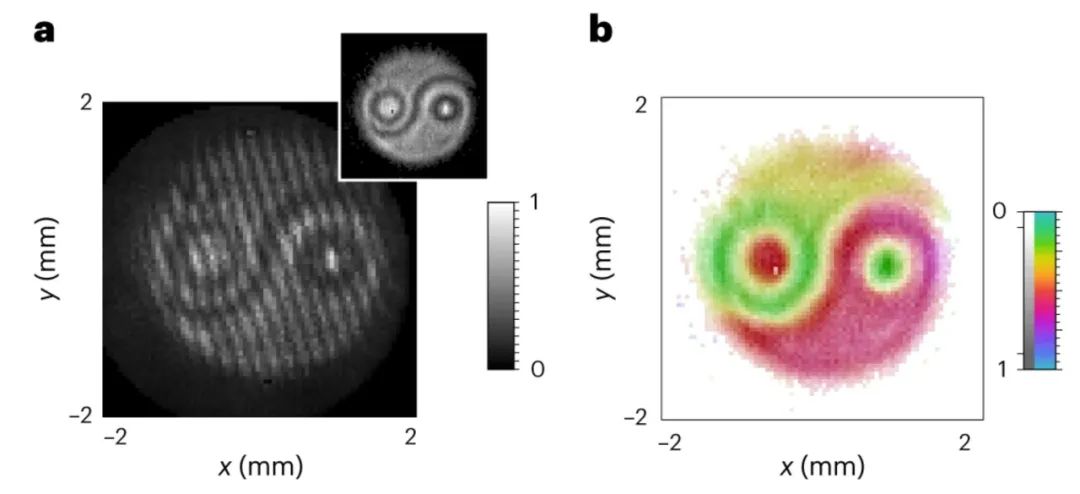
Overview of the measurement technique
The technique is two-photon digital holography. It can measure the spatial distribution of high-dimensional two-photon states produced by spontaneous parametric down-conversion. These two-photon states exhibit rich quantum properties and can be applied to high-dimensional quantum communication, quantum imaging, and related tasks. Two-photon digital holography uses interferometric imaging: an unknown two-photon state is superposed with a reference state, and coherent coincidence counts are recorded on two detectors to reconstruct the unknown state's amplitude and phase. Compared with conventional projective measurements, this approach is more efficient and robust and better suited to arbitrary spatial-mode bases.
What are two-photon states
A two-photon state is a quantum state composed of two single photons that share a special correlation called entanglement. Entanglement is a nonclassical phenomenon in which the properties of the two photons cannot be described independently but are interdependent. For example, if two photons are entangled in polarization, measuring the polarization of one photon immediately determines the polarization of the other, regardless of the distance between them. Albert Einstein famously called this "spooky action at a distance." Entanglement can occur in polarization and in other degrees of freedom such as time, frequency, and orbital angular momentum.
This article focuses on the spatial degree of freedom, i.e., the photons' positions and directions in space. The spatial degree of freedom spans an infinite-dimensional Hilbert space, enabling large information capacity. For instance, a single photon can be described by its orbital angular momentum or by Laguerre-Gaussian modes that represent different transverse wavefront shapes. One common method to generate spatially entangled photon pairs is spontaneous parametric down-conversion in a nonlinear crystal. In this process, a higher-energy pump photon (typically ultraviolet or blue) splits into two lower-energy photons (often red or near-infrared), known as the signal and idler photons.
Because energy and momentum are conserved, the signal and idler photons must share the pump photon's energy and momentum, which produces spatial entanglement between them. By shaping the pump beam, one can control the degree and form of spatial entanglement. For example, a Gaussian pump yields a Gaussian two-photon state, while a helical pump beam can produce a two-photon state with a helical spatial structure.
How to measure two-photon states
Measuring two-photon states is essential for characterizing their quantum properties and for using them in quantum information tasks. However, measurement is challenging because these states are inherently nonclassical. A common approach is projective measurement: decompose the two-photon state into an orthogonal basis and record probabilities on each basis element using corresponding detectors. For example, to measure orbital-angular-momentum entanglement, one can use a set of Laguerre-Gaussian modes as the basis and implement projective measurements with a spatial light modulator and a single-photon detector.
Projective measurement can provide complete information about a two-photon state, allowing reconstruction of its density matrix. But it has drawbacks: it typically requires many measurement settings because each basis element must be sampled statistically, which increases measurement time and uncertainty. Precise alignment and calibration are needed for each basis element, adding complexity and instability. A complete basis coverage is required to avoid incomplete reconstruction, which limits practical measurement capability.
These limitations motivate alternative methods such as two-photon digital holography, which can overcome many of the drawbacks while retaining the advantages of projective tomography.
Two-photon digital holography
Two-photon digital holography is an interferometric imaging method for measuring two-photon states in arbitrary spatial-mode bases. The procedure is as follows. Prepare an unknown two-photon state, typically generated by spontaneous parametric down-conversion, and a reference state produced by a controllable laser. Superpose the unknown state and the reference to form an interference pattern using a beamsplitter or a spatial light modulator. Record coherent coincidence counts on two detectors, which can be single-photon detectors or pixelated detectors. Finally, use a mathematical algorithm, such as a Fourier transform or an iterative reconstruction algorithm, to retrieve the unknown state's amplitude and phase from the coherent counts.
Two-photon digital holography offers several advantages. It can obtain the necessary information in a single measurement because the interference pattern directly encodes amplitude and phase, reducing measurement time and statistical uncertainty. It does not require tuning measurement bases, since the reference state can take arbitrary shapes and orientations, simplifying the apparatus and improving stability. Because the coherent counts contain information across all spatial modes, the method expands the accessible measurement space and enhances measurement capability. Consequently, two-photon digital holography provides an efficient, reliable, and general approach to characterizing spatially entangled two-photon states for high-dimensional quantum information applications.