Modular spectrometer technology lets users combine optical platforms and accessories in various ways to support thousands of applications. Removable slits in spectrometers add flexibility.
Slit size is one factor that determines a spectrometer system's optical resolution, the dispersion of the diffraction grating, and how detector pixels sample the spectrum. Choosing slit size involves trade-offs: a larger slit width increases throughput but sacrifices optical resolution, while a smaller slit yields higher optical resolution at the expense of throughput. The optimal slit size depends on the specific application and the required balance between those outcomes.
Multiple slit options increase flexibility
Many Ocean Optics spectrometers use removable slits to mitigate design limitations and give users greater experimental flexibility. For example, a narrow slit can be used to obtain high resolution for sharp absorbance peaks, then switched to a wider slit to gain higher throughput for fluorescence or other low-light measurements.
This represents an improvement over older modular spectrometers that required the manufacturer to replace the slit assembly. Applications that need a precise balance between optical throughput and resolution previously required returning the spectrometer for adjustment, which was inconvenient. Removable slits avoid that process.
Trade-off between resolution and throughput
Removable slits give laboratories practical advantages for routine absorbance and fluorescence measurements. For example, measuring the absorbance of alumina, which has narrow, distinct peaks, typically requires appropriate resolution and may need a 25 μm or narrower slit.
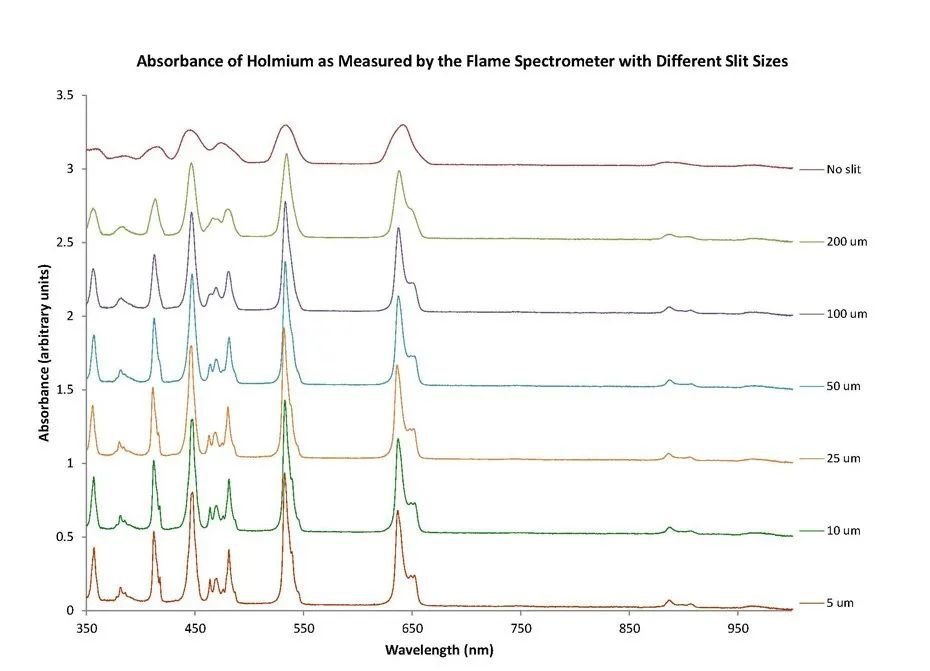
Figure 1. Absorbance of alumina measured with a Flame spectrometer using different slit widths. Note the peak broadening as slit size increases. For demonstration, spectra are normalized in the y direction. When experiments are limited by signal strength or acquisition time — that is, when short integration times are required — high throughput becomes the primary consideration, and a 25 μm slit may not perform well in all cases. Fluorescence measurements are a common example because signals can be very low, especially at low fluorophore concentrations. For instance, using fluorescent labels at low concentration for product verification often requires maximizing throughput. In such applications, improving throughput with a larger slit is more effective than increasing resolution with a narrower slit. Figure 2 shows the effect of narrowing slit size on spectrometer throughput. For smaller slit sizes, required integration times increase rapidly because the amount of light passing through the slit is greatly reduced. This provides a practical advantage when measurement speed is critical.
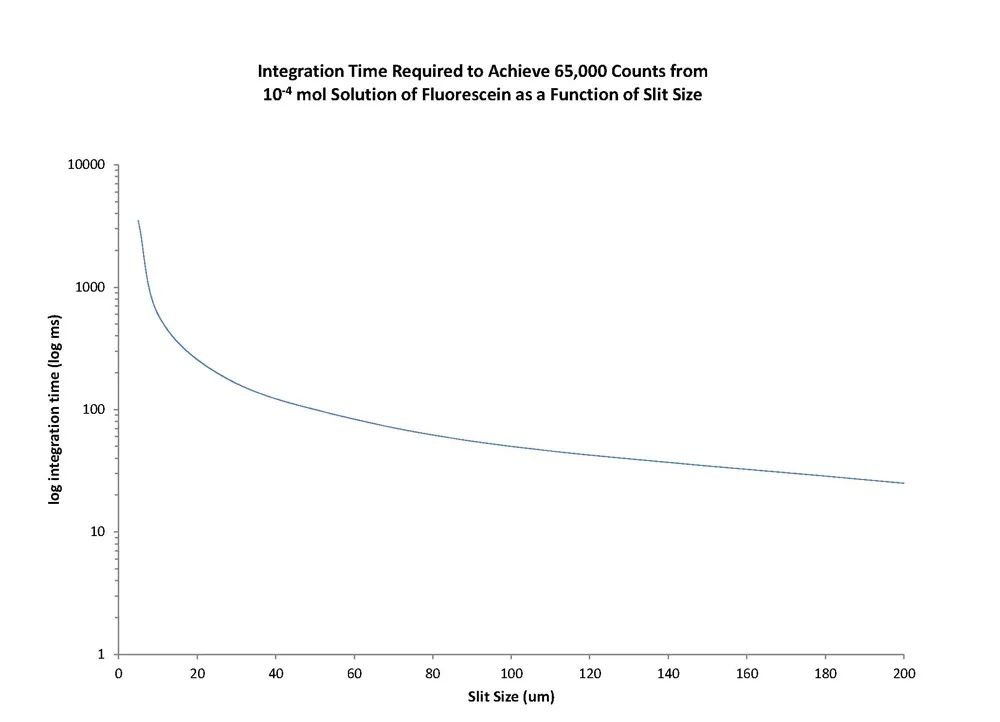
Figure 2. Flame spectrometer measurement of fluorescein fluorescence in water. The log plot shows integration times required to reach an optimal signal level as a function of slit size. Smaller slits require longer integration times.
By using removable slits, users can adjust a spectrometer's optical resolution and throughput simply by swapping the slit. Removable slits provide more design freedom without returning the instrument to the manufacturer for rework and recalibration.