Overview
Continuous measurement of vital signs such as heart rate, respiratory rate, and blood oxygen saturation (SpO2) is essential for effective care. The ability to measure multiple signals simultaneously makes multi-parameter patient monitors increasingly important.
Electronic patient monitors use noninvasive sensors attached to the patient to collect and display physiological data. For multi-parameter monitors, a primary challenge is maintaining high performance while achieving small size and low power consumption.
Motivation for compact, portable designs
Many hospital patients remain connected by numerous wires to bulky, nonportable multi-parameter monitors, which limits use in mobile care and home-care environments. This has driven demand for compact monitors that connect wirelessly to the patient and transmit data, wirelessly or wired, to a smartphone, tablet, or computer.
Reference design components
Texas Instruments (TI) provides a multi-parameter patient vital signs monitor front-end reference design that targets small size, low cost, and low power, integrating front-end components required to acquire vital signs data.
The design acquires ECG, SpO2, heart rate, and respiratory rate using AFE4403 and ADS1292R bio-sensing front-end integrated circuits. It can be combined with a software-configurable pacemaker detection module reference design to support pacing pulse detection, and can connect three TMP117 temperature sensors with 0.1°C precision to measure skin temperature. For ECG, the design uses standard wet ECG electrodes and can use a transmission-type finger-clip sensor to measure SpO2. Raw data are transmitted by an onboard MSP432P401 microcontroller via an isolated UART transceiver at 460.8 kbps to a back-end processor or PC. A standard USB port or a USB-charged lithium-ion battery can power the design.
User interface and measurements
The graphical user interface displays collected waveforms with a 5-second scroll interval while applying basic filtering to remove noise such as common-mode interference from power and lighting. Figure 2 shows ECG, respiration, and SpO2 measured on a PC, along with heart rate, breaths per minute, SpO2 percentage, and temperature values.
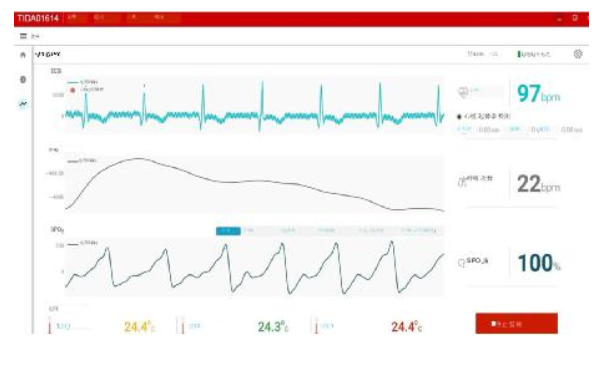
Figure 1: GUI showing ECG, PPG, respiration, heart rate and skin temperature
Figure 2 shows ECG, photoplethysmogram (PPG), pacemaker pacing pulses, heart rate, and temperature sensor data measured on a computer. When a pacing pulse is detected, the pacemaker signal indicates the presence of the pacing pulse, shown as the top trace in Figure 2.
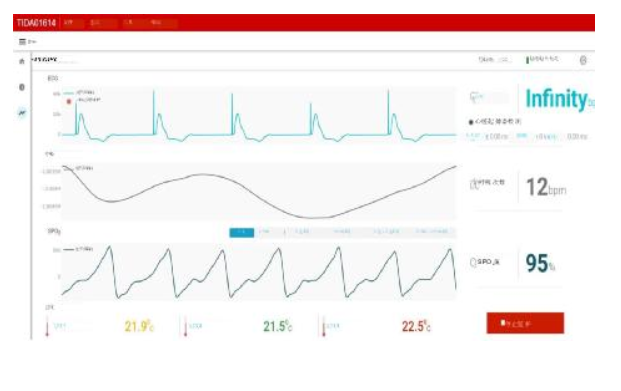
Figure 2: GUI showing ECG, PPG, pacemaker, heart rate and skin temperature
Conclusion
This reference design facilitates evaluation of cooperating devices. It includes design guidance, schematics, layout, and a bill of materials to help speed evaluation and accelerate product development. The design also supports real-time acquisition of vital signs parameters.