Overview
The COVID-19 outbreak sharply increased demand for temperature measurement products. Infrared thermometers, like face masks, became key medical products used in epidemic control. As production and deployment surged, reports surfaced of devices delivering inaccurate readings. What causes these errors, and how can they be addressed? This article analyzes factors that affect the accuracy of infrared thermometers from a product design perspective.
Measurement Methods
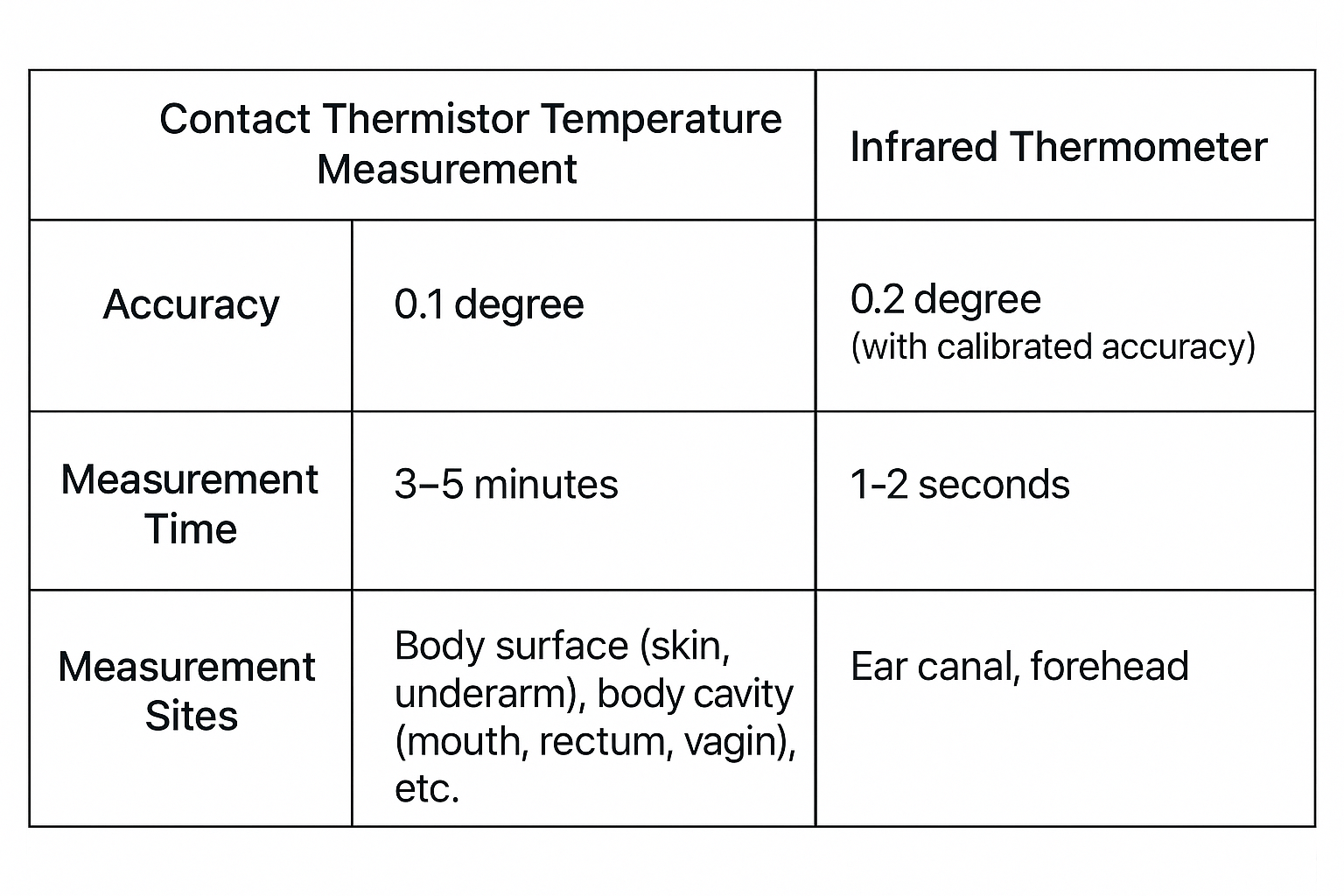
Body temperature measurement can be divided into contact and non-contact methods. Contact methods typically use negative temperature coefficient thermistors (NTC). Non-contact methods rely on infrared (IR) detection:
Industry Context
Manufacturers in China are mainly concentrated in the Pearl River Delta and the Yangtze River Delta, reflecting the regional distribution of the medical device industry. The upstream and downstream supply chain for infrared temperature devices spans sensor suppliers, optical components, calibration and test equipment, and final assembly.
Key Factors Affecting Accuracy
From the upstream supply chain perspective, the three most critical factors affecting infrared thermometer accuracy are:
- Infrared sensor performance
- Optical system design
- Calibration and verification procedures
Note: This article focuses on thermopile-based infrared detectors used in ear and forehead thermometers. For focal plane array technology, refer to the paper "Development of Infrared Focal Plane Detector Array Specifications" by Wang Yifeng and Huang Jiangping of the Kunming Institute of Physics.
Sensor Example: Thermopile Detector
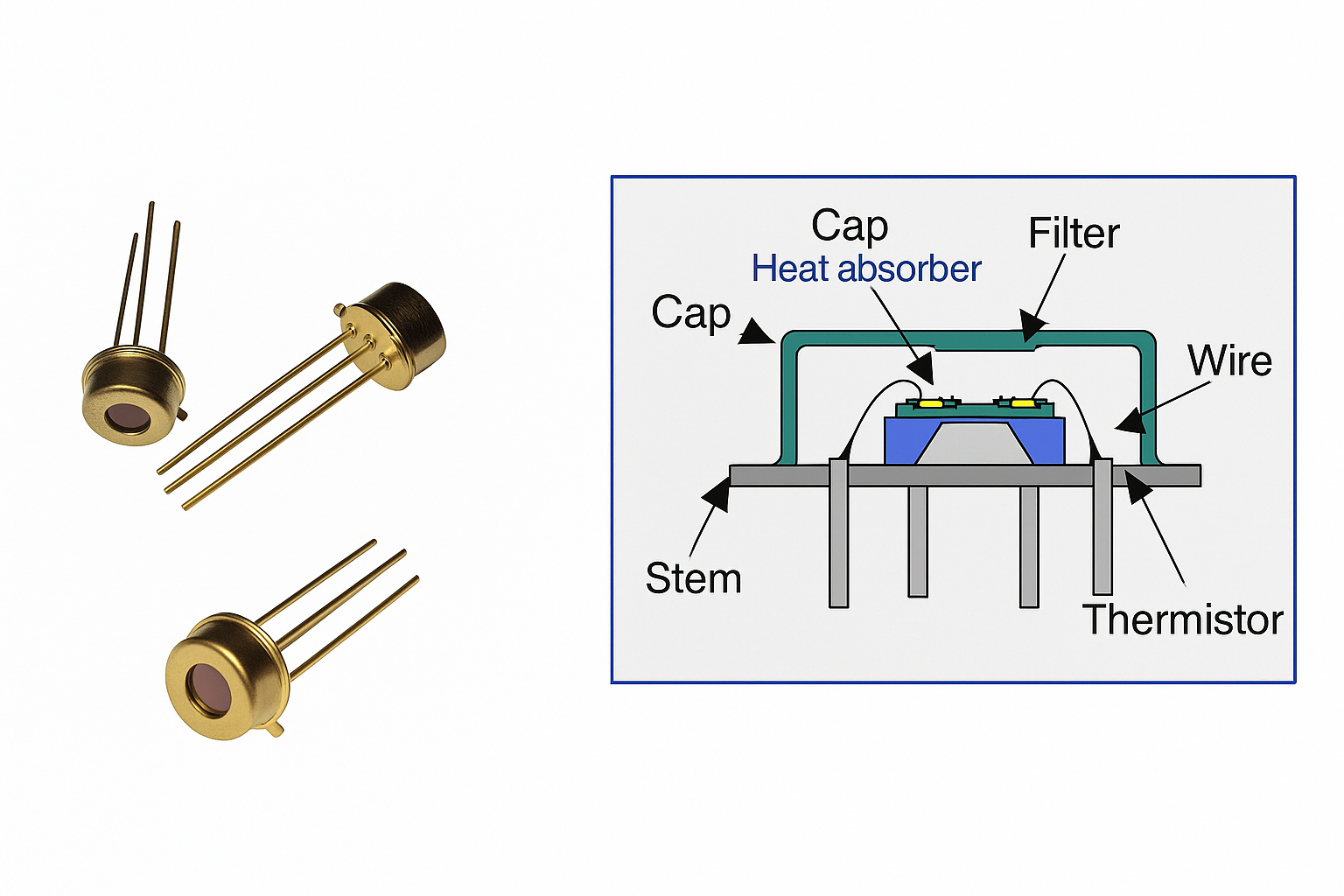
The following analysis uses a commonly available thermopile infrared sensor as an example: the ASTG ZTP148-SR thermopile sensor. The sensor structure is shown below.
Notes on Design and Supply Chain
When evaluating or designing infrared temperature devices, focus on the sensor's signal-to-noise ratio, temperature coefficient, spectral response and uniformity; the optical system's field of view, spot size, and stray radiation suppression; and robust calibration against traceable temperature references. Errors can arise from emissivity differences, ambient reflections, device-to-skin distance, sensor drift, and inadequate calibration procedures.
References
- GB/T 13584-1992 Methods for testing infrared detector parameters
- S. N. Mekhontsev, V. B. Romchenko, L. M. Hanssen, NIST Radiance Temperature and Infrared Spectral Radiance Scales at Near-Ambient Temperatures, United States Government Contribution, 2008
- N. P. Avdelidis, A. Moropoulou, "Emissivity considerations in building thermography", Energy and Buildings 35 (2003): 663–667
- "Non-extensive thermodynamical investigation of blackbody radiation", Chaos, Solitons and Fractals 13 (2002): 749–750
- Zhang Jingyi, "Experimental study on blackbody furnace accuracy", Journal of Chongqing Institute of Technology, 2003: 416–418
- Shen Guoyan, Song Ping, "Discussion on methods for measuring body temperature with infrared thermometers", Instrumentation Technology, 2003: 39–42
- Wang Chenzhong, "Emissivity and its influence on infrared thermometer measurement results", Jiangsu Quality, 2003: 37–38
- Schieferdecker J., "Infrared thermopile sensors with high sensitivity and very low temperature coefficient", Sensors & Actuators A, 1995, 46–47: 422–427