Background
Photoplethysmography (PPG) is an optical technique used for heart rate monitoring (HRM) and peripheral capillary oxygen saturation (SpO2) measurement. Its simplicity comes from placing an LED and a photodetector (PD) on the body.
The PPG principle is based on changes in optical absorption in tissue that correlate with the relative concentrations of oxyhemoglobin and deoxyhemoglobin. Blood volume changes caused by cardiac contraction and relaxation can be used to estimate arterial oxygen saturation.
Capabilities beyond traditional SpO2
Motion artifacts affect PPG signals, and their impact depends on the wavelength of the light source. Absorption and thus penetration depth into tissue depend on wavelength. Longer wavelengths such as red and near-infrared (NIR) are absorbed less and penetrate deeper into tissue. Shorter wavelengths such as green and blue are strongly absorbed by melanin, so their penetration is relatively shallow. Red and NIR PPG are therefore more susceptible to artifacts from motion, while green and blue PPG are relatively less affected by motion artifacts.
Figure 1 shows skin penetration depth for wavelengths from 400 to 1,000 nm.
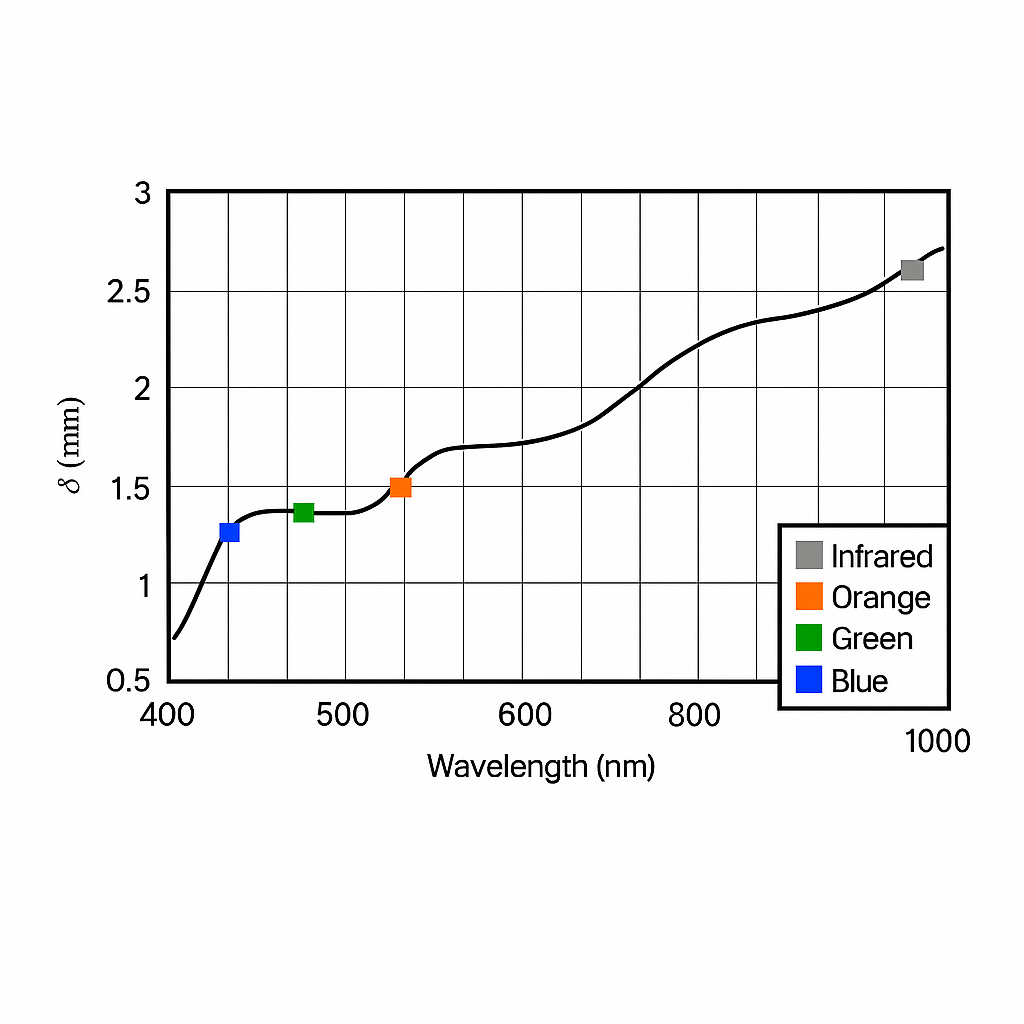
Figure 1: Optical penetration depth (δ) for a range of source wavelengths
Multi-wavelength approach
Using multiple LEDs and PDs in a time-multiplexed configuration enables multi-wavelength measurement and monitoring. Each diode and detector can support different wavelengths or be multiplexed across different sampling phases to monitor different parameters.
Reference design overview
The multi-wavelength optical HRM and SpO2 monitoring reference design supporting Bluetooth 5 uses the AFE4420 single-chip biosensing front end, which supports four LEDs and four time-multiplexed photodetector inputs. It integrates flexible LED drivers and a complete receiver chain for the photodetectors.
Signal acquisition can be configured across up to 16 phases, with flexible assignment of LEDs and PDs per phase. The design pairs the AFE with the CC2640R2F SimpleLink Bluetooth low-energy microcontroller (MCU) for wireless communication. The MCU integrates an Arm Cortex-M3 and a 2.4 GHz RF transceiver, and communicates with the AFE via serial peripheral interface or I2C. The design supports wired data capture for bench testing and wireless data capture over Bluetooth 5.
Key features
- Raw PPG data for computing heart rate, SpO2, and other related parameters. The AFE4420 provides a high level of integration, low power, and small size. It offers ultralow-power modes and an integrated FIFO so the MCU can remain in sleep mode to extend battery life.
- Wireless connectivity via the CC2640R2F. The CC2640R2F integrates an Arm Cortex-M3 and a 2.4 GHz RF transceiver supporting Bluetooth 4.2 and 5.0 profiles and can be used as the host processor. An internal DC/DC converter improves overall system efficiency and extends battery life. Built-in low-battery detection algorithms help reduce external components for wearable applications.
- Low-power operation with a button cell. The design uses a single 3 V, 500 mA Cr3032 button cell. Tested runtime is 100 hours of continuous operation; when not continuously transmitting, battery life is about 30 days.
Applications and deliverables
The reference design targets medical, personal healthcare, and fitness applications. It includes design guidelines, schematics, layout files, and a bill of materials to accelerate evaluation and product development. The design supports real-time monitoring and data logging and allows optimization for different configurations.