Background
The COVID-19 outbreak placed significant pressure on public health systems and prompted many people to work on the front line of the response. During the containment period, logistics, material donations, and voluntary support continued to play an important role. As businesses resume operations, implementing effective infection control measures remains essential; handheld infrared thermometers and forehead thermometers have become common equipment in many workplaces.
Battery Types Commonly Used in Handheld Thermometers
Most handheld infrared thermometers are wireless and rely on batteries as the system power source. Common battery configurations include:
- One or two dry cell alkaline batteries in series, producing 1.5 V or 3.0 V system voltage.
- A 9 V snap battery.
- Rechargeable lithium battery packs.
Reference Solutions
1-Cell / 2-Cell Dry Cell Battery Application
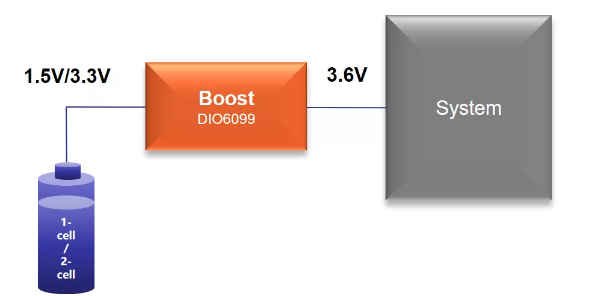
DIO6099 is an ultra-low-power, ultra-low-startup-voltage synchronous-rectified boost converter. It operates from 0.7 V to 5.5 V input and supports adjustable output from 1.5 V to 5.0 V. Quiescent current is as low as 1 μA. The device supports load-startup at 300 mA and is available in CSP-6, DFN2x2-6, and SOT23-6 packages. It is suitable for products that require long battery life and operation from very low input voltages.
9 V Battery Application
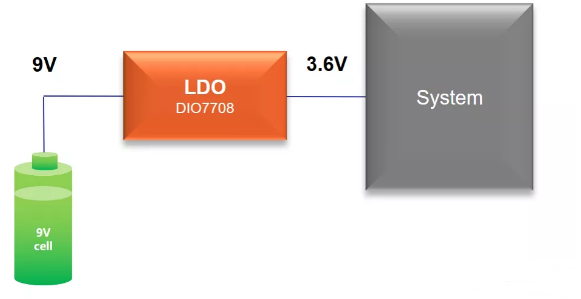
DIO7708 is a wide-input-voltage, low-noise, high-precision linear regulator. Input range is 2.5 V to 30 V. It is available in adjustable and fixed-output versions; fixed outputs include 1.2 V, 1.5 V, 1.8 V, 2.5 V, 3.0 V, and 3.3 V. Quiescent current can be as low as 4 μA (with lower-power variants available). Noise is 60 dB@1 kHz, and it supports 300 mA load current. Output accuracy is within 2% (higher precision variants are available). Packages include DFN2x2-6, SOT23-6, and TSOT23-6. This type of regulator is commonly used in high-voltage, long-life products.
Single-Cell Lithium Battery Application
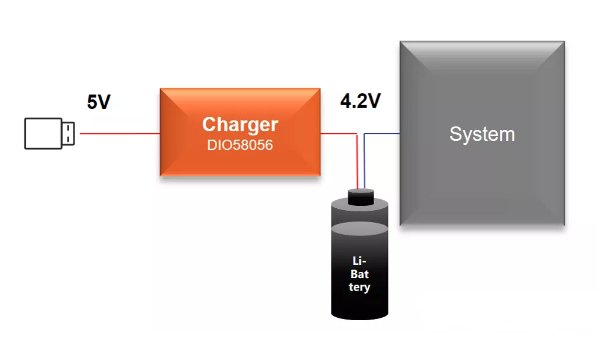
DIO58056 is a high-voltage linear charging management IC with maximum withstand voltage up to 36 V. It provides protection against input surge and high-voltage DC. Charge current is programmable up to 1 A (configurable between 50 mA and 1 A). Charge termination current is programmable. The device supports AC OK detection, charge-complete indication, charge enable control, and is available in versions for 4.2 V and 4.35 V single-cell lithium chemistries. Packaging options include DFN2x2-8 and ESOP-8. It is suitable for charging applications that must tolerate high input voltage or surge events.
Precision Temperature Sensing Front End
DIO2352 is a low-noise, high-precision, low-drift, rail-to-rail operational amplifier. It operates from 2.5 V to 5.5 V, with input offset specified at 0.012 mV, input noise of 40 nV/√Hz, and drift of 0.01 μV/°C across the full temperature range. Gain bandwidth is 1.2 MHz. The device is available in single-, dual-, and quad-channel versions; dual-channel parts are commonly used in temperature sensing circuits. Packaging options include SO-8, MSOP-8, and TSSOP-8. These op amps are supplied by the company for use in high-performance front-end designs.
Other System Components
In addition to the parts above, typical thermometer designs may include analog switches, LED display drivers, boost drivers for buzzers, Wi?Fi or Bluetooth modules, voltage regulators, and other high-performance operational amplifiers. These components form the complete system for temperature sampling, display, alerting, and wireless connectivity.
Support and Final Notes
Some suppliers provided equipment and support to assist response efforts in affected areas. Support for Wuhan and affected areas in China has continued, and the supplier has provided assistance where possible.