Overview
Body temperature screening is commonly used at home, in public spaces, workplaces, and during travel. Infrared, non-contact thermometers reduce the risk of cross-contamination. This article reviews a typical system and design options based on MSP430 microcontrollers and TI power, amplifier, and temperature-sensor devices.
System Block Diagram
The diagram below shows a reference system that combines an MSP430 microcontroller with TI power-management, amplifier, and temperature-sensor components for an infrared thermometer.
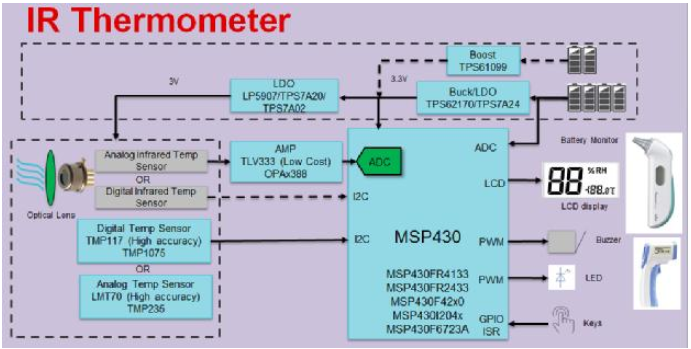
Figure 1 Infrared thermometer system block diagram
MCU: MSP430 Series
MSP430 series microcontrollers from TI, introduced in 1996, are 16-bit, ultra-low-power RISC mixed-signal processors. They are widely used in sensor and measurement endpoints because of their on-chip ADCs, LCD drivers, serial interfaces, PWM outputs, and other peripherals. TI also provides online hardware and software resources that can simplify development and speed prototype creation.
Peripherals Relevant to Thermometer Design
- SAR ADCs or high-resolution sigma-delta ADCs on MSP430 devices, together with TI amplifiers such as the TLV333, can sample analog output from infrared temperature sensors and convert it into digital temperature values. The MCU can also monitor battery voltage in real time.
- On-chip LCD drivers enable rapid implementation of LCD displays. For example, the MSP430FR4133 includes up to a 4×36 or 8×32 segment LCD driver with flexible segment and COM pin configuration, which can simplify PCB layout.
- I2C interfaces support high-precision digital temperature sensors, digital infrared sensors, and digital proximity sensors for auxiliary sensing inputs.
- Integrated timer modules can generate multiple PWM signals to drive indicator LEDs and buzzers.
- GPIO interrupts in low-power modes provide quick button response for battery-powered devices in standby.
Low-Power and Memory Options
MSP430 devices are designed for ultra-low power and include low-power intelligent peripherals. Since infrared thermometers are often used frequently and are battery powered, low-power operation is a key design consideration. The MSP430 family offers various memory sizes from 16 KB up to 512 KB, enabling migration between devices with minimal software changes. Recommended MCU part numbers are shown in the image below.
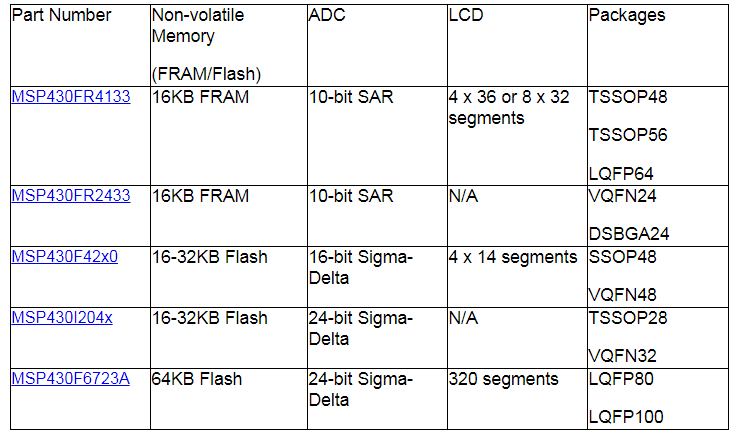
Table 1 Recommended MSP430 MCU models for infrared thermometers
Power Management
The reference design includes several power-management options.
- TPS61099 series boost converters target ultra-low-power applications. Static quiescent current is around 800 nA and the input can be as low as 0.7 V, supporting single-cell battery operation. With 1.5 V input and 3.3 V/10 μA output, the device can achieve about 80% efficiency. Fixed and adjustable output versions are available.
- TPS62170 buck converters offer low IQ to extend battery life when the system is idle. They also support switching frequencies above 2 MHz to enable smaller inductors and a reduced solution size.
- Low-noise, sensitive analog rails often use LDOs. TPS7A20 provides ultra-low output noise (6 μVRMS), high ripple rejection (85 dB @ 1 kHz), and low quiescent current (typical 6 μA, 150 nA in shutdown), making it suitable for ADC and sensor supply rails. For battery systems, TPS7A02 offers nanoamp IQ (25 nA, 3 nA in shutdown) and high PSRR for post DC/DC regulation, with good transient response for pulsed loads.
Signal-Chain Amplifiers
TLV333 is a zero-drift op amp family with high accuracy and low power. It features very low input offset (15 μV max) and low drift (0.02 μV/°C) to minimize temperature-measurement error, rail-to-rail I/O for maximum dynamic range, low quiescent current (28 μA max), low-voltage operation (1.8 V to 5.5 V), small packages, and an operating range of ?40°C to +125°C. Dual and quad channel options are available.
For faster settling time and lower noise, OPA388 can be used as an alternative to TLV333. OPA388 offers lower input offset (5 μV max), lower noise (7 nV/√Hz), and faster settling (2 μs), which can reduce settling time and the required average number of samples to reach a target temperature resolution.
TI provides multiple op amps that can interface analog sensors to ADCs. Other suitable dual-package amplifiers are listed in the table below.
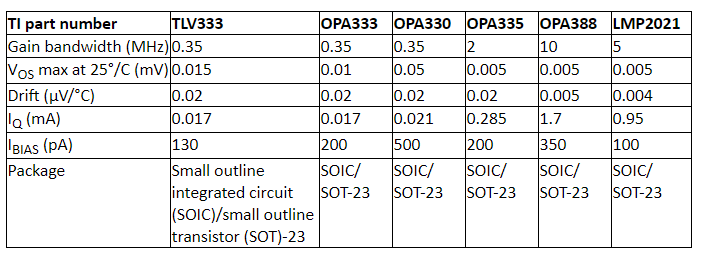
Table 2 Recommended operational amplifiers for signal interface
Temperature Sensors
TI offers a range of temperature sensors. The high-precision digital TMP117x provides ±0.1°C accuracy from ?20°C to 50°C, integrates a 16-bit ADC, and communicates over I2C/SMBus. It is designed for battery-powered systems, consuming 150 nA in shutdown and 3.5 μA per 1 Hz conversion.
For systems with an MCU ADC, TI provides analog temperature sensors and thermistors. LMT70 outputs a voltage proportional to temperature with a maximum accuracy of ±0.13°C from 20°C to 42°C. TMP61, a linear thermistor, provides 1% temperature tolerance and simplifies calibration compared with traditional NTCs. For cost-sensitive digital sensing, TMP1075 offers ±1°C accuracy from ?25°C to +100°C. The TMP23x analog sensors allow designers to trade accuracy and gain across a range from ±0.5°C to ±6°C.
Wireless Options and Power Switching
Some products include low-power Bluetooth Low Energy modules. TI devices such as the CC2640R2F IC or CC2650MODA module are suitable options. TI SimpleLink software is available to support development for these wireless devices.
To reduce quiescent current, use load switches such as TPS2051x with integrated fault protection, or TPS22916xx with ultra-low leakage, to disconnect the BLE module from the battery or other DC sources. This extends battery life while enabling additional features when needed.
Summary
The devices and components described here can be used to design handheld, battery-powered infrared thermometers with emphasis on low power, high accuracy, and compact size. Reference diagrams, component selections, and device characteristics presented above provide a starting point for system design and component selection.