According to World Health Organization statistics, there are about 155 million people with diabetes worldwide, and this number was projected to rise to 300 million by 2025. Because both high and low blood glucose levels pose serious health risks, prevention and monitoring are important. This implies a potential future demand for millions of personal portable blood glucose monitors (BGMs).
Modern blood glucose monitors must achieve a high level of integration in a small form factor for portability. At the same time, to meet daily patient needs these devices must accurately measure glucose using only a tiny blood sample.
The precision multiplexer at the sensor front end of a blood glucose monitor can reduce the need for multiple finger pricks. Although a multiplexer may appear to perform the simple task of switching between signal channels, it plays a key role in accurately routing and preserving the small currents produced by sensor strips.
Choosing the right precision multiplexer helps designers of compact BGMs address major design challenges such as leakage current, on-capacitance, and size constraints. Understanding these parameters helps engineers design more accurate systems, and in turn reduces patient pain and improves quality of life.
Ultra-low leakage current (Ileakage)
Sensor strips interact chemically with blood to produce a small current signal. That current is typically converted to a voltage by a transimpedance amplifier (TIA) and then sampled by an analog-to-digital converter (ADC), often inside a microcontroller.
External resistors provide the feedback network, and one channel can remain closed to ensure the amplifier never operates in an open-loop configuration. Although four feedback resistors are depicted, the number can be adjusted to provide the required gain settings.
The feedback gain settings are driven by the strip current, which can range roughly from 10 uA to 80 uA depending on glucose level. Designers therefore need not only low on-resistance (RON) but also ultra-low leakage in the multiplexer to preserve ADC accuracy.
Leakage matters because when a switch is on, leakage current from the multiplexer adds to the sensor current and flows through the feedback resistor, producing an error at the amplifier output. That erroneous output voltage is then sampled by the ADC, producing an inaccurate digital reading on the display.
Therefore, the lower the multiplexer leakage current, the more accurate the output readings.
Product families for precision multiplexers include devices that meet ultra-low leakage requirements. For example, the TMUX1104 offers very low on-leakage (typical 3 pA and maximum 50 pA at 25°C). With such low leakage, the device can switch signals from high source-impedance inputs to high-input-impedance amplifiers with minimal offset error.
Low on-capacitance (CON)
Another important parameter for multiplexer performance in BGMs is on-capacitance, CON. CON affects multiplexer settling performance and therefore the system transient response.
If CON is ignored, the TIA circuit can suffer stability issues. The multiplexer CON may introduce oscillation or degrade transient performance. Although designers may not intentionally add capacitance to the design, the multiplexer CON can be large enough to affect system behavior.
Selecting a multiplexer with low CON helps minimize these common circuit issues. When a multiplexer channel is on, its CON appears to the system as a capacitance to ground. Typical CON values for analog multiplexers range from tens of picofarads up to over 400 pF. Some devices, such as the TMUX1104, specify CON as low as 35 pF.
If a configurable gain control uses four single-pole single-throw (1:1) switches, each channel contributes its own CON. When all channels are on, the CON values are in parallel. Keeping one of the four channels permanently off ensures the amplifier does not operate open-loop. If a multiplexer with higher CON is used, a single 1:1 switch channel may have about 70 pF of capacitance. With all four channels on, the total feedback CON would be 280 pF. By contrast, using a device with 35 pF CON yields a total feedback capacitance of about 140 pF when all channels are on.
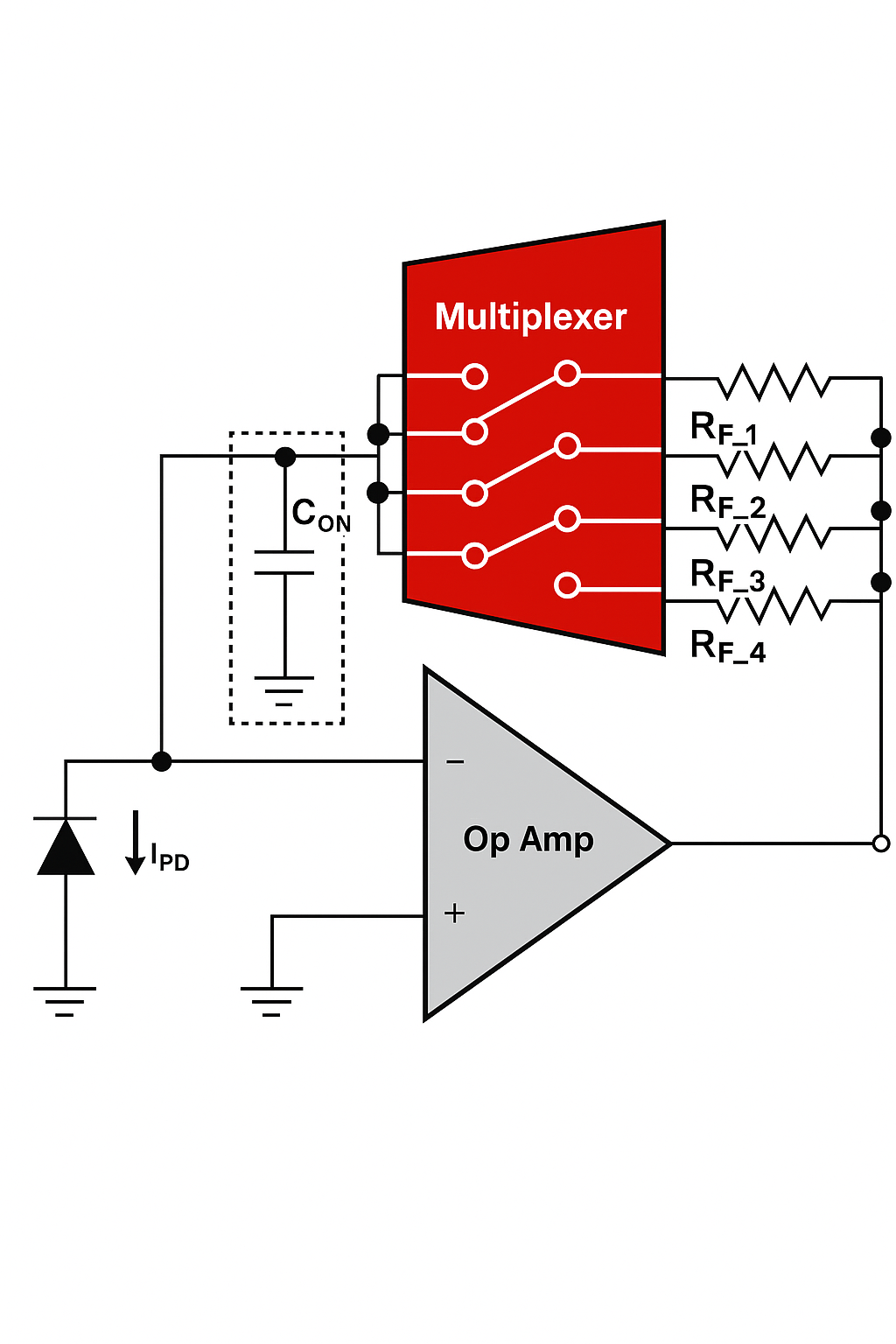
Figure 1: Configurable gain control.
Considerations for compact monitors
As with phones, laptops, and tablets, smaller and lighter solutions are preferred. Portable medical devices such as BGMs follow the same trend: users prefer compact meters that provide accurate readings. This drives designers to find precise, space-efficient solutions.
The TMUX11x series of precision multiplexers supports a wide operating supply range (single-supply 1.08 V to 5.5 V or dual-supply ±2.5 V) and is available in small leaded and leadless packages. These devices combine very low leakage, low CON, and small package options suitable for portable medical applications that require high-precision measurements. The TMUX1104 is available in a 10-USON package and specifies ultra-low leakage (typical 3 pA) and low quiescent supply current (about 8 nA), characteristics suitable for battery-powered BGMs.
When designing precise blood glucose monitors, it is not necessary to compromise system accuracy or stability. Selecting a precision multiplexer with ultra-low leakage, low CON, and a compact package at the sensor front end can satisfy both precision and size requirements.