Overview
The intelligent fetal monitoring system uses TI's MSC1210 microprocessor, which integrates a 24-bit A/D converter and provides strong analog performance and digital processing capability. The microprocessor consolidates input channel selection, buffering, amplification, gain adjustment, A/D conversion, and digital processing on a single chip. With one integrated circuit, it can acquire monitoring parameters such as fetal heart rate, uterine contraction pressure, and fetal movement count, and control the voice unit and vibrator. The control basis for the intelligent monitoring system is fetal heart rate; therefore, accurate and timely measurement of fetal heart rate is a prerequisite for system control. Because fetal Doppler signals have low signal-to-noise ratio and nonstationary random characteristics, errors such as one-half, two-thirds, and double heart rates can appear when computing fetal heart rate, leading to control mistakes. This design applies wavelet analysis combined with a double-threshold algorithm to obtain fetal heart rate accurately and in real time, ensuring effective intelligent control.
System Architecture
The system block diagram is shown in Figure 1. The main components are: an ultrasound Doppler fetal probe, a uterine contraction probe, a fetal movement probe, a fetal heart signal conditioning circuit (low-pass filtering, absolute value operation, and envelope extraction), a contraction pressure signal conditioning circuit, voice control, a vibrator, the MSC1210 microprocessor, and a computer processing system. The MSC1210 and the computer processing system form the core of the design.
The MSC1210 handles acquisition of monitoring parameters and communication, and receives computer commands to control the voice unit and vibrator. The computer system implements modules for intelligent control, communication control, data processing algorithms, and monitoring display.
Signal Conditioning Circuits
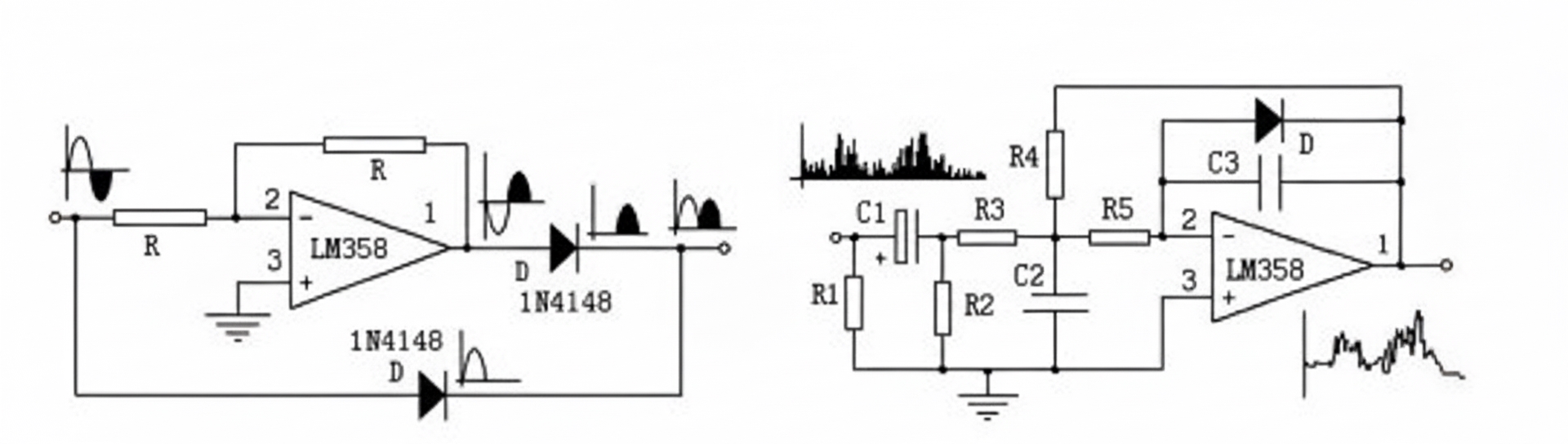
Given the importance of fetal heart rate monitoring and the complexity of fetal Doppler signals, this section focuses on the fetal Doppler signal conditioning circuit. The circuit performs preprocessing including low-pass filtering, absolute value operation, and envelope extraction. The low-pass filter is a second-order filter with a cutoff frequency of 250 Hz to remove high-frequency signals and interference. The absolute value circuit, shown in Figure 2, effectively doubles the signal amplitude and increases detection sensitivity. The envelope extraction circuit, shown in Figure 3, uses a combination of Pi-shaped and T-shaped low-pass filters with a 10 Hz cutoff frequency. Parallel diodes and capacitors limit negative voltages in the circuit and attenuate high-frequency oscillations within a specific band.
MSC1210 Microprocessor
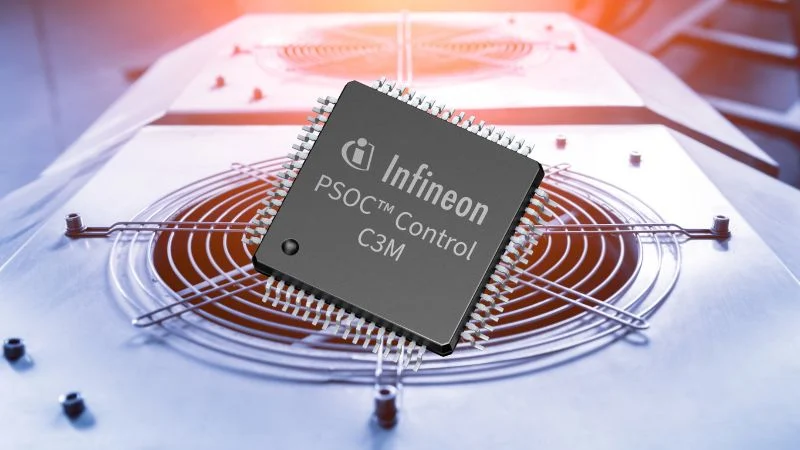
The acquisition system uses Texas Instruments' MSC1210 microcontroller as the processor. The MSC1210 integrates an enhanced 80C51 core, flash memory, and a high-precision sigma-delta A/D converter. The chip adopts an enhanced 8051 core to shorten instruction execution cycles and uses a low-power design. It integrates a 24-bit A/D converter with a conversion rate up to 1000 Hz, an 8-channel multiplexer, an analog input test current source, input buffers, a programmable gain amplifier (PGA), an internal reference voltage source, program/data flash memory, and data RAM. Digital filters are provided in three modes: fast, sin2, and sin3. The enhanced 8051 core includes two data pointers and an instruction set fully compatible with the standard 8051 while executing instructions at higher speed, allowing operation at lower clock frequency to reduce power consumption and noise. To reduce interference, analog and digital supplies are powered separately. The high integration of this chip simplifies the system hardware and reduces the number of external components, which improves reliability and shortens development time.
The MSC1210 interface circuit is shown in Figure 4. Doppler fetal heart and contraction pressure signals enter via IN0 and IN2, pass through the multiplexer and then into buffers; a variable-gain amplifier amplifies the input signals. Fetal movement signals are handled by the MSC1210 via an interrupt. The MSC1210 receives control commands from the computer over an RS-485 bus; it controls a voice chip via port P2 for voice prompts and controls the vibrator via P1.7 for automatic fetal stimulation. Using the MSC1210 as the microprocessor enables accurate, real-time acquisition of fetal monitoring parameters and supports the intelligent control functions.