Overview
Connectivity is advancing rapidly and has significant implications for health and care. Medical devices are no longer confined to hospital beds or dedicated facilities; clinicians can monitor and adjust devices worn by patients remotely, even during air travel.
This progress is driven by the convergence of smartphones, computers, wearable peripherals, and personal area networks (PANs). From an economic perspective, cost-conscious insurers are promoting wearable medical devices because early detection and prediction of events can reduce treatment costs.
This article describes prototyping wearable medical devices using off-the-shelf WiFi modules. Such modules can accelerate development of medical sensors and circuits, serve as OEM solutions, or be adopted into printed circuit boards as reference designs prior to product release. All devices, datasheets, and training materials referenced here are available from Digi-Key.
Why WiFi?
Many wired and wireless protocols compete within a PAN. Wireless options include WiFi, ZigBee, Bluetooth, ANT+, 6LoWPAN, and Z?Wave. While these protocols offer advantages such as lower power consumption, reduced protocol complexity and overhead, and lower traffic, WiFi has several practical advantages for medical devices.
One reason is the wide deployment of WiFi. Public venues such as cafes, restaurants, and transit hubs commonly provide WiFi, offering a convenient path to cloud services and clinical systems for devices that require direct access to public infrastructure. This direct path can also serve as a fallback if the wearable host fails.
Another reason is pervasive smartphone support for WiFi. Smartphones act as computation and communication aggregators for wearables, providing a low-power, continuous link to the cloud via 3G/4G/5G services.
WiFi also provides built-in security and encryption capabilities. With IPv6 there are sufficient IP addresses for unique device identification, so addressing is not a limiting factor.
Finally, there are many mature, ready-to-use WiFi chip and module solutions with reference designs, example code, PCB layouts, and application support, allowing developers to use the technology without having to master every RF detail.
Consider Using Modules
For designers, copying a reference RF design onto a PCB may seem straightforward since the manufacturing, testing, and characterization are already complete. However, many factors affect RF performance, and even chip vendors often iterate many times on PCB demo and development boards. Certification processes are time consuming and expensive, and even non-RF changes can force a PCB redesign, increasing cost, risk, and time to market.
Specifying a module for prototyping and initial production is often a better choice. Modules typically come with FCC, TUV, and other certifications and are available for various regional frequency bands. Modules can be tested in isolation from other system components, enabling enclosure, spacing, and component placement testing to optimize RF performance, especially where materials near the antenna affect results.
One major advantage of modules is parallel development: the RF module team can continue developing while the main application, prototypes, and testing proceed. This reduces pressure and risk, and OEM WiFi modules can be used for early production at reasonable cost.
Choosing a Module
Data rate requirements help determine the appropriate module. Not every application needs high throughput or high power. Examples of available modules:
MikroElektronika MIKROE?1135
The MIKROE-1135 is a 3.3 V, 11 Mbit/s 802.11b module with an integrated PCB antenna. Its firmware-encoded protocol stack allows an embedded microcontroller to communicate via a standard UART. The plug-in module format enables quick assembly and upgrades and is accompanied by reference schematics and code samples.
H&D Wireless HDG104?DN?2
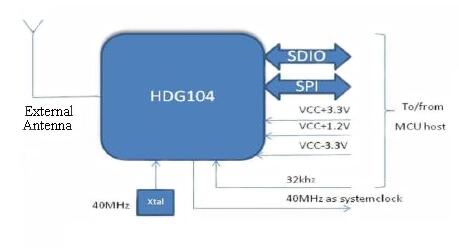
The HDG104?DN?2 supports 54 Mbit/s and both 802.11b and g. It operates at 2.7–3.3 V and is packaged in an SMT form factor similar to a QFN44, occupying only 7.1 x 7.7 mm. The module is pre-calibrated, requires no RF tuning, and uses a preassigned MAC address. It integrates an Atmel AVR processor with internal ROM and accepts a 40 MHz clock from the host system or a local oscillator. For low power modes it can use a 32.768 kHz clock, drawing about 15 mW in soft shutdown segments. The module uses an external antenna and communicates over SPI; it also provides digital I/O.
Texas Instruments WiLink Modules
Texas Instruments offers 54 Mbit/s modules such as WL1831MODGBMOCT that combine WiFi 802.11b/g/n transceivers with Bluetooth. These WiLink series modules are based on TI Sitara processors and integrate stacks and software supporting Linux and Android together with development kits.
Other 54 Mbit/s Options
Other plug-and-play modules include Microchip RN171XVS I/RM and H&DSP B800-BCP1. These modules enable devices with UART or RS?232 connectivity to connect wirelessly to the Internet or local networks.
Faster Options
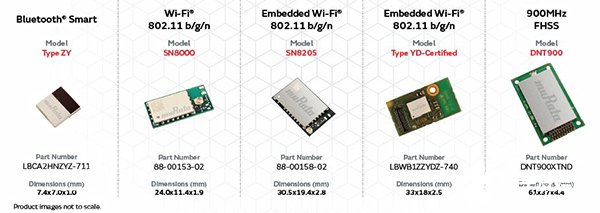
Murata offers the LBEE5ZSTNC523, a 65 Mbit/s 802.11b/g/n and Bluetooth 4.0 combo module. Murata also provides RF modules that extend coverage and penetration by supporting Bluetooth and even 900 MHz links.
Inventek ISM43362?M3G
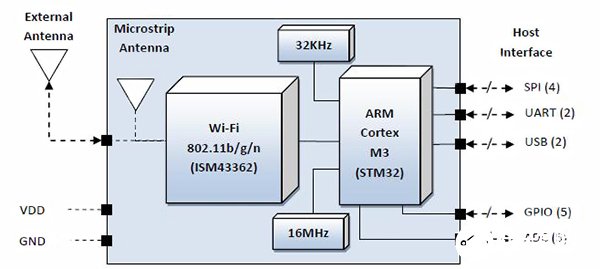
Inventek's ISM43362-M3G-L44-E-C2.4.0.2 is an attractive UART-fed 802.11b/g/n module with a microstrip antenna and an external antenna option. It supports multiple interfaces including SPI, UART, and USB, allowing it to act as a small hub. The module can also provide ADC functionality for mixed?signal applications.
Higher Throughput Modules
BlueGiga's WF111 and WF121 series are available with internal or external antennas; for example, the WF111?E offers 72 Mbit/s with an external antenna while the WF121-A uses an internal antenna. The Sagrad SG901?1059B-5.0-H reaches 150 Mbit/s using an external antenna and integrates the RT3070 single-chip USB 2.0 solution with a 150 Mbit/s PHY compliant with 802.11n draft specifications. Achieving full performance may require a host processor with sufficient compute, such as 300–400 MIPS; 32-bit ARM and x86 hosts have been successfully used.
Conclusion
Medical device manufacturers are experts in clinical use and healthcare product development, but may not be experts in wireless communications. Modular RF solutions simplify adding wireless connectivity to sensors or therapy systems. While one team focuses on the optimal medical solution, another team can develop the low-cost RF link in parallel. This approach reduces risk, can lower cost, and shortens time to market, particularly when certification tests must be repeated.