This article clarifies the differences between Flash and EEPROM for readers who encounter both types in projects.
In practice, both Flash and EEPROM are non-volatile memories, meaning data is retained after power loss. By contrast, RAM loses its data when power is removed.
Overview
Below are the differences between Flash and EEPROM across several aspects.
1. Read method
Both Flash and EEPROM support random access reads and can be accessed directly by address.
2. Write method
EEPROM typically supports byte-level writes, while Flash usually requires block-level programming. In Flash, writing new data often requires erasing an entire block before programming the new data into that block.
3. Erase method
EEPROM can be erased at the byte level, whereas Flash generally requires block-level erasure. That means in Flash, to update a small piece of data you often need to erase the whole block and then rewrite the data that must be preserved, which is more involved than EEPROM operations.
4. Program/erase speed
EEPROM program and erase operations are generally much slower than Flash. Actual speed depends on the memory model, interface type, the amount of data being written or erased, chip temperature, and other factors.
5. Storage density
Flash typically offers higher storage density and can store more data per die than EEPROM.
6. Endurance
Endurance depends on usage patterns and application scenarios. In general, EEPROM may achieve longer life in cases where byte-level updates reduce unnecessary erase cycles, since Flash requires page- or sector-level erasure. However, this is not universally true for all devices and use cases.
7. Cost
Flash devices are generally less expensive than EEPROM for the same storage capacity.
8. Communication interfaces
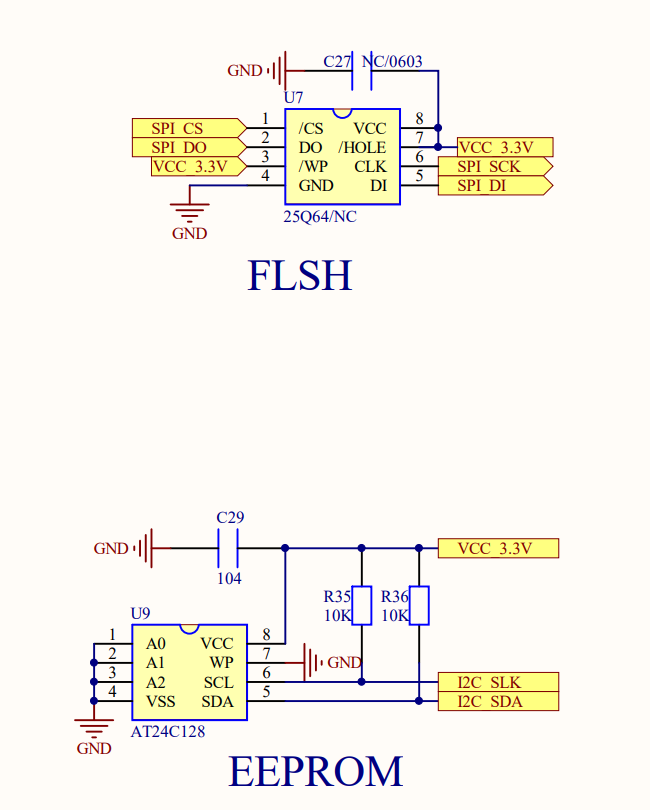
Flash memories often use SPI interfaces, while EEPROM devices commonly use I2C interfaces.
9. Data protection
Flash devices commonly provide both hardware and software protection features. EEPROM typically offers software-based protection mechanisms.
10. Summary
Flash is better suited for storing code and large, infrequently changed data such as audio, images, and programs. EEPROM is more suitable for small data that requires frequent updates, such as system parameters and configuration values.