Overview
FeRAM (ferroelectric random-access memory), also called FRAM, uses a ferroelectric film as the dielectric in a capacitor to store data. FeRAM combines characteristics of ROM and RAM and is notable for fast reads and writes, high endurance, low power consumption, and resistance to tampering.
FeRAM is compatible with industry-standard EEPROM interfaces. Compared with EEPROM, FeRAM offers higher endurance (for example, >1e12 cycles at 5 V and effectively unlimited cycles at 3.3 V in some implementations), faster write operations with no program-wait states, byte-level write capability, and significantly lower write energy (orders of magnitude lower than EEPROM in many cases).
Key differences between FeRAM and Flash
- Working principle: FeRAM stores data using a ferroelectric material whose polarization state can be switched by an applied electric field, creating two stable polarization states in each memory cell. Flash stores data by trapping or removing charge in a floating gate or charge-trapping layer; data is represented by the presence or absence of charge.
- Access speed: FeRAM typically provides faster random-access read and write times than flash, enabling quicker read/write operations.
- Endurance: Flash has a limited program/erase cycle count per cell (commonly 1e4 to 1e6 cycles depending on the flash type). FeRAM generally offers much higher write endurance, often reaching 1e8 cycles or more in many implementations.
- Power consumption: FeRAM read and write operations require lower energy compared with flash, which needs higher voltages and larger energy for erase and program operations.
- Density and cost: Flash is widely used for high-capacity storage because it provides higher cell density at lower cost. FeRAM typically has lower density and higher cost per bit, so it is used where lower power, higher endurance, or faster writes are required.
PZT structure and FeRAM operation
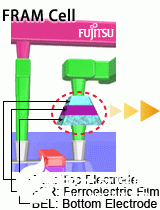
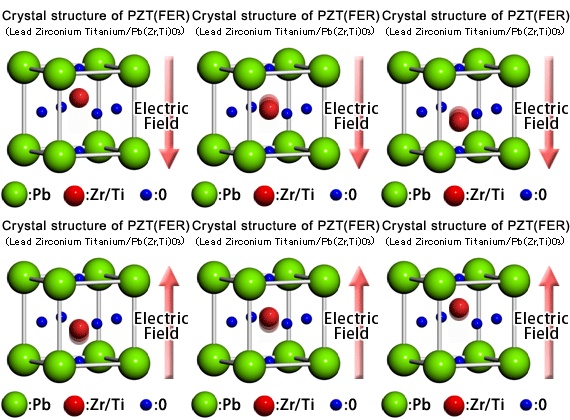
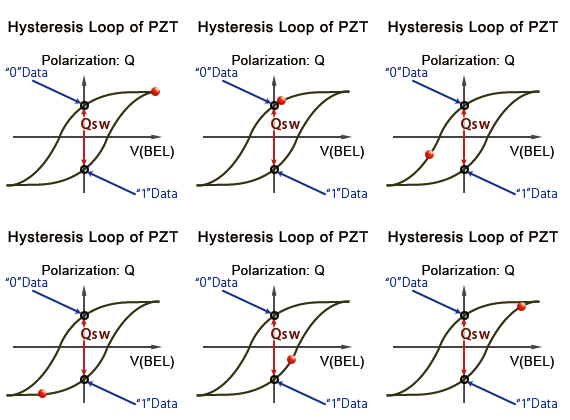
FeRAM replaces the dielectric layer of a capacitor with a ferroelectric material, such as PZT (lead zirconate titanate). Tiny ferroelectric domains are integrated into the capacitor; applying an electric field shifts ions in the lattice, switching the polarization between two stable states. Once set, the polarization remains without an applied field, providing nonvolatile storage. The capacitor electrodes sense the polarization state, which corresponds to logical "0" or "1".
PZT crystal lattice contains zirconium and titanium ions that move between two stable positions depending on the external electric field. The resulting hysteresis of polarization versus electric field is used to represent stored data.
FeRAM in the memory landscape
Memory technologies fall into volatile and nonvolatile categories. Volatile memories, such as SRAM and DRAM, lose stored data when power is removed. Traditional nonvolatile memories originated from ROM technology. EEPROM and flash evolved to support write operations, but they typically require high voltages and have limited write endurance.
FeRAM is the first nonvolatile memory that provides RAM-like write behavior. It combines easy, low-energy write/read properties similar to SRAM/DRAM with the nonvolatility of flash/EEPROM, making it suitable for applications that require frequent writes, low power, and high endurance.