What the memory hierarchy includes
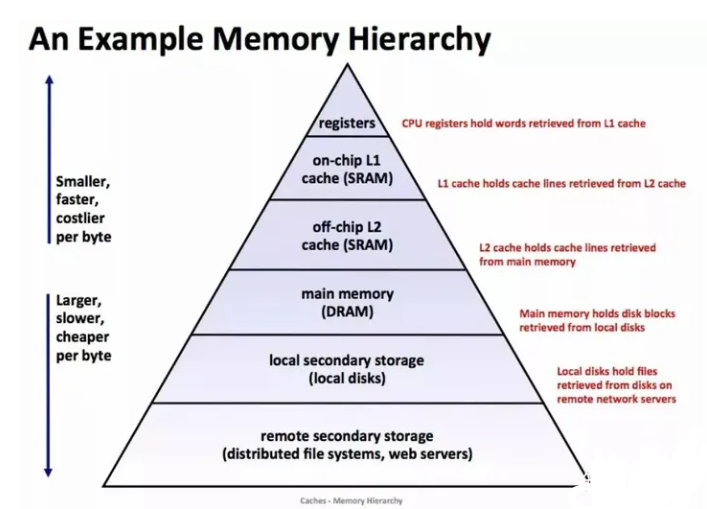
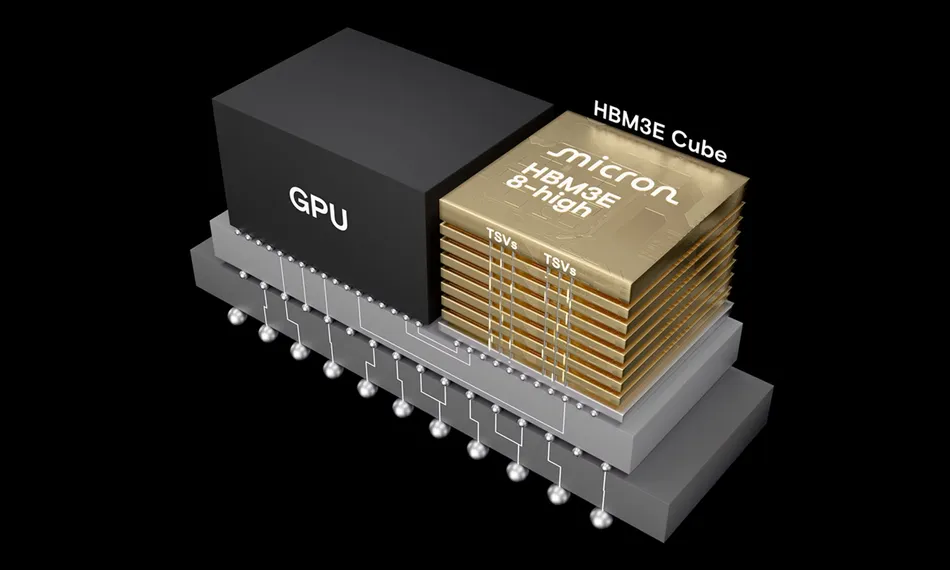
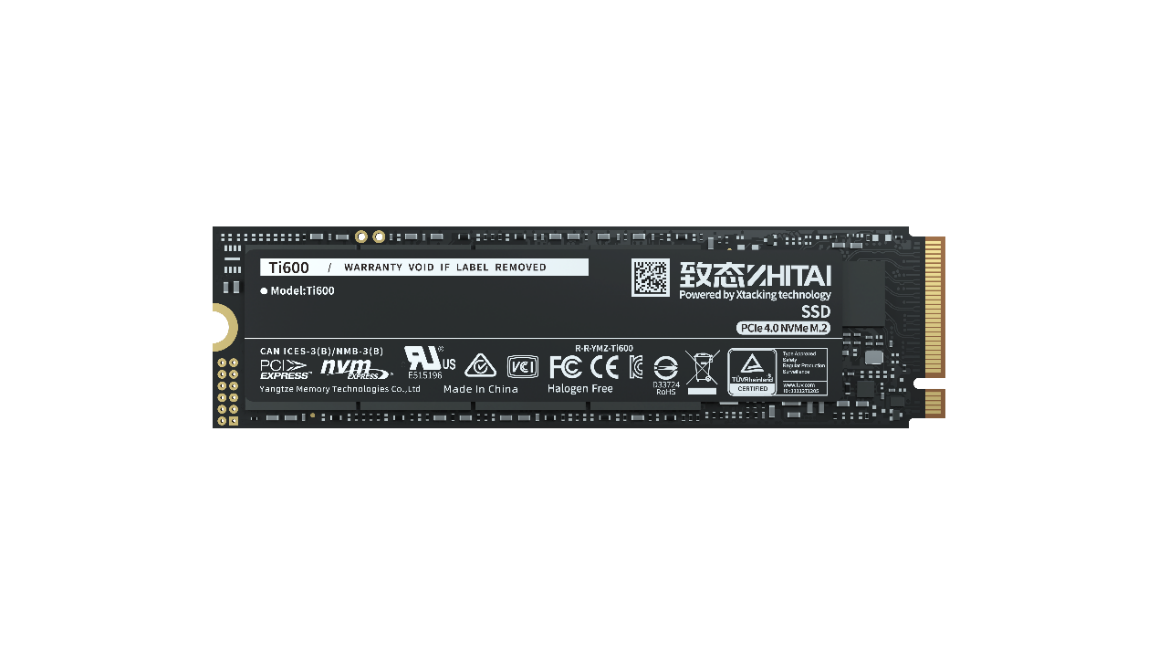
The memory hierarchy typically includes CPU registers, cache memory, main memory (for example DRAM), and secondary storage (for example disk). In this hierarchy, devices at higher levels generally provide faster access but have smaller capacity, while devices at lower levels offer larger capacity but slower access.
This design balances storage capacity and access speed to meet different application requirements. For example, CPU registers are at the top level with the fastest access but very limited capacity. Secondary storage such as disks is at the bottom level with very large capacity but slower access. Cache and main memory sit between these extremes and act as buffers.
In the memory hierarchy, each level caches data objects from the level below. When a program needs data, it first looks in the highest-level storage. If the data is not found, the search proceeds down the hierarchy until the data is located. This approach takes advantage of the strengths of each level to improve access speed.
Virtual memory is an important application of the memory hierarchy. By extending physical memory into a larger logical address space, virtual memory gives programs access to more usable memory and can improve overall system performance.
Benefits of the memory hierarchy
The main benefits of the memory hierarchy include the following:
- Balance of speed and capacity: Multi-level memory design enables a tradeoff between capacity and access speed. Cache and main memory provide fast access, while secondary storage provides large capacity. This design helps systems meet both speed and capacity requirements.
- Improved data access efficiency: Because each level caches data from lower levels, accesses often hit at higher, faster levels. If not found, the search proceeds downward. This behavior leverages the strengths of each level to speed up data access.
- Lower cost: Selecting appropriate memory types at different levels reduces cost while meeting performance requirements. Fast memories like cache and main memory are more expensive per byte, while secondary storage is cheaper. Using a hierarchy reduces overall hardware cost.
- Improved reliability: Data distributed across multiple levels reduces the risk that a single device failure causes total data loss. Backup and recovery mechanisms can further enhance reliability.
Memory hierarchies help improve system performance, reduce cost, and increase reliability. This explains their widespread use in modern computer systems.
Difference between memory hierarchy and memory striping
Memory hierarchy and memory striping are different concepts.
The memory hierarchy arranges different types of storage by access speed and capacity, forming layers. Fast, small-capacity devices are at the top; slow, large-capacity devices are at the bottom. A program searches from the highest level downward until it finds the needed data. This design balances capacity and access speed and improves access efficiency.
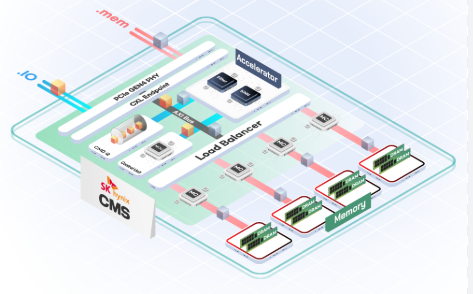
Memory striping is a technique that combines multiple storage devices into one logical device by distributing data across several physical devices. Striping can increase data throughput and improve load balancing. It is commonly used in large storage systems to enhance performance and reliability.
In short, memory hierarchy focuses on balancing access speed and capacity across different device types, while memory striping focuses on combining multiple devices to create a higher-performance, higher-reliability logical storage device. Their goals and implementations differ.