Market players and product categories
Rambus has become one of only three global suppliers of memory interface chips, with the other two being Montage Technology and Renesas (formerly IDT). Their main products include memory interface chips, memory interface IP, and security IP solutions.
Rambus product categories include:
1. Memory interface chips: The company has developed across multiple generations up to the latest DDR5 products. Current offerings include industry-leading DDR4 and DDR5 chipset families.
2. High-speed interface IP: The company provides interconnect and interface IP, including complete subsystem solutions, digital controllers, and PHY IP suitable for PCIe, CXL, HBM, GDDR, and DDR standards.
3. Security IP: Hardware-level security IP that supports encryption for static and dynamic data in data centers and servers. These products and solutions are targeted at data center applications such as enterprise memory modules, AI accelerators, smart NICs, network switches, memory expansion, and pooling.
DDR5 vs DDR4: Key improvements
DDR refers to DDR SDRAM, or double data rate synchronous dynamic random access memory. As the second generation after SDR SDRAM, DDR transfers data on both the rising and falling edges of the clock, achieving twice the data rate without increasing the clock frequency. The DDR standard upgrade delivers substantial performance improvements. In July 2020, JEDEC released the final specification for DDR5 SDRAM. Compared with DDR4, DDR5 delivers several major enhancements:
- Higher data rate: Base transfer rate increases from DDR4 starting around 1.6 Gbps to DDR5 starting around 4.8 Gbps.
- Lower power consumption: Operating voltage decreases from 1.2 V to 1.1 V, and DDR5 integrates PMICs (power management ICs) to optimize power management, improving overall energy efficiency by about 30%.
- Improved reliability: On-die ECC is supported, with an 8-bit ECC for every 128 bits of data.
- Higher density: Single memory-die density increases from 16 Gb to 64 Gb, enabling LRDIMM assemblies with up to 2 TB effective memory capacity using 40 components.
- Better access efficiency: A dual-channel architecture with two independent 40-bit channels is used, and the burst length per channel doubles from 8 bytes to 16 bytes.
JEDEC described DDR5 as a significant architectural advance to address storage and data transfer demands driven by AI, cloud computing, and the Internet of Things. After DDR5 DRAM became standard on Intel's 12th-generation "Alder Lake" processors, AMD announced DDR5 support for its 7000 series processors, which launched on September 27, 2022. In December 2022, Samsung announced development of 16 Gb DDR5 DRAM using a 12 nm-class process and completed compatibility testing with AMD, planning mass production in 2023. The market is undergoing a transition from DDR4 to DDR5, and DDR5 adoption is expected to stimulate industry growth.
CXL adoption and Rambus technical positioning
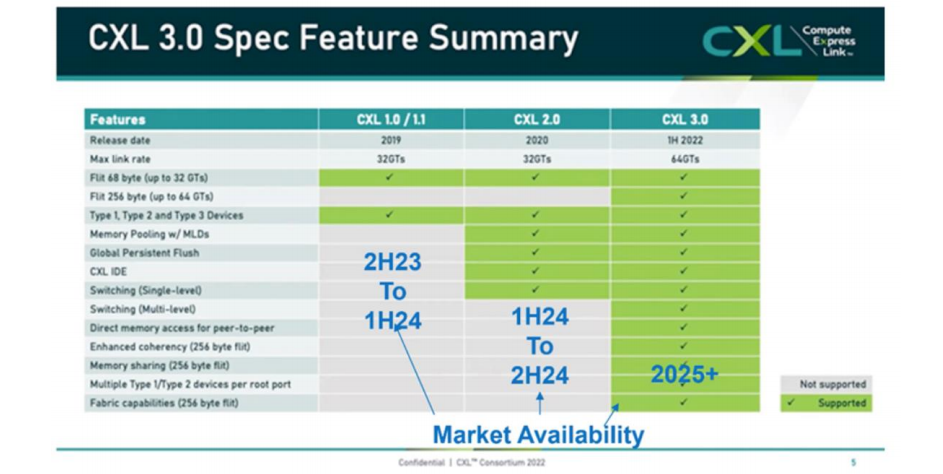
Intel introduced Compute Express Link (CXL) in 2019. In a few years, CXL has become the industry-recognized standard for advanced device interconnects. Competing initiatives such as Gen-Z and Open CAPI have withdrawn and transferred their protocols to CXL. CXL enables high-speed, efficient interconnects among CPUs, GPUs, FPGAs, and other accelerators while maintaining coherency between CPU memory space and device memory, addressing fragmented memory across devices and meeting the needs of high-performance heterogeneous computing. CXL can be seen as an evolution of PCIe, adding transformative capabilities.
CXL 2.0 enables memory pooling, realizing a memory-centric architecture that can significantly reduce data center build cost and increase DRAM utilization. CXL 3.0 adds memory sharing and remote memory access, enabling multiple machines to access the same memory addresses in hardware. CXL 1.1 and 2.0 run over PCIe 5.0 at 32 GT/s, while CXL 3.0 extends to PCIe 6.0 at 64 GT/s, doubling transfer rate and further reducing total data center costs.
CXL increases on-chip technical complexity, requiring integrated circuit and complex SoC expertise to design, develop, and implement intricate SoCs. Rambus is positioned to offer CXL-related solutions and may expand revenue opportunities in the CXL technology domain.
Mergers, acquisitions, and product evolution
Rambus has expanded its product portfolio and capabilities through multiple acquisitions:
- 2011: Cryptography Research, Inc., enhancing cryptographic expertise and security offerings.
- 2012: Lighting Science Group's LED business, extending technology into energy-efficient lighting.
- 2012: Unity Semiconductor, diversifying and strengthening memory-related technologies.
- 2013: Silicon IP assets from GlobalFoundries, reinforcing advanced memory solution capabilities.
- 2016: Bell ID, expanding products in mobile payments and smart ticketing.
- 2016: Snowbush IP assets, broadening high-speed interface business.
- 2016: Inphi Corporation's memory interconnect business, strengthening position in memory markets.
- 2019: Verimatrix silicon IP and security protocol assets, extending security IP products.
Acquisitions have at times supported short-term stock price increases by signaling positive prospects to the market. However, without substantive revenue or technological leaps, such effects can be temporary.
Historically, Rambus introduced XDR DRAM technology in 2003 and launched XDR DRAM in 2005. Sony selected XDR DRAM for the PlayStation 3, producing brief stock upticks. XDR initially competed with the next DDR version. As DDR2 and then DDR3 increased effective data transfer rates, XDR DRAM could not maintain competitiveness, and Rambus's stock declined, reaching a low point in 2012.
With DDR4 adoption beginning around 2014 and accelerating after Intel Skylake in 2015, Rambus introduced R+ DDR4 server memory chips (RB26 DDR4 RDIMM and RB26 DDR4 LRDIMM) in 2015. These chipsets include register clock drivers and data buffers compliant with JEDEC DDR4 standards.
By 2020, data center and cloud demand increased, and the DDR4 market stabilized. Rambus also led in DDR5 qualification efforts, driving record product revenues and an improvement in market valuation after a prolonged downturn.