Background
MEMS accelerometers detect mechanical acceleration through changes in capacitance, resistance, or charge (piezoelectric) within microstructures. They are now the second most widely used MEMS device category after pressure sensors. MEMS accelerometers have long been used for vibration monitoring, automotive testing, and inertial navigation. Recent studies have highlighted their potential for health monitoring and implantable hearing aids. Early MEMS accelerometers used piezoresistive coupling in silicon. Advances in silicon micromachining enabled reliable fabrication of more complex movable microstructures and produced capacitive accelerometers with comb-drive actuators. In recent years, piezoelectric MEMS accelerometers have become more common. Compared with piezoresistive and capacitive accelerometers, piezoelectric devices offer advantages such as better temperature stability, higher robustness, lower power consumption, improved linearity, wider dynamic range, enhanced sensitivity, and no requirement for vacuum packaging. For implantable hearing aids, piezoelectric accelerometers can potentially interface directly with neurons without additional readout circuitry.
Materials and manufacturing trade-offs
Despite their advantages, piezoelectric MEMS accelerometers face trade-offs between environmental impact and performance. High-performance piezoelectric materials such as lead zirconate titanate (PZT) raise ecological concerns due to heavy metals. Lead-free high-performance alternatives such as potassium sodium niobate (KNN) have sustainability issues related to raw material extraction. More environmentally friendly materials such as aluminum nitride (AlN) and zinc oxide (ZnO) can be used for piezoelectric MEMS transducers, but their weaker piezoelectric properties limit device performance compared with PZT-based devices. All these inorganic materials share similar manufacturing processes. Both bottom-up surface micromachining and top-down bulk micromachining employ repeated cycles of material deposition, photolithographic masking, and anisotropic etching, resulting in comparable process complexity. If performance is intentionally reduced for environmental benefit, manufacturing should at least be simplified to make the trade-off worthwhile.
Polymer approach with PVDF
Using polyvinylidene fluoride (PVDF) film to develop polymeric piezoelectric MEMS devices offers a feasible way to address these challenges. PVDF has a higher piezoelectric coefficient than ZnO and AlN, enabling potentially higher-performance devices. PVDF films can be directly patterned into microstructures using advanced methods such as laser micromachining and additive manufacturing, bypassing the conventional deposition-photolithography-etching cycle and simplifying the manufacturing flow.
In addition to enabling simpler and more environmentally friendly microfabrication and higher sensitivity, PVDF-based polymeric piezoelectric MEMS accelerometers could strengthen the role of MEMS inertial sensors in flexible electronics. Continued advances in organic semiconductor materials and organic field-effect transistors have increased interest in all-polymer electronic systems featuring polymer sensors and polymer integrated circuits. This trend raises the significance of polymer MEMS sensors as front-end information collectors and accelerates related research.
Research gap and recent study
Research on polymer MEMS inertial sensors remains relatively immature. Existing studies on high-performance polymer piezoelectric MEMS accelerometers often treat energy harvesters as accelerometers. MEMS energy harvesters are tuned to operate near their mechanical resonance and exploit the largest mechanical response. Compared with conventional MEMS accelerometers, devices converted from energy harvesters have limited bandwidth, restricting their application potential. To address this longstanding limitation, deeper research into polymer piezoelectric MEMS accelerometers is necessary.
Researchers in the Department of Electrical and Computer Engineering at the University of British Columbia have proposed a new PVDF piezoelectric MEMS accelerometer design and fabricated three samples using a simplified polymer micromanufacturing process. The samples were characterized for mechanical resonance, frequency response, flat-band sensitivity to input acceleration, and device-level noise. The researchers compared experimental measurements with benchmarks to demonstrate performance potential. The work was published in Microsystems & Nanoengineering under the title "A polymeric piezoelectric MEMS accelerometer with high sensitivity, low noise density, and an innovative manufacturing approach."
Device images
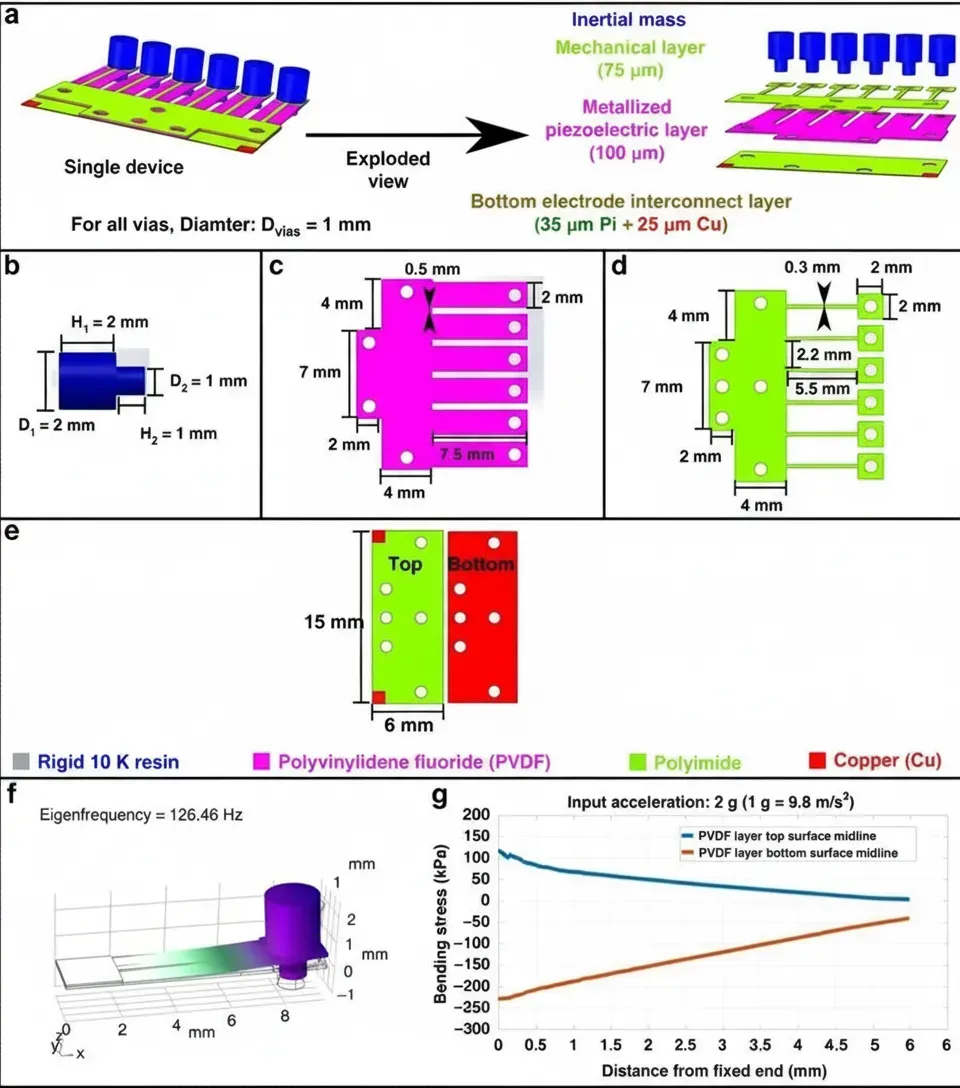
Design and characterization
The design and simulation of the PVDF piezoelectric MEMS accelerometer focused on producing a polymer-based conventional piezoelectric MEMS accelerometer rather than an energy-harvesting derivative. The research team fabricated three PVDF piezoelectric MEMS accelerometer samples and characterized their mechanical and electrical performance.
Summary of results
In summary, the study presents a new design for a polymeric piezoelectric MEMS accelerometer based on PVDF. The authors state this is the first conventional piezoelectric MEMS accelerometer design based on PVDF. The design demonstrates sensitivity and noise density comparable to state-of-the-art piezoelectric MEMS accelerometers that use ultrathick PZT films, and it outperforms several commercial capacitive MEMS accelerometers. Compared with leading organic MEMS accelerometers, the new PVDF accelerometer offers a fourfold wider flat-band. The fabricated accelerometers are also one order of magnitude smaller in size. Beyond competitive performance, the design features a simple, flexible, repeatable, and predictable micromanufacturing process without heavy-metal piezoelectric materials. Therefore, the design may serve as a more environmentally friendly alternative to conventional PZT-based high-performance piezoelectric MEMS accelerometers and has application potential in multiple domains.
Outlook
Importantly, the proof of concept shows that PVDF films can directly enable high-performance conventional piezoelectric MEMS accelerometers, avoiding the indirect approach of converting PVDF energy harvesters into accelerometers. Given that MEMS accelerometers are the second-largest MEMS product category after pressure sensors, this work addresses a long-standing gap in the polymer MEMS field and opens pathways for further research, such as fully polymeric inertial sensing systems that integrate polymer MEMS accelerometers with organic integrated circuits.