Market Overview
In 2023 the automotive memory market was about $6 billion, and it was the only bright spot and growth area in the memory market. Vehicle electrification and increased vehicle intelligence have driven strong demand for automotive memory, and the market is expected to reach $10 billion by 2028.
Automotive storage is critical. Tesla Model S once used a non-automotive-grade memory part, SK hynix H26M42003GMRA, a legacy 2014 product. Frequent OTA updates and high temperatures caused failures that led to repeated crashes and black screens. This failure could not be fixed by OTA; the car head unit had to be opened, the chip removed, and replaced with an automotive-grade memory chip, which is a costly repair.
Where Memory Is Used in Vehicles
Each SoC and high-end MCU in a vehicle requires memory. The largest consumers are the cockpit SoC and ADAS/autonomous driving SoC, followed by T-Box and instrument clusters, and then gateway and chassis systems.
Three Main Memory Categories
Memory in automotive applications is mainly divided into three categories:
- DRAM, used for data and code caching. Mainstream types are LPDDR4 and LPDDR5.
- Data storage, where eMMC and UFS are common.
- Code storage, where NOR Flash is commonly used.
Example: SAIC Feifan R7 Autonomous Driving Domain Controller
The large central chip in the image is Nvidia Orin-X. Around it are four Micron LPDDR5 memory devices, part number MT62F1G64D8EK-031 AAT:B, capacity 8 GB each, 6400 MB/s, x64 bus width. This is a new Micron product. A Micron eMMC labeled JWD65, model MTFC32GASAQHD-AAT, capacity 32 GB, 200 MHz clock, is present and likely stores boot and root filesystem. A Micron UFS labeled HSA06, model MTFC256GAVATTC-AAT, UFS 3.1, 256 GB, likely stores perception and decision models and related files for autonomous driving; this capacity is twice that of an ideal dual-Orin autonomous driving controller. To the right of JWD65 is a serial Flash for boot, model MX25U51279, 512 Mb, supplied by Macronix. On the other side is another serial Flash, model MX78U64A00FXDR02, also 512 Mb and supplied by Macronix.
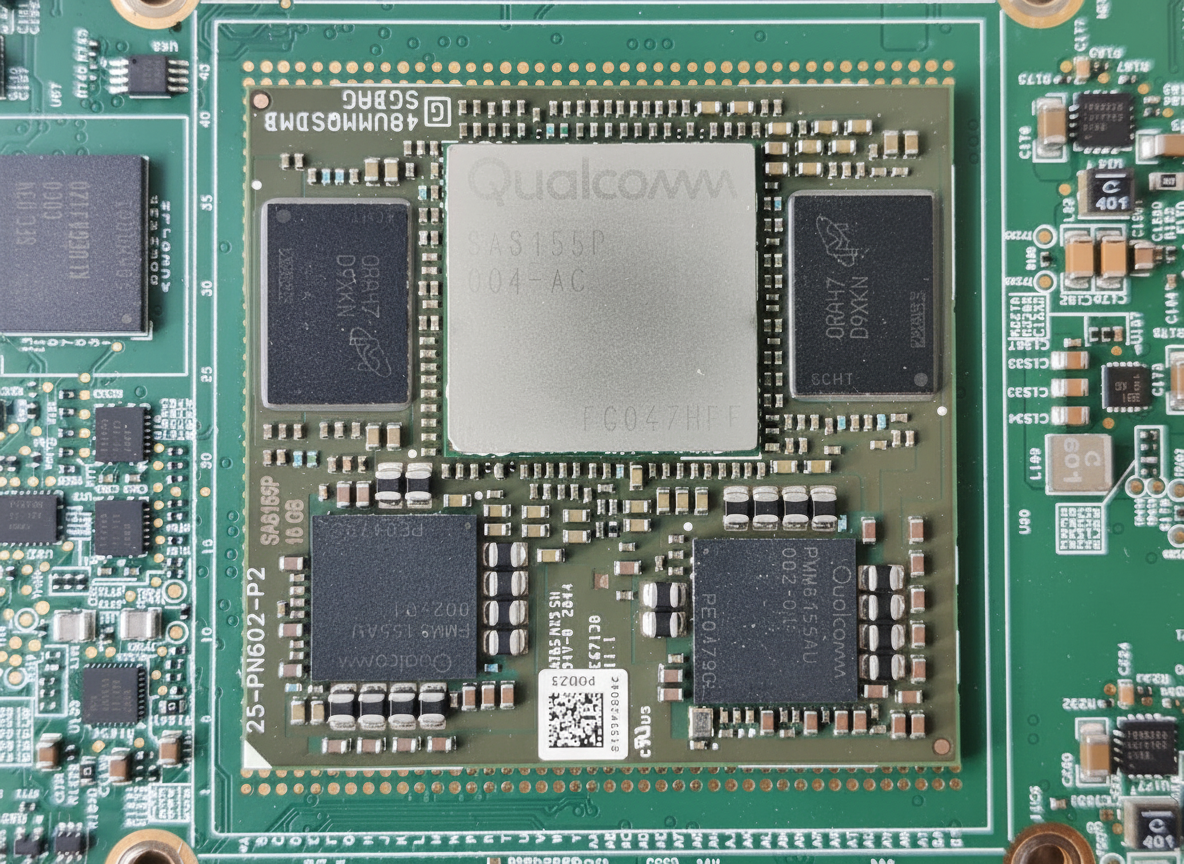
Example: Li Auto L8/L9 Cockpit Domain Controller Module (SA8155P)
The SA8155P module uses two LPDDR4 devices supplied by Micron, model MT53E1536M32D4DT-046 AT:A, capacity 6 GB each, 4266 Mbps. The UFS, also from Micron and located below the SA8155P, is labeled HSA12, model MTFC128GAZAOTD-AAT, capacity 128 GB, UFS 2.1.
Example: NIO ET7 SA8155P Module
The NIO ET7 SA8155P module uses two Micron D9XKN chips. D9XKN is Micron LPDDR4, model MT53E2G32D4DT-046, capacity 6.4 Gb each (8 GB). NIO's UFS is from Samsung, model KLUEGAJ1ZD-C0CQ, capacity 256 GB, UFS 2.1, voltage 1.8/3.3 V, interface G3 2-lane. On the PCB backside there is an SA8155P BootLoader serial NOR Flash provided by Micron, chip ID RW199, model MT25QL128ABA8ESF-0AAT, capacity 128 Mb, voltage 2.7–3.6 V, temperature range -40°C to 105°C.
Example: Nissan Latest Cockpit Chip
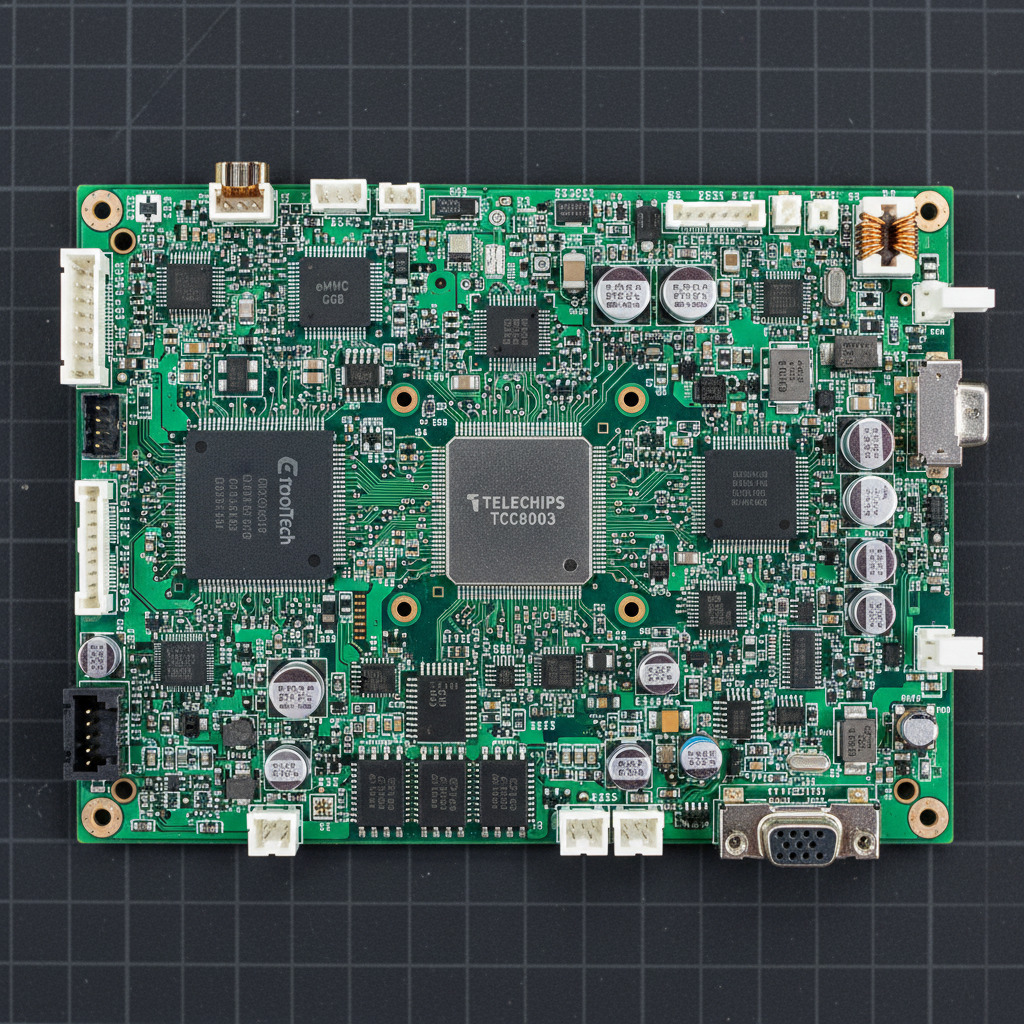
Nissan's latest cockpit uses the rare DDR3 memory, a 2002 standard that is now over 20 years old and seldom produced. The DDR3 memory is supplied by a Taiwan-based vendor, model EM6HE16EWAKG-10H, capacity 4 Gb per die (0.5 GB per chip), likely manufactured on an older process node. Nissan also uses a synchronous SDRAM chip provided by the same vendor, capacity only 16 Mb and physically large, likely from another older process. eMMC is supplied by a Chinese supplier, Jiangbolong, capacity 8 GB. On the PCB backside there is a Bootloader Flash supplied by a Taiwan-based supplier, model EM29LV320A, capacity 48 Mb and physically large.
Market Positions and Vendor Relationships
Micron dominates the high-end automotive DRAM market; over 90% of automotive DRAM above 1 GB is supplied by Micron. One reason is the relatively small size of the automotive market compared with the PC market, so Samsung and SK Hynix pay less attention. Another reason is that Micron provides custom services to SoC companies like Qualcomm, Nvidia, and even Renesas; some SoCs specify Micron memory. Only some Korean automakers use Samsung high-capacity DRAM in small volumes.
During each computation, a CPU issues instructions and model weights are loaded from UFS into DRAM. If a dedicated graphics memory is available, weights may go into that memory; graphics memory typically offers much higher bandwidth than shared DRAM, so computations do not have to fetch data from UFS repeatedly. This explains why DRAM and graphics memory exist: their speed is far greater than UFS.
Standards Body: JEDEC
JEDEC is the standards body for the memory industry. Over the past 50+ years, JEDEC standards have been widely accepted and adopted across the industry. JEDEC is a global organization with multinational membership and is not affiliated with any single country or government. Its standard-setting process brings manufacturers and suppliers together through approximately 50 committees and subcommittees. JEDEC has nearly 300 member companies, including most of the industry's top 100 firms. In JEDEC voting, each company has one vote regardless of size. A standard requires a two-thirds majority in committee votes and final approval by the board of directors with a 75% majority.
JEDEC standards documents are typically available for purchase, for example the LPDDR4X standard costs about $106 and LPDDR5X about $459. These are detailed specifications spanning hundreds of pages, which most readers do not need to review in detail.
LPDDR and Other DRAM Variants
The latest mobile DRAM standard is LPDDR5X, released in late June 2021. LPDDR4/LPDDR4X do not support bank grouping, so their price can be higher than LPDDR5 in some cases. LPDDR4/LPDDR4X are dual-channel and can deliver higher peak bandwidth than some LPDDR5 configurations. The difference between LPDDR4X and LPDDR4 lies in Vddq, the DRAM I/O buffer voltage, which is effectively merged with core voltage VDD. Lower voltages enable faster rates and lower power consumption.
LPDDR5X emerged to address LPDDR5's bandwidth shortcomings. LPDDR5X increases the data rate up to 8533 Mbps, matching LPDDR4 (which is dual-channel). Theoretical peak bandwidth increases from 51.2 GB/s to 68.26 GB/s. LPDDR5X supports variable voltage from 0.5 V to 1.1 V, reducing power consumption by about 20%. This makes it attractive for smartphones—Xiaomi 13 was among the first to use LPDDR5X—but power savings are less significant for automotive use. There are currently no automotive-grade LPDDR5X products. Given the limited improvement of LPDDR5X, SK Hynix has introduced LPDDR5T with up to 9600 Mbps, about a 13% increase over LPDDR5; LPDDR5T is likely a step toward LPDDR6.
GDDR was originally used in graphics cards, but as AI workloads and Transformer models become common in automotive applications, memory demands have increased. Tesla was an early adopter of GDDR6, but there are not yet automotive-grade GDDR6 products.
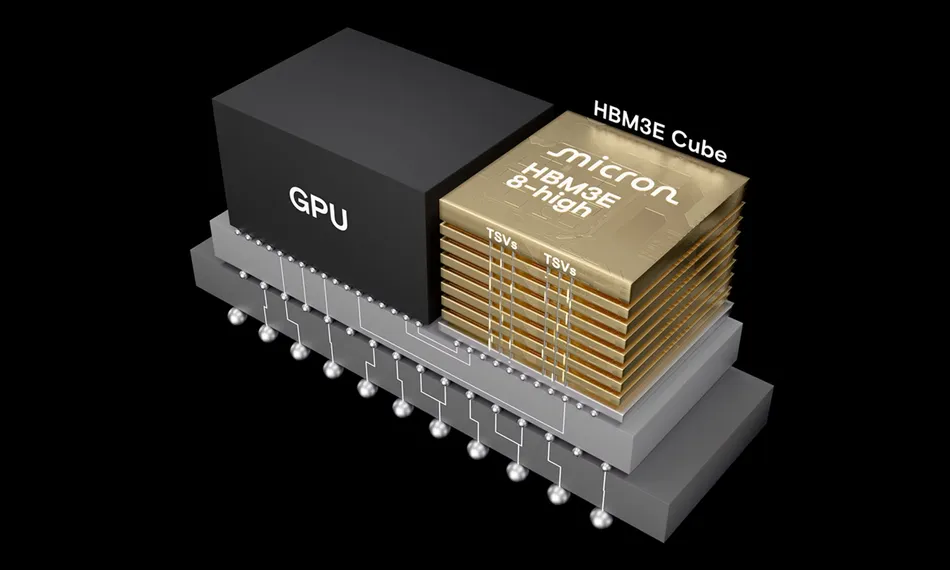
GDDR6X is already available. Samsung has made incremental improvements to GDDR6, increasing theoretical peak bandwidth from 672 GB/s to 768 GB/s by adjusting bus widths and other parameters. GDDR7 is under internal development at some vendors, with announcements claiming readiness for early 2024, although its standard has not been finalized. GDDR7 could reach around 1 TB/s, approaching the bandwidth of HBM.