Overview
With the wider adoption of PCIe 4.0, most modern motherboards now provide PCIe 4.0 interfaces. Compared with PCIe 3.0, PCIe 4.0 doubles bus bandwidth and can improve SSD and graphics card performance. Storage vendors have released multiple PCIe 4.0 SSDs targeting different price points. WD Blue SN580 is Western Digital's mainstream PCIe 4.0 offering. This review examines its design, specifications, and performance.
Product specifications
Interface: PCIe 4.0 x4
Controller: SanDisk 20-82 series
Flash: SanDisk BiCS5 112-layer 3D NAND TLC
DRAM cache: N/A (DRAM-less design)
Capacities: 250 GB, 500 GB, 1 TB, 2 TB
Form factor: M.2 2280
Endurance (TBW): 150 TB (250 GB), 300 TB (500 GB), 600 TB (1 TB), 900 TB (2 TB)
Warranty: 5 years
Reference price: about CNY 419 (1 TB)
Design and components
The WD Blue SN580 closely resembles its predecessor in external design and has a simple board layout. The 1 TB sample tested is single-sided, with only the controller and flash packages on the front, indicating a DRAM-less architecture. A DRAM-less controller does not require external DRAM for cache; it can use a small portion of system memory to build a virtual cache pool that stores the FTL mapping table, providing efficient cache management while reducing power and manufacturing cost.
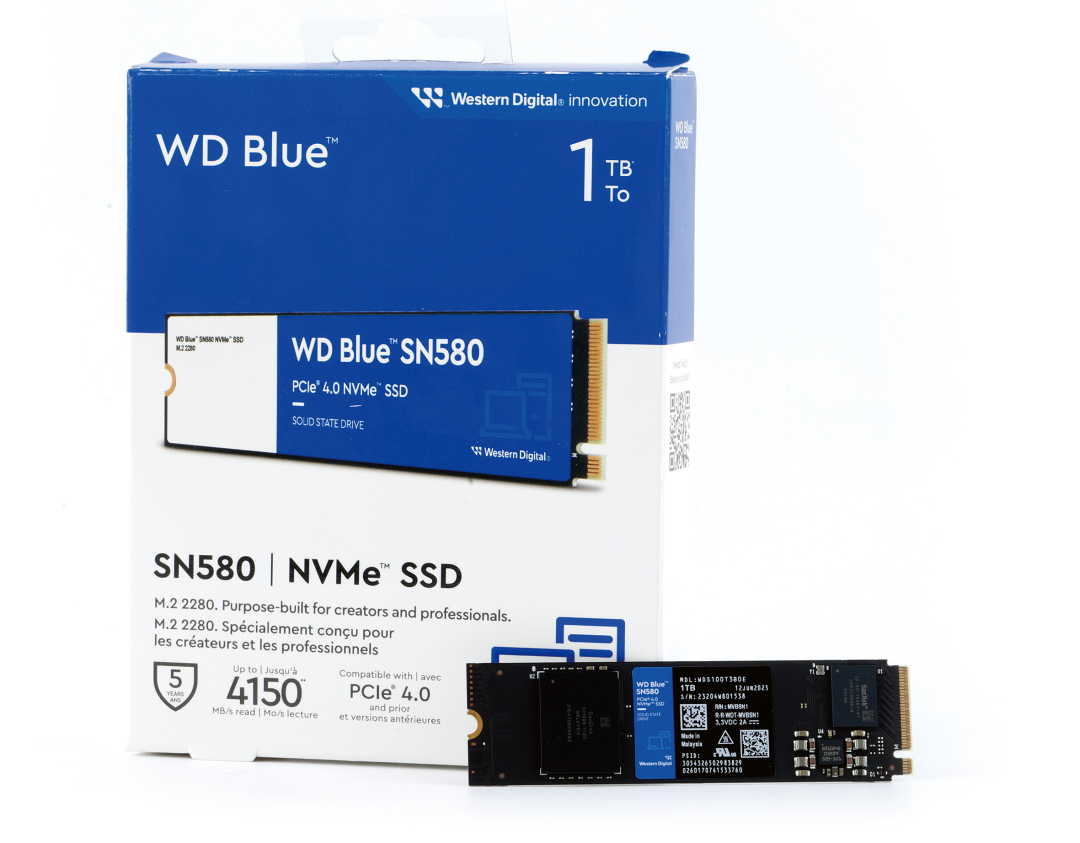
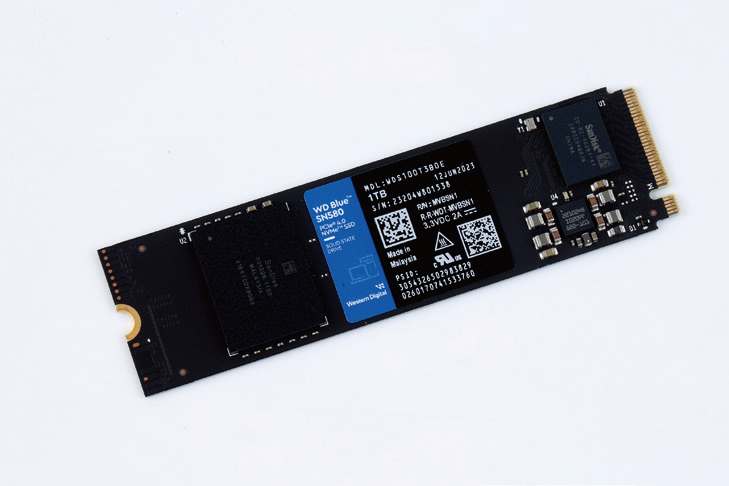
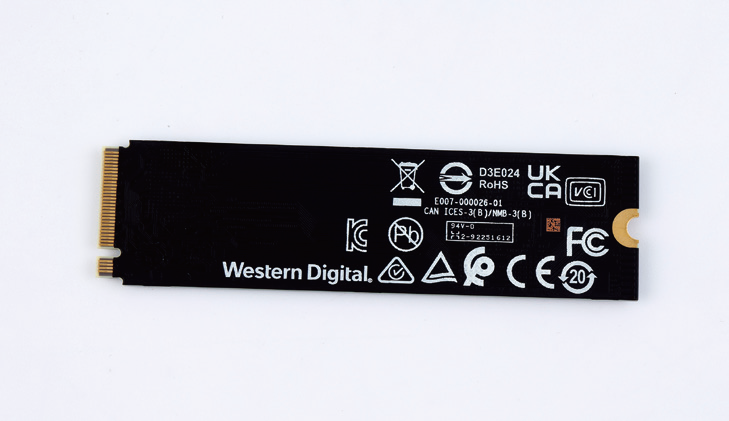
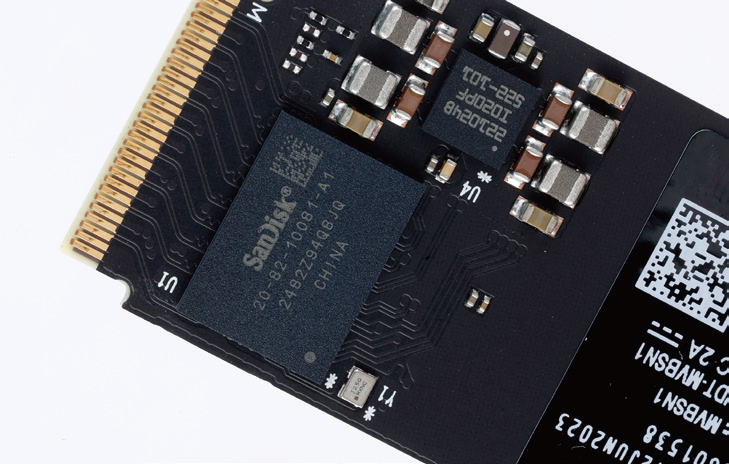
The controller is identified as SanDisk 20-82-10081-A1, which is similar to the SanDisk 20-82-10048-A1 used on the SN570. Western Digital has not published detailed specs; the controller is a 4-channel design. CrystalDiskInfo detects NVMe 1.4 support and common features such as S.M.A.R.T and TRIM.
Official performance figures indicate an upgrade over the PCIe 3.0 SN570: sequential read up to 4150 MB/s (SN570: 3500 MB/s) and sequential write up to 4150 MB/s (SN570: 3000 MB/s) thanks to nCache 4.0. Random 4K performance is listed up to 600K read and 750K write IOPS, compared with SN570's 460K/450K.
The SN580 uses SanDisk BiCS5 112-layer TLC flash, which offers higher density and improved I/O characteristics versus 96-layer devices. Interface transfer bandwidth reaches 1200 MT/s and read latency is reduced.
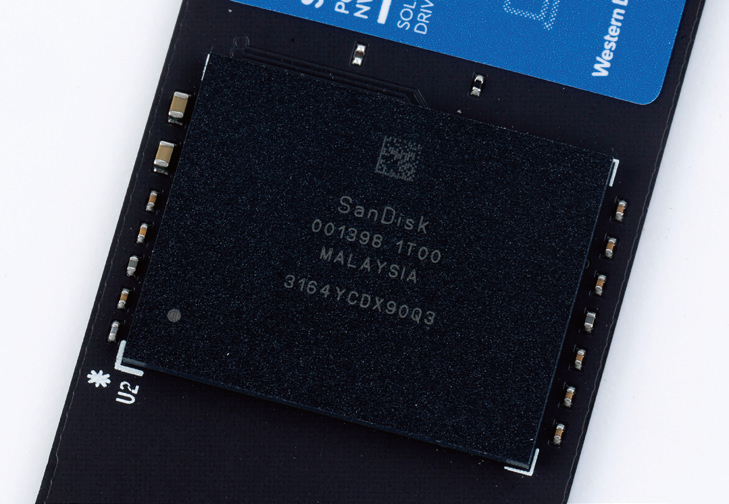
Available capacities are 250 GB, 500 GB, 1 TB, and 2 TB. TBW ratings are 150 TB, 300 TB, 600 TB, and 900 TB respectively. Compared with many mainstream PCIe 4.0 drives that use QLC flash and offer lower endurance, the SN580's TLC flash provides substantially higher write endurance. Western Digital backs the SN580 with a 5-year warranty or the stated TBW limit, whichever comes first.
Test methodology
Test platform
Motherboard: ROG MAXIMUS Z690 EXTREME
CPU: Intel Core i9-12900K
Memory: DDR5-6000 32 GB dual-channel
Drive tested: WD Blue SN580 1 TB
GPU: GeForce RTX 3080
Power supply: ROG THOR 1200 W
Operating system: Windows 11
Test procedure
The SN580 was tested with the motherboard M.2 heatsink installed. Benchmark tools included CrystalDiskMark, Anvil's Storage Utilities, and AS SSD Benchmark with default settings and with maximum test file sizes to evaluate behavior during large transfers. Application-level tests used PCMark 8 and PCMark 10 storage benchmarks plus game launch timing. TxBENCH was used for full-disk read/write testing to assess performance under sustained heavy load. Since the SN580 ships without a heatsink, we also measured full-disk write performance with the drive exposed to simulate laptop, mini-PC, and all-in-one environments.
Default 1 GB test results
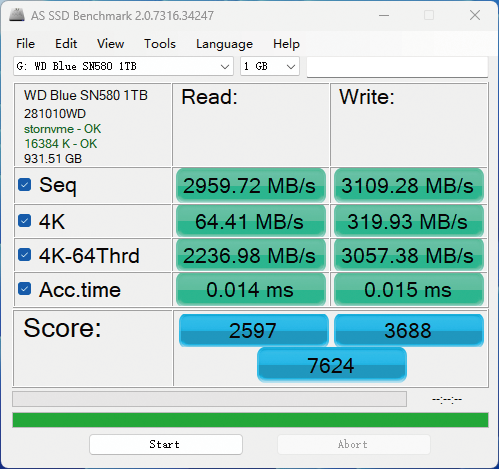
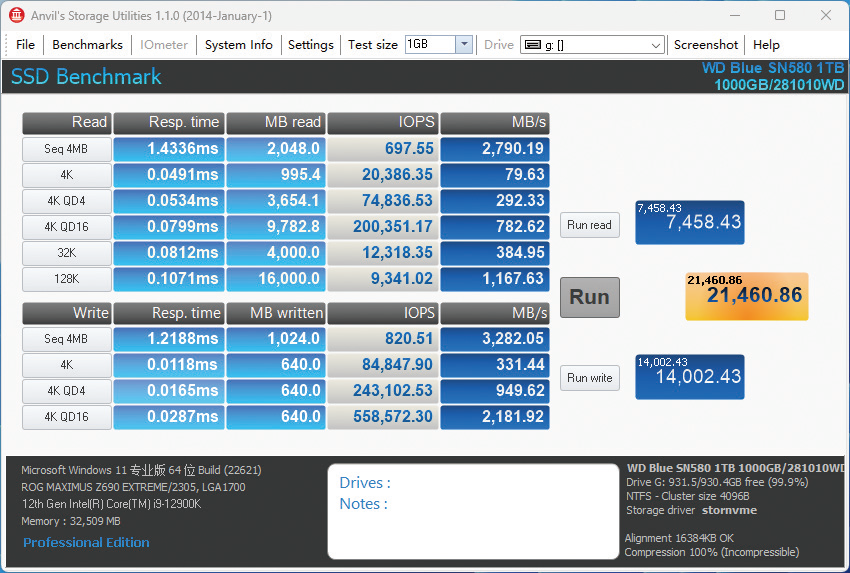
Test summary: The SN580 performs well. In CrystalDiskMark most results exceed official specifications. The 1 TB sample reached a sequential read peak of 4231.1 MB/s, slightly above the rated 4150 MB/s and well ahead of the SN570's ~3588 MB/s. Sequential write measured 4141.6 MB/s, close to the rated 4150 MB/s and much higher than the SN570's ~3160 MB/s. Random 4K Q32T16 read/write for the 1 TB sample measured 2536.5 MB/s and 3379.3 MB/s, corresponding to about 619K and 825K IOPS, exceeding the listed 600K/750K numbers and showing a substantial improvement over SN570 (approximately 486K/487K IOPS).
Random 4K Q1T1 read performance, important for application responsiveness, is also improved: CrystalDiskMark shows about 84.51 MB/s read, roughly 20,632 IOPS, higher than many mainstream SSDs and better than the SN570's ~18,432 IOPS.
Max file-size benchmark tests
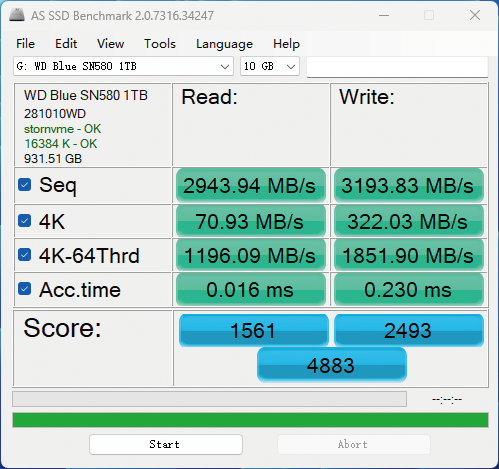
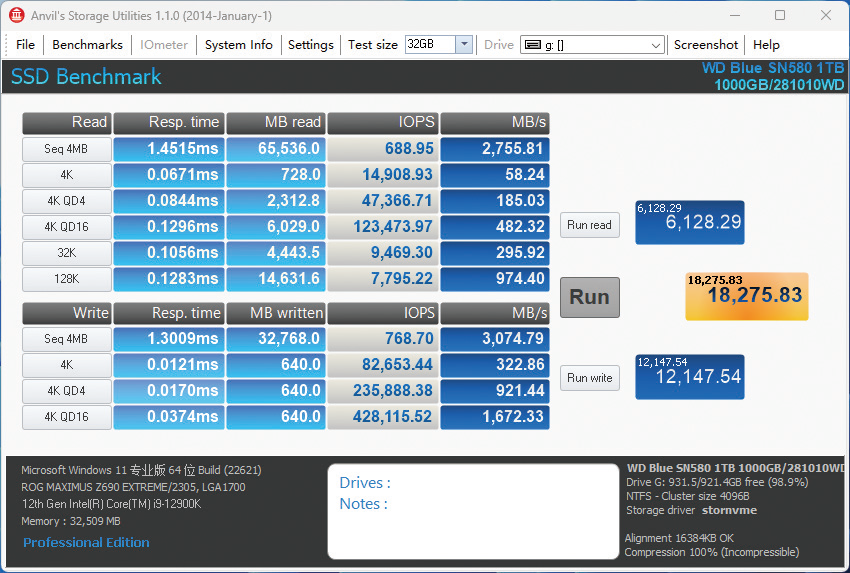
Test details: Large-file test capacities used were 10 GB for AS SSD, 32 GB for Anvil, and 64 GB for CrystalDiskMark. Results show some drop in random read/write performance during large random workloads, which lowered total scores (AS SSD total ~4883, Anvil reduced from 21460.86 to 18275.83). This is likely because random I/O may target regions outside the SLC cache and cannot be cached, reducing random performance. Sequential read/write remains robust; CrystalDiskMark sequential write stayed above 3900 MB/s.
Application and gaming tests
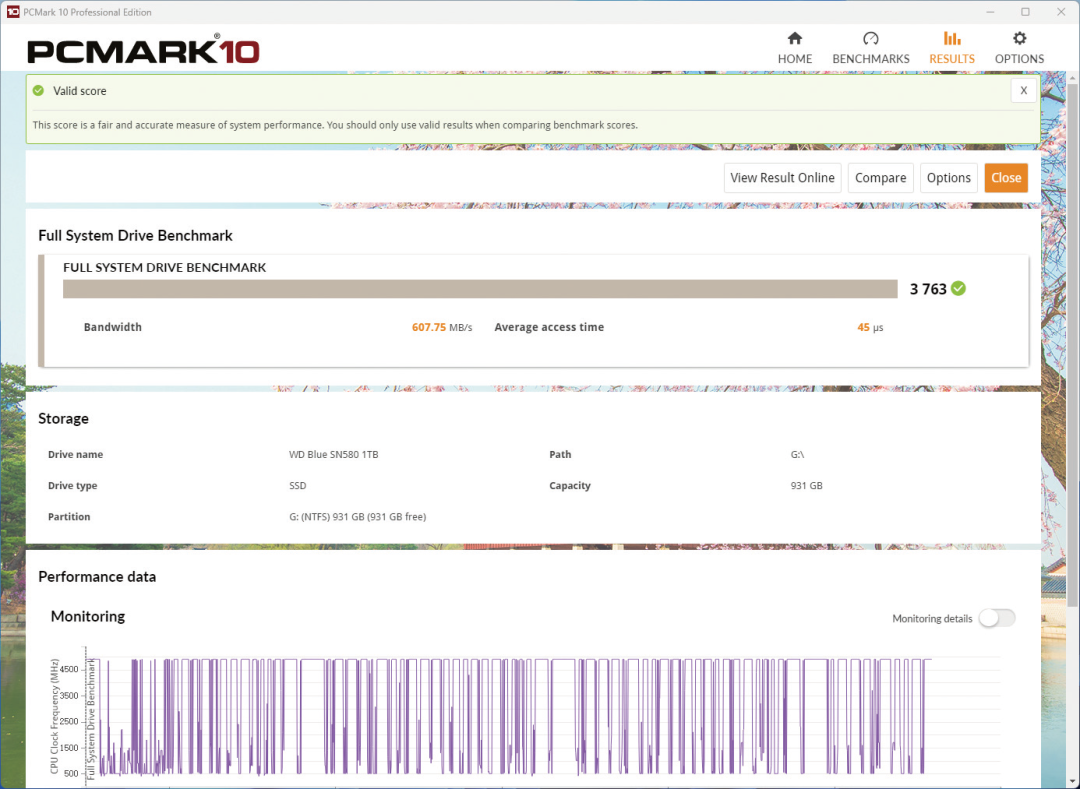
PCMark 10 full system disk score covers a wide range of real-world storage tasks including OS boot, Adobe suite launches and workloads, office applications, and file copy operations. The SN580 1 TB scored 3763 with an average bandwidth of 607.75 MB/s, a level comparable to higher-end PCIe 4.0 drives and significantly above many mainstream PCIe 4.0 SSDs, which typically score under 3300 in this test.
Gaming storage performance was evaluated with 3DMark storage tests that simulate game launch and recording, plus file installation and copy operations for Battlefield V, Call of Duty: Black Ops 4, and Overwatch. The SN580 1 TB scored 3788 with an average transfer rate of 657.04 MB/s, outperforming entry-level PCIe 4.0 SSDs that typically score around 2500 with 400-500 MB/s average. This translates into faster game launches, installs, and asset loading.
Further tests using Final Fantasy XIV benchmarks at 4K maximum settings measured scene load times. The SN580 1 TB recorded scene load durations of approximately 7.495 s, 7.455 s, and 8.162 s across three benchmark scenarios, indicating quick scene loading even with high-resolution assets.
TxBENCH consistency and sustained performance
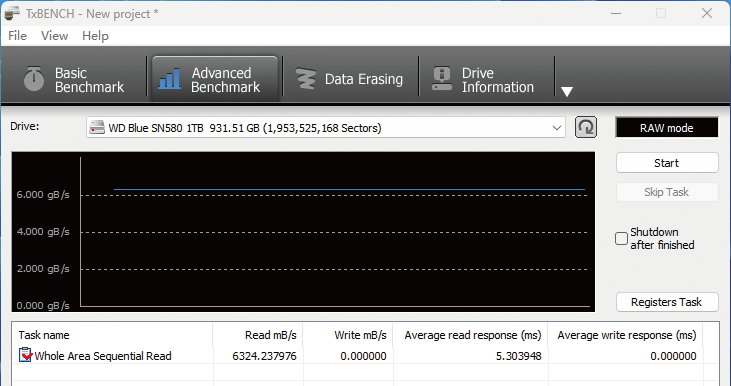
Full-disk read tests show excellent sustained read behavior. The SN580 1 TB delivered an average sequential read of 6324.24 MB/s during the TxBENCH full-disk read test without throttling.
Full-disk sequential write testing indicates a sizable SLC cache of approximately 350 GB. Sequential write speeds remain between 3900 MB/s and 4150 MB/s until about 350 GB of continuous writes are reached. Beyond that, data is written directly to TLC flash and speeds drop to roughly 440 MB/s to 650 MB/s. Because the SN580 uses 3D NAND TLC, write speed after cache exhaustion is far higher than that of QLC-based drives, which can fall below 50 MB/s when their SLC cache is exhausted.
Thermal behavior under sustained write with the motherboard M.2 heatsink installed: after writing 1 TB continuously, monitored internal temperature reached 50°C. The full-disk average write speed during the test was about 812.7 MB/s.
Performance without a heatsink
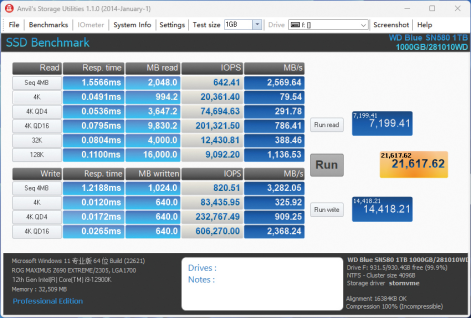
To simulate laptop and compact system use, the M.2 heatsink was removed. Without the heatsink, internal temperature rose to about 82°C after writing 1 TB. Despite the higher temperature, the drive did not show throttling during this test and the average full-disk write speed measured about 818.8 MB/s, slightly higher than with the heatsink in this specific run. Lighter workloads such as CrystalDiskMark also showed sustained high sequential speeds above 4200 MB/s read and near 4150 MB/s write without the heatsink. Anvil's total score in that configuration reached 21617.62.
Conclusion
The WD Blue SN580 1 TB is a well-rounded mainstream PCIe 4.0 SSD. It does not reach the extreme peak numbers of the fastest high-end PCIe 4.0 drives, but it offers strong real-world performance and high endurance thanks to TLC NAND. The drive delivers excellent sequential read and solid random 4K performance, fast application and game load times, and a large SLC cache that preserves high sequential write speeds for most typical workloads. When the cache is exhausted, write speeds drop but remain far better than QLC-based alternatives. Combined with a 5-year warranty and high TBW rating, the SN580 1 TB is a reliable mainstream PCIe 4.0 option for users seeking a balance of performance and endurance.