Summary
Gartner published an enterprise storage trends report in June. I will provide a brief interpretation focused on flash-related trends, informed by my recent attendance at the US FMS flash summit.
Cloud-inspired operating models, advanced flash technologies, cybersecurity, and data insights are the top enterprise storage trends for 2023.
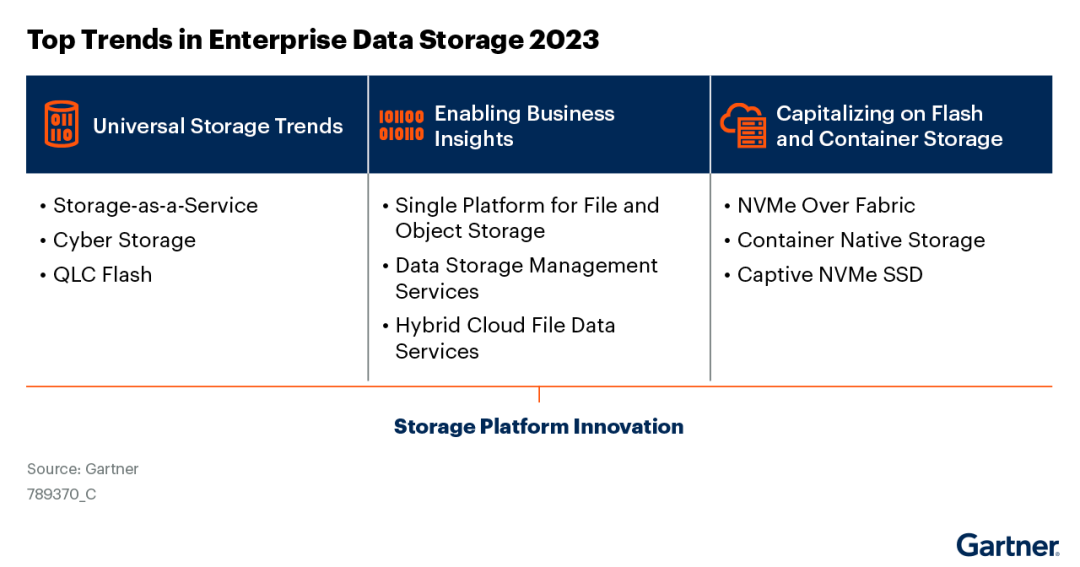
Advances in flash technology — including the use of QLC-based flash, TCP/IP-based NVMe, and dedicated NVMe drives with onboard compute — are extending flash applicability to both extreme-performance and cost-sensitive use cases.
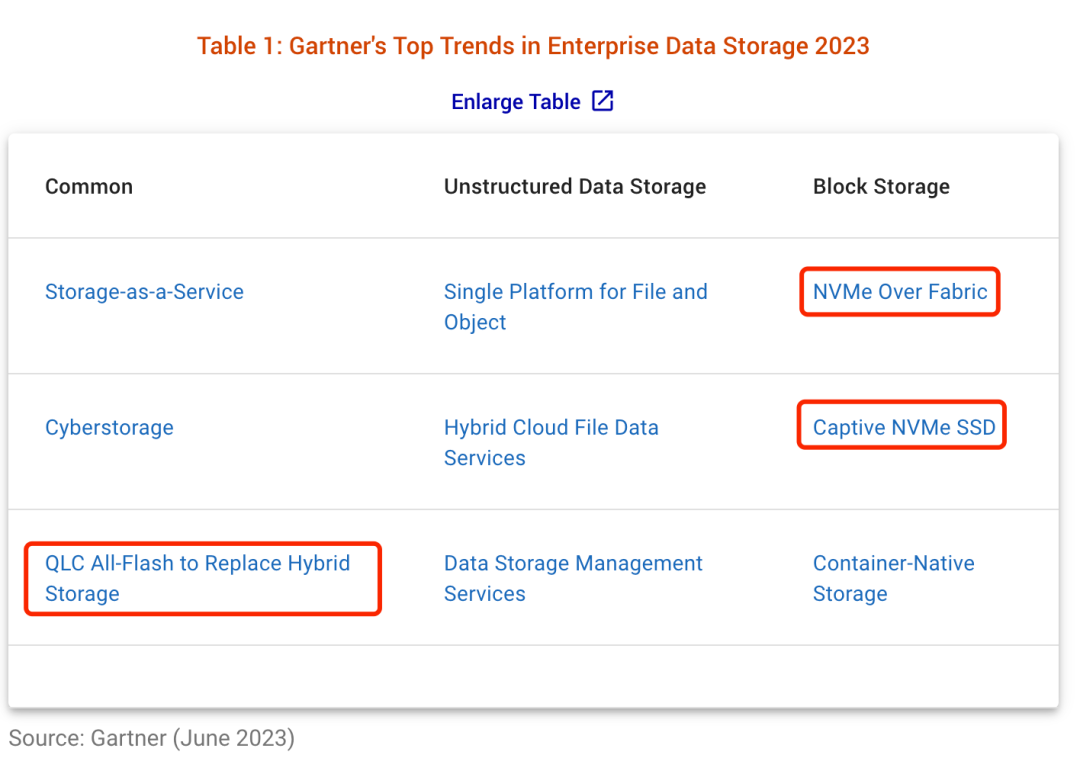
Common trend: QLC all-flash will replace hybrid storage
Strategic assumption: By 2027, enterprises will use QLC in 25% of solid-state drive flash media, up from about 5% at the end of 2022.
Description: Storage arrays based on quad-level cell (QLC) flash use software-supported ASIC or FPGA logic to overcome endurance limits and improve durability and performance. These arrays are now deployed for general-purpose block storage, and they are also used for backup and disaster recovery where TLC performance is less critical. In file and object use cases such as analytics, backup, and disaster recovery, QLC-based arrays are increasingly replacing HDD arrays. QLC arrays are gaining traction in very high-density, large-capacity use cases.
Why this is happening: To take advantage of lower-cost flash media across more applications, storage vendors are using software and custom logic to mitigate QLC limitations. The cost advantage of QLC versus TLC arrays, combined with improved durability and performance, provides long-term benefits to enterprises—for example, faster recovery of backup data after ransomware events.
Impact: Growth of unstructured data is driving demand for higher-density SSDs, and QLC-equipped arrays can replace increasing numbers of TLC-based flash arrays and hybrid HDD arrays. The net effect on traditional hybrid HDD arrays is reduced market share as unstructured data expands. This shift is likely to lower the average selling price of general-purpose block storage arrays while increasing the average selling price of object storage arrays.
Recommended actions: Reassess application infrastructure and workload requirements to determine whether the price and performance tradeoffs of QLC-based storage provide overall advantages compared with hybrid HDD and TLC-based storage.
Commentary
QLC has already been replacing HDDs in many scenarios. Mainstream NAS products from vendors such as Pure Storage, Dell, and NetApp all support QLC SSDs. However, full replacement of HDDs is still unlikely in the near term. I will provide more detailed analysis in my FMS summit summary.
Block storage trend: NVMe over Fabric (NVMe-oF)
Strategic assumption: By 2027, 25% of enterprises will deploy NVMe-oF as a storage network protocol, up from less than 10% in mid-2023.
Description: NVMe-oF is a network protocol that leverages NVMe and PCIe device parallelism and low latency. NVMe commands are tunneled to remote subsystems. The specification defines a protocol interface intended to work with high-performance fabric technologies, including Fibre Channel, InfiniBand, or Ethernet with RoCE v2, iWARP, or TCP, and supports RDMA where applicable. NVMe-oF provides a front-end interface for storage systems, allowing scale to large numbers of NVMe devices and extending access distances to NVMe subsystems in the data center. It can significantly improve data center network latency.
Why this is happening: NVMe-oF products meet use cases where the low-latency characteristics of NVMe drives are critical. Although infrastructure changes and upgrades are required, the clear benefits are attracting high-performance workloads and architectures that combine network functionality with NVMe flash. NVMe-oF provides a scalable architecture that enhances storage capabilities in distributed disaggregated platforms.
Impact: NVMe-oF accelerates adoption of next-generation storage architectures such as disaggregated storage-compute, software-defined storage, hyperconverged infrastructure, and composable infrastructure. Among NVMe-oF transport options, NVMe/TCP has a strong advantage in many enterprises because Ethernet cost and simplicity meet the bandwidth needs of iSCSI and lower-end Fibre Channel SANs below 16 Gbps. NVMe-oF can scale with high-availability features and be centrally managed to serve dozens of compute clients.
Recommended actions: Identify workloads that require NVMe and NVMe-oF scalability and performance to justify the premium for deployment. Consider NVMe-oF for high-performance applications such as AI/machine learning, mobile computing, high-performance computing, in-memory databases, transaction processing, or as a replacement for iSCSI environments managed as STaaS. Evaluate potential storage platforms, NICs, HBAs, and fabric vendors for interoperability testing and available references.
Commentary
Gartner favors NVMe/TCP. Questions remain: Is NVMe/FC still required? Is NVMe over InfiniBand more popular in vendor ecosystems that emphasize GPU-accelerated workloads? Does NVMe/RoCE offer better performance in specific environments? NVMe-oF is clearly a direction many vendors are pursuing. Many vendors in China, including SDS vendors, are expected to release end-to-end NVMe-oF products. Technology choices should be made carefully, considering both technical tradeoffs and local supply-chain or domestic technology policy considerations. More analysis will appear in my FMS summit summary.
Block storage trend: Captive NVMe SSDs
Strategic assumption: By 2026, captive NVMe SSDs will account for more than 30% of on-premises deployed capacity, up from less than 5% in mid-2023.
Description: Captive NVMe SSDs integrate processor cores to provide significant onboard compute capability and handle I/O functions at the drive level. These drives are progressively replacing standard SSDs as a means to offer storage-system-level functions and to increase application capability across a range of storage system benefits. Captive NVMe SSD suppliers design arrays starting from NAND and optimize the storage environment through software. A primary function of captive NVMe SSDs is to offload I/O from the storage controller CPU.
Why this is happening: Storage is increasingly treated as a strategic lever to enable critical system functions. Captive NVMe drives allow vendors to procure and integrate compute and analytics capabilities at the drive level, improving intelligent behavior required for many operational goals. Future enhancements are expected to reduce hardware management and support costs and to enable advanced AIOps-like data management functions. Captive NVMe drives also enable more efficient, scalable storage architectures, such as software-defined disaggregated storage-compute, and help drive NVMe-TCP adoption.
Impact: Using captive NVMe SSDs can deliver many potential benefits, including improved storage operations, reduced costs, and more resilient, intelligent data services. However, the vendor-supplied drive model requires significant internal engineering and procurement expertise and must be leveraged across a vendor's product portfolio. Competing with vertically integrated NAND/SSD suppliers requires strategic access to next-generation NAND technologies and sufficient scale. Drawbacks include increased single-source supply risk, potential availability issues, and migration costs if supply changes.
Typical advantages of captive NVMe SSDs:
- Cost advantages from using low-cost NAND such as QLC
- Higher SSD density compared with standard SSDs
- Additional onboard compute to provide enhanced SSD functions and performance
- Efficient compression and deduplication performed at the drive
- Fine-grained flash management and limited over-provisioning to improve endurance and resilience
- More efficient and flexible scale-out block storage architectures
- Advanced network resilience features such as media-level filtering, search, and scan
- Real-time telemetry of entropy changes for stored data on the drive itself, improving security
- Improved NVMe application-aware end-to-end security features
- Optimized power usage to offset carbon emissions, plus intelligent power and cooling management
Recommended actions:
- Evaluate the role captive NVMe SSDs would play in your storage systems and determine whether their advantages are critical to vendor selection.
- Proactively assess how vendors meet tactical and strategic NVMe SSD requirements and how their roadmaps align with future storage trends.
- Perform due diligence on risks and dependencies that could negatively affect procurement and ongoing supply.
- Ask captive NVMe SSD vendors about long-term roadmaps and the strength of their procurement and supply-chain commitments.
Commentary
Vendors that have adopted self-developed SSDs include Pure Storage, IBM, and Huawei. Captive SSDs enable close integration between drive firmware and array software, offloading many tasks to the SSD and improving efficiency. However, many software-defined storage vendors prefer commodity SSDs; successful examples using general-purpose SSDs exist, such as Vast Data.