Overview
For DIYers and hardware enthusiasts, recent months have seen large-capacity SD storage become much more affordable. Yangtze Memory recently introduced the Ti600 SSD family. The 500 GB model is rated for sequential reads up to 6000 MB/s, while larger capacities are rated up to 7000 MB/s. This review examines whether the Ti600 meets those claims in real use.
Product specifications
- Interface: PCIe 4.0 x4
- Controller: PCIe 4.0 x4 controller
- Flash: Yangtze Memory QLC factory chips
- DRAM cache: N/A (DRAMLESS, uses HMB)
- Capacities: 500 GB, 1 TB, 2 TB
- Form factor: M.2 2280
- Endurance: 200 TBW (500 GB), 400 TBW (1 TB), 800 TBW (2 TB)
- Warranty: 5 years
- Reference price: 699 CNY (2 TB)
Design and components
The Ti600 ships in new blue-themed packaging. It uses a DRAMLESS architecture and supports HMB (Host Memory Buffer), which allocates a small portion of system memory to cache recently read or pending write data and address mapping tables instead of using discrete DRAM chips.
The 2 TB Ti600 sample contains a single controller and four flash packages; the PCB back is unpopulated.
The product uses Yangtze Memory QLC flash based on the Xtacking 3.0 architecture, with a 2400 MT/s per-die I/O. This high flash interface speed helps the Ti600 approach PCIe 4.0 x4 bandwidth even without onboard DRAM. Rated sequential performance for the 1 TB and 2 TB models is up to 7000 MB/s read and 6000 MB/s write, and random 4K performance is stated as up to 900K IOPS read and 700K IOPS write. The 500 GB model is rated 6000 MB/s read, 3000 MB/s write, and 500K IOPS random 4K read/write.
Compared with Yangtze Memory's prior TiPlus7100, the Ti600 uses QLC flash. QLC is well suited to read-heavy workloads typical of mainstream users (web browsing, gaming, video playback, office tasks and image editing), making it a reasonable choice for budget-oriented mainstream usage.
The Ti600 includes one standoff and two mounting screws for desktop or laptop installation. The warranty policy is 5 years or the stated TBW, whichever comes first. The tested 2 TB sample has an 800 TBW rating; 1 TB and 500 GB have 400 TBW and 200 TBW respectively, which are higher than many common QLC SSD standards.
Test platform
- Motherboard: ROG CROSSHAIR X670E HERO
- CPU: AMD Ryzen 9 7950X3D
- Memory: G.Skill Trident Z5 Neo DDR5-6000 32 GB kit
- Drive: Ti600 PCIe 4.0 SSD 2 TB
- GPU: Radeon RX 7800 XT
- PSU: ROG THOR 1200W
- OS: Windows 11
Benchmark performance
In synthetic benchmarks, the Ti600 2 TB performed strongly. CrystalDiskMark showed a sequential read of 7326.38 MB/s and peak sequential write of 6425.03 MB/s, both exceeding the rated values. The Xtacking 3.0 flash interface at 2400 MT/s contributes significantly to these results. Random 4K Q32T16 read/write reached 4305.46 MB/s and 3024.18 MB/s respectively, corresponding to IOPS above 1,000K and 700K, also exceeding the rated random performance.
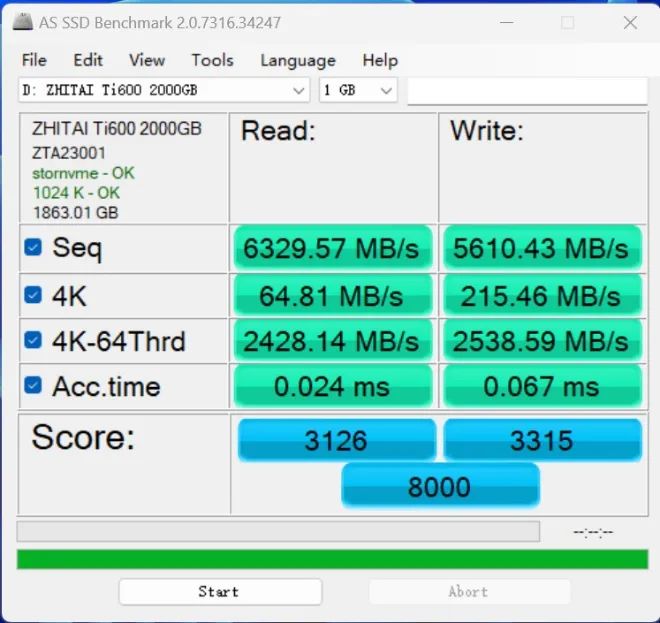
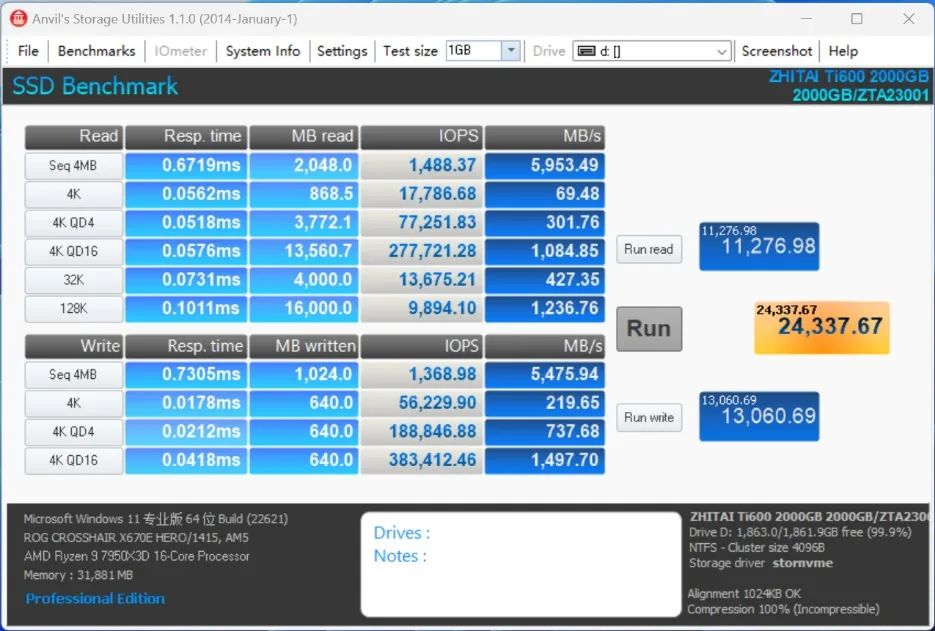
In AS SSD Benchmark and Anvil's Storage Utilities, the Ti600 2 TB scored about 8000 and 24337.67 respectively, outperforming common mainstream PCIe 4.0 QLC SSDs, which typically score under 5000 in AS SSD and struggle to exceed 20000 in Anvil's.
Overall performance tests
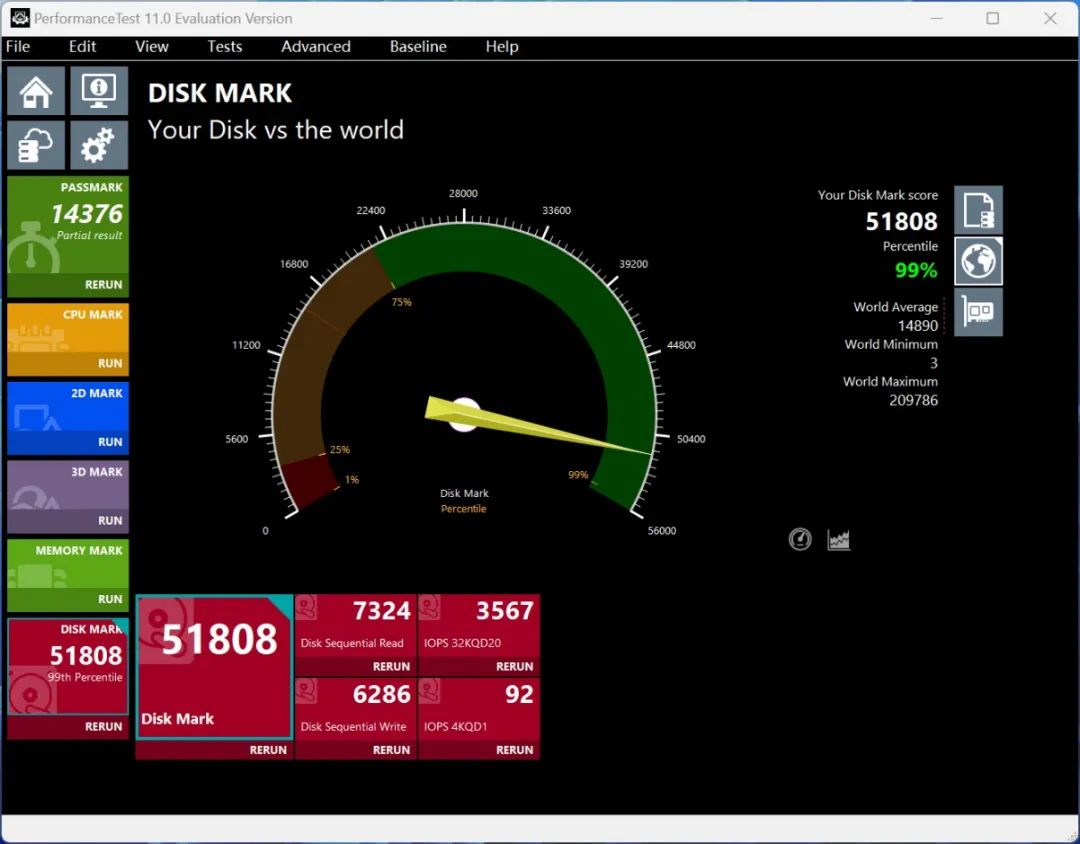
Using PerformanceTest 11.0 and additional storage benchmarking tools, the Ti600 ranked near the top among tested storage devices, confirming its strong performance profile.
Real-world file transfer: 120 GB large files
To evaluate practical transfer performance, we copied six ISO files totaling 120 GB. Average sequential read and write speeds were 5986 MB/s and 5107 MB/s respectively. The transfer completed in under 30 seconds without significant sustained write speed drop. The drive implements an SLC cache of approximately 468.7 GB in its initial state, which is adequate for most single-session writes below 100 GB.
Small-file transfers: CS:GO folder
Small-file I/O can be challenging for storage devices. Using a 32 GB CS:GO installation folder composed of 3094 files, the Ti600 averaged 3557 MB/s read and 3639 MB/s write, completing the copy in under 10 seconds, demonstrating strong small-file transfer performance.
Application and gaming tests
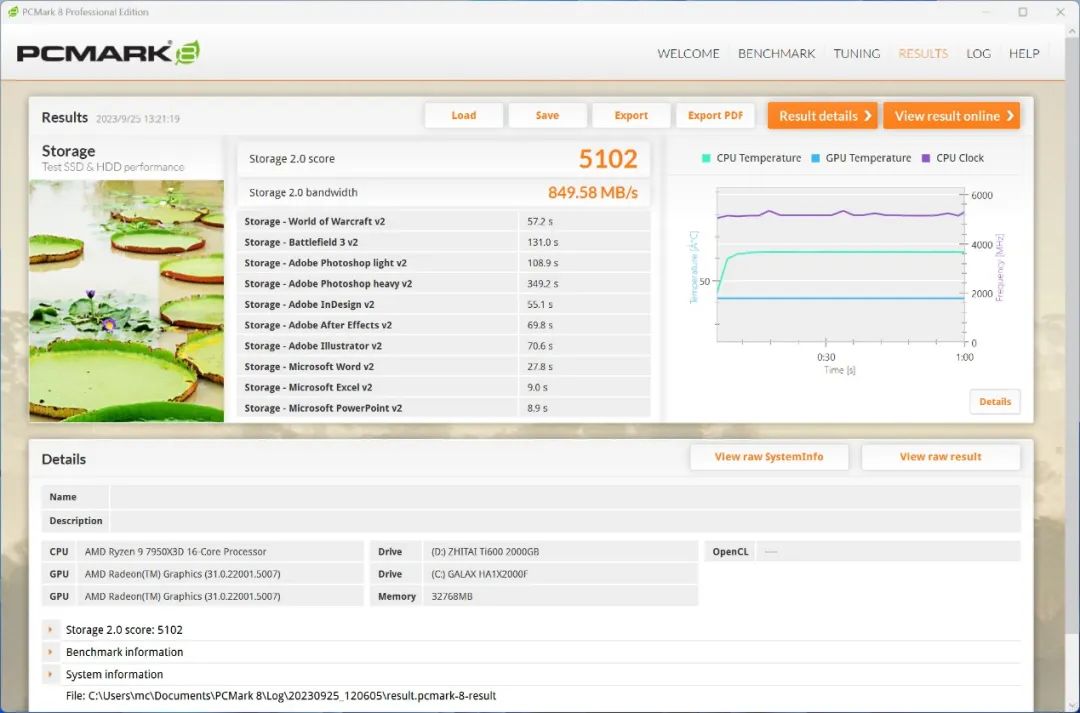
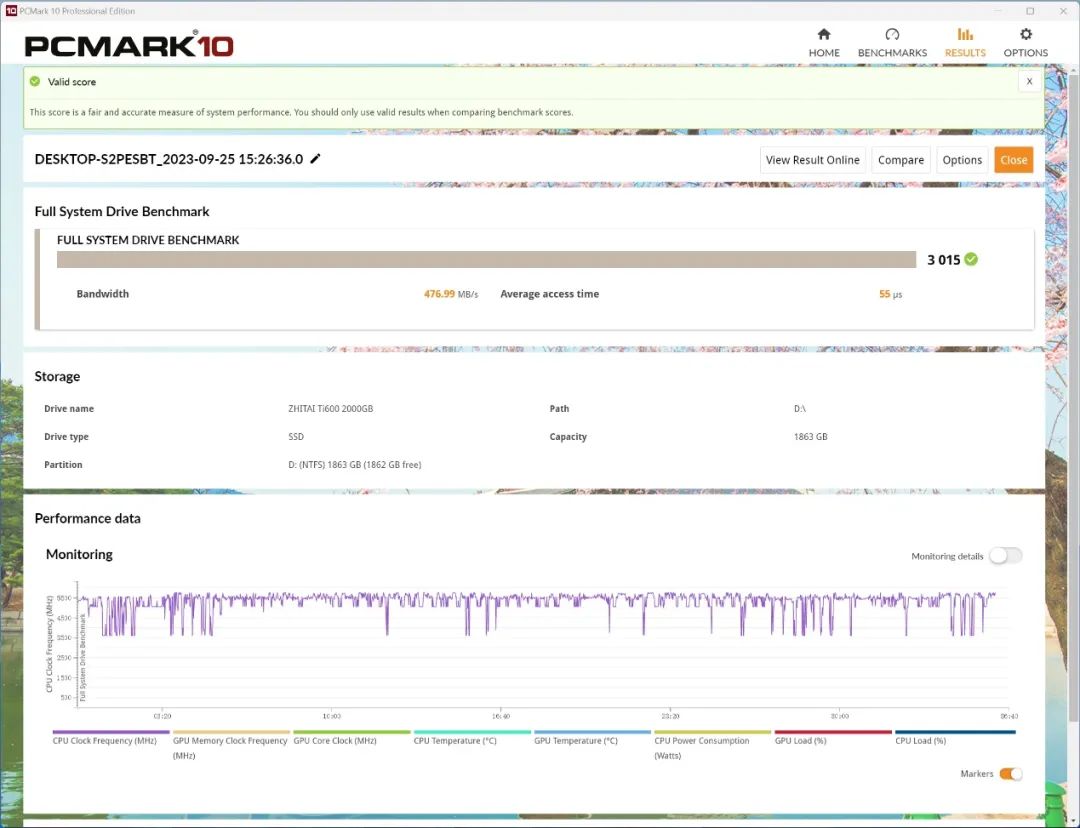
In PCMark 8 storage tests, the Ti600 2 TB scored 5102, which is comparable to high-end PCIe 4.0 SSDs and indicates solid performance for applications like Photoshop, InDesign, After Effects and Illustrator. In PCMark 10 storage, it scored 3015 with an average transfer bandwidth of 476.99 MB/s, placing it close to high-end PCIe 4.0 drives and above entry-level PCIe 4.0 SSDs.
For game scene load tests at 4K maximum settings, three Final Fantasy XIV benchmarks yielded short load times:
- Endwalker: 5.592 s
- Shadowbringers: 5.816 s
- Heavensward: 6.567 s
These load times are faster than many PCIe 4.0 and some PCIe 5.0 drives in our prior tests, reflecting strong random read performance that helps reduce game startup and scene loading times.
Thermal behavior
After a full-disk 2 TB read, average throughput reached 7477.9 MB/s and measured drive temperature was about 61°C. Using a passive heatsink effectively controlled operating temperature during sustained loads, and the drive sustained high throughput without thermal throttling in our TxBench full-disk test.
Maintenance tools
Yangtze Memory provides the Smart Tool SSD utility. It displays drive details including health, operating temperature and S.M.A.R.T. attributes, supports online firmware updates, and offers secure erase to restore the drive to factory state. The tool simplifies routine maintenance and firmware management.
Conclusion
The Ti600 PCIe 4.0 SSD 2 TB delivers strong real-world and synthetic performance. It achieves sequential read speeds comparable to high-end PCIe 4.0 drives, includes a large SLC cache for fast practical transfers, and shows excellent small-file and game load performance. With a 5-year warranty and relatively high TBW ratings for QLC flash, the Ti600 is a compelling value for users whose workloads are read-heavy or focused on gaming, web browsing and media playback. Users with very high sustained write demands should consider drives with higher endurance.