Overview
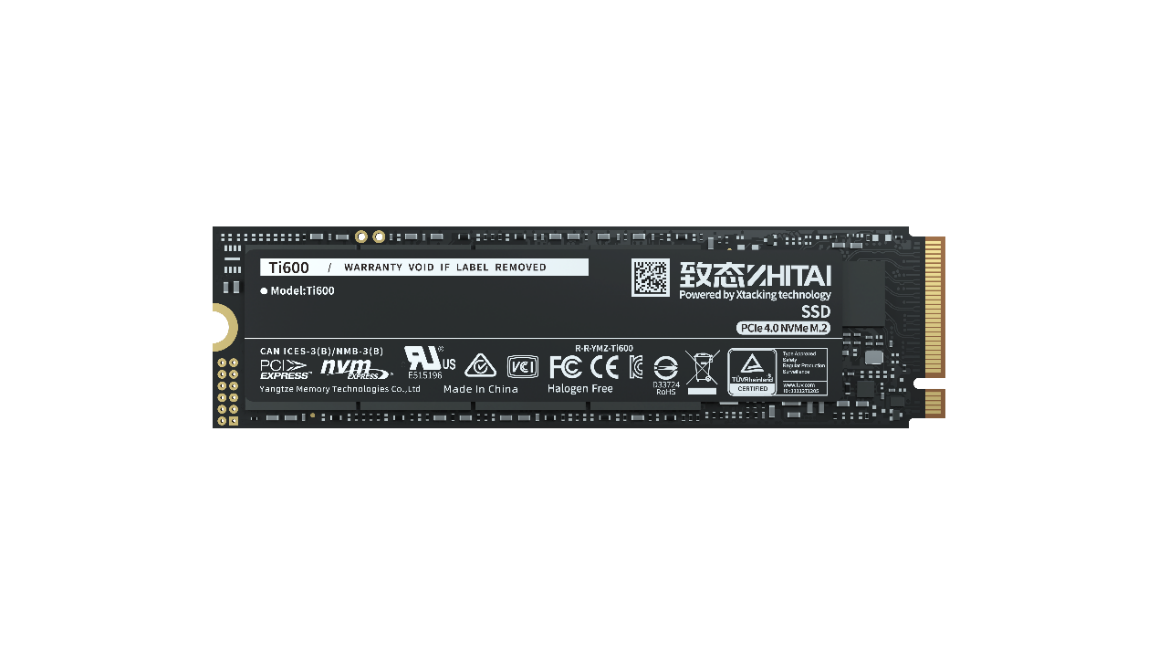
The ZHITAI family from Yangtze Memory has a new member: Ti600. The Ti600 is ZHITAI's first QLC SSD. SSDFans tested the Ti600 (2 TB) to evaluate its performance.
The Ti600 uses Yangtze Memory's factory QLC flash dies based on the Xtacking 3.0 stacking architecture. Common NAND flash types include SLC, MLC, TLC, and QLC. These types differ in cell structure, bits per cell, and endurance. Endurance is determined by the P/E (program/erase) cycle count; a higher P/E rating indicates higher writable cycles and therefore higher endurance.
Consumer products commonly use an SLC cache mode. Under SLC mode, QLC NAND and TLC NAND have similar read/write speeds, which enables good performance for QLC SSDs. A well-designed FTL algorithm can compensate for QLC's inherent speed limitations. Compared with contemporary TLC, QLC pages typically have larger spare areas. With the same LDPC decoding capability, QLC NAND can therefore offer stronger error correction capability.
As a die manufacturer, Yangtze Memory subjects its QLC NAND Flash to strict quality control across multiple dimensions, including data retention, read disturb, write disturb, and temperature extremes. QLC NAND also typically consumes less power for read/write operations compared with TLC NAND.
Product Information
- Capacities: 500 GB / 1 TB / 2 TB
- Form factor: M.2 2280
- Interface: PCIe 4.0 Gen4 x4, NVMe 2.0
- Factory flash: Yangtze Memory dies based on Xtacking 3.0
- Factory monitoring software: ZHITAI Smart Tool
- Supports HMB (Host Memory Buffer) technology, allowing system memory to be used as dynamic cache instead of requiring dedicated DRAM
Test Platform
- Motherboard: ASUS PRIME Z790-P
- CPU: 13th Gen Intel Core i3-13100
- Memory: ADATA DDR4 16 GB
- OS: Windows 11
Test Software
Test tools: Luanqi Technology professional SSD test software, CrystalDiskMark, BurnInTest, HDTune, PCMark 10.
NVMe Protocol Test
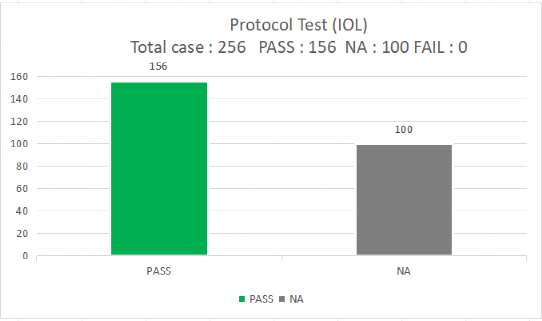
For protocol testing we used Luanqi Technology's IOL test suite. We selected 256 test cases, all of which passed.
Performance and Stability Tests
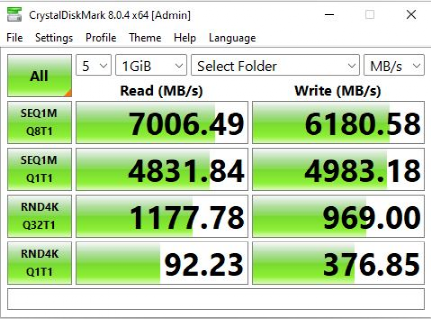
We first used CrystalDiskMark for performance testing. Sequential and random read/write performance met the vendor's published specifications.
We then ran several popular stress-testing tools to evaluate stability under heavy load.
BurnInTest
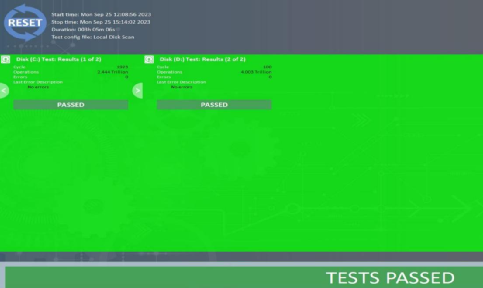
The Ti600 completed 100 cycles (totaling 40.04 million million operations) and passed the stress test.
HDTune
HDTune read/write jitter remained within acceptable ranges and showed stable behavior.
PCMark 10
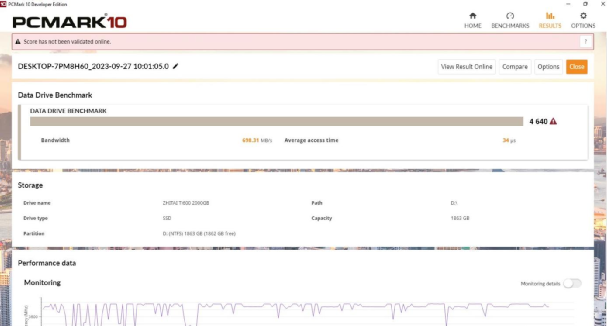
PCMark 10, which simulates real-world workloads, produced a score of 4640 for the Ti600, reflecting performance typical for a consumer-grade SSD in system boot, application load, and latency-sensitive tasks.
Extended Tests with Luanqi Professional Platform
Using Luanqi Technology's professional test platform, we ran read/write stress, data integrity, and power-loss recovery tests.
Read/Write Stress Test
Result: Pass. Duration: 6 hours 52 minutes. The Ti600 showed stable behavior during the test.

Data Integrity Test
Result: Pass. Duration: 1 hour. The Ti600 was subjected to mixed data-type read/write patterns for one hour without any data errors detected.

Unexpected Power Loss Test
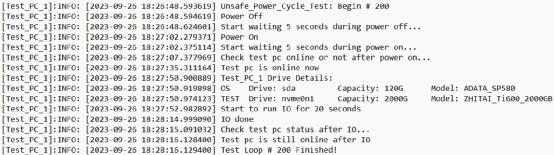
Result: Pass. 200 cycles. Using the PowerShark power-loss test tool, we evaluated whether the SSD can safely recover from unexpected power loss and preserve previously written data. The Ti600 successfully completed 200 consecutive power-loss cycles and recovered without data loss.
ZHITAI Smart Tool
ZHITAI provides a factory monitoring tool, ZHITAI Smart Tool, which can check disk information and perform firmware upgrades, facilitating maintenance and updates.
Conclusion
The Ti600 delivers performance in line with mainstream PCIe 4.0 SSDs. Yangtze Memory has released several NVMe SSD products over the past two years. NVMe SSDs offer advantages in read/write speed, system boot, application loading, and low latency. The Ti600 is positioned as an entry-level SSD that adequately meets everyday office, entertainment, and gaming scenarios. Its larger capacities are suitable for many use cases and personal storage needs. Overall, the Ti600 demonstrated good stability and reliability for typical office and home use.