Summary
Researchers from the Institute of Aero-Engine, School of Mechanical Engineering and Power Engineering, Shanghai Jiao Tong University, and a group at City University of Hong Kong published a paper titled "Meta-lens Particle Image Velocimetry" in Advanced Materials. The work introduces a metalens-based particle image velocimetry (metalens PIV) technique for advanced optical flow diagnostics. First authors are postdoctoral researchers Xiaoyuan Liu and Zhou Zhao. Corresponding authors include Shengxian Shi, Mugu Chen, and Dingping Cai.
Background and motivation
Particle image velocimetry, or PIV, is a well established experimental method in fluid mechanics and finds applications in biomedical research, marine equipment, and aerospace. Conventional PIV often requires multiple cameras and complex multi-lens systems to capture images from different perspectives and reconstruct three-dimensional velocity fields. This complexity limits deployment in constrained spaces and complicates practical applications.
Metalens integration and system design
The study explores combining optical metasurfaces with PIV to miniaturize the measurement system. A metalens is a planar optical element composed of an array of engineered nanostructures. As an emerging optical metasurface, a metalens can precisely control the optical wavefront, offering an ultrathin, compact, and aberration-free alternative to traditional imaging optics.
The team fabricated a pair of metalenses on a 0.5 mm-thick sapphire substrate and integrated them directly with a CMOS sensor to build a compact binocular metalens camera. The binocular metalens assembly weighs only 116 mg, which is far lighter than commercial lenses. Using the binocular metalens to capture particle images enables reconstruction of accurate three-dimensional velocity fields. The method was validated in a vortex-ring experiment at Reynolds number 2000, where the vortex-ring diameter measurement error was about 1.25%.
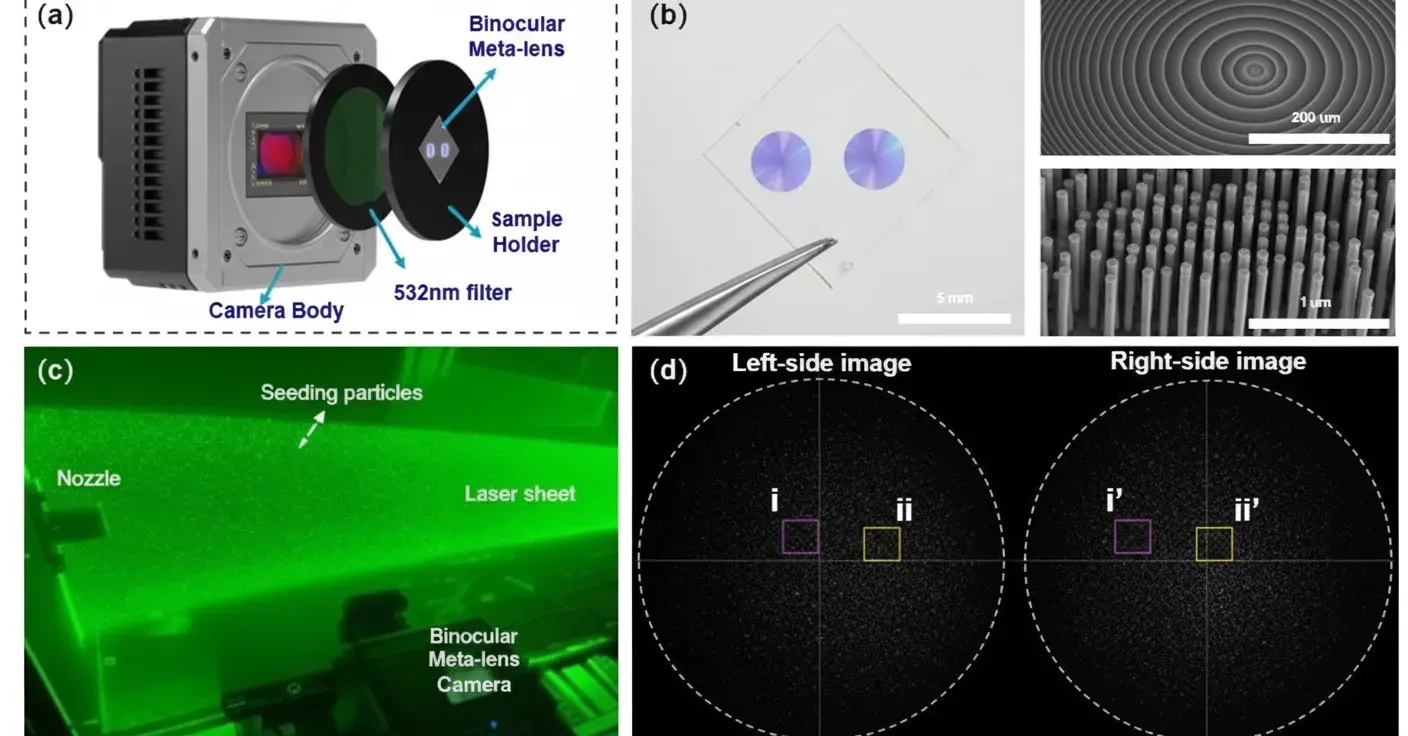
(a) binocular metalens camera (b) binocular metalenses (c) experimental setup (d) particle image
Implications
By designing and fabricating ultrathin, lightweight, and aberration-free metalenses and integrating them directly with CMOS chips, the researchers demonstrated a compact binocular metalens PIV system. The work illustrates a path toward smaller, easier-to-deploy PIV systems.
The research combines advanced micro? and nano?optics with traditional flow-field diagnostics, revitalizing experimental fluid-measurement tools. It also broadens the application potential of both PIV and optical metasurfaces for portable and constrained-space measurement scenarios, and suggests new directions for research on PIV miniaturization and low-power implementations.
Funding
The work was supported by the National Natural Science Foundation of China (general and youth programs) and central university basic research funds.