2024 is being called the first year of 5G-A. As the next evolutionary stage of 5G, 5G-A introduces several improvements. Three-component carrier aggregation, or 3CC, is considered the first widely deployed 5G-A technology and is expected to substantially increase smartphone network speeds.
What is 3CC
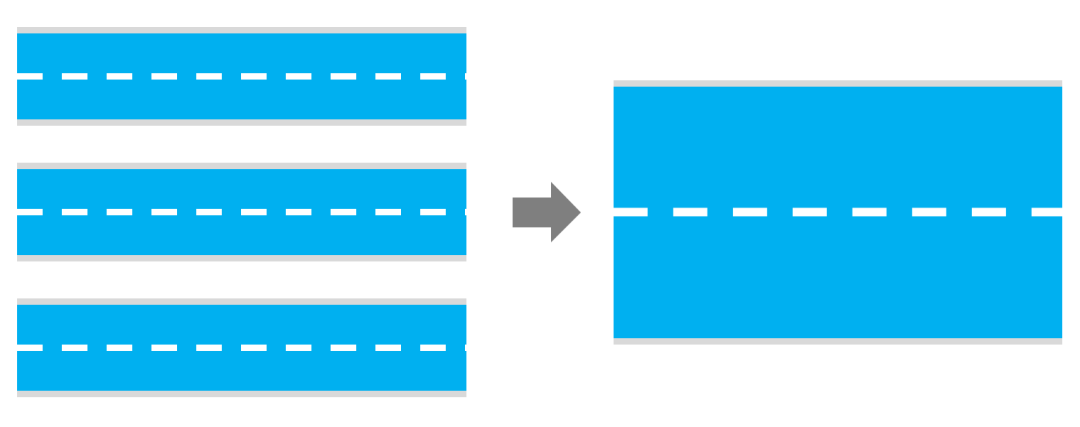
3CC stands for 3 Component Carriers, commonly referred to as three-carrier aggregation or three component carriers. In wireless communications, carriers occupy radio frequency bands. "3CC" means an operator combines three of its frequency bands into a larger aggregated bandwidth to achieve higher data rates. A simple analogy is merging three adjacent lanes into a wider lane to increase vehicle throughput.
3CC is a form of carrier aggregation (CA). CA is not new: it was widely used in the LTE era. Original FDD LTE downlink peak rates were around 150 Mbps and TD-LTE around 100 Mbps, which did not meet the ITU-R IMT-Advanced 4G target of over 1 Gbps for stationary/low mobility and 100 Mbps for high mobility. 3GPP introduced LTE-Advanced (LTE-A), which used carrier aggregation (up to five carriers) to exceed 1 Gbps and meet the 4G requirements. Traditional LTE is therefore often called 3.9G or "near-4G".
In the 5G era, carrier aggregation is used again—not to validate the standard but to push performance further. Frequency bandwidth is the principal factor affecting throughput. 5G operates in Sub-6 GHz and millimeter-wave bands. Millimeter-wave has limited deployment in the Chinese market for now, and the 6 GHz band (5.925–7.125 GHz) has not seen broad use. With modulation and coding nearing practical limits, further throughput gains rely on using available sub-6 GHz spectrum efficiently.
Frequency band distribution among operators in the Chinese market is the basis for 3CC. Operators bind different bands, including co-shared bands, to create wider effective bandwidths. This raises peak rates for users and supports marketing and service differentiation.
Technical highlights of 3CC
Carrier aggregation was originally categorized into three types:
- Intra-band contiguous CA: two carriers are in the same 3GPP band and are contiguous in frequency.
- Intra-band non-contiguous CA: two carriers are in the same 3GPP band but non-contiguous in frequency.
- Inter-band non-contiguous CA: two carriers are in different 3GPP bands.
Each participating carrier is called a Component Carrier. Component carriers are classified by function. The carrier that carries control signaling and manages other component carriers is the primary carrier, or PCell (Primary Cell). Carriers used to expand bandwidth and increase throughput, which the primary carrier can add or remove, are secondary carriers, or SCells (Secondary Cells).
Operators in the Chinese market adopt different 3CC combinations. One example used by China Mobile is 700 MHz (30 MHz) + 2.6 GHz (100 MHz) + 4.9 GHz (100 MHz), totaling 230 MHz. China Mobile also holds another 60 MHz in the 2.6 GHz band that may be used in the future, yielding 260 MHz total.
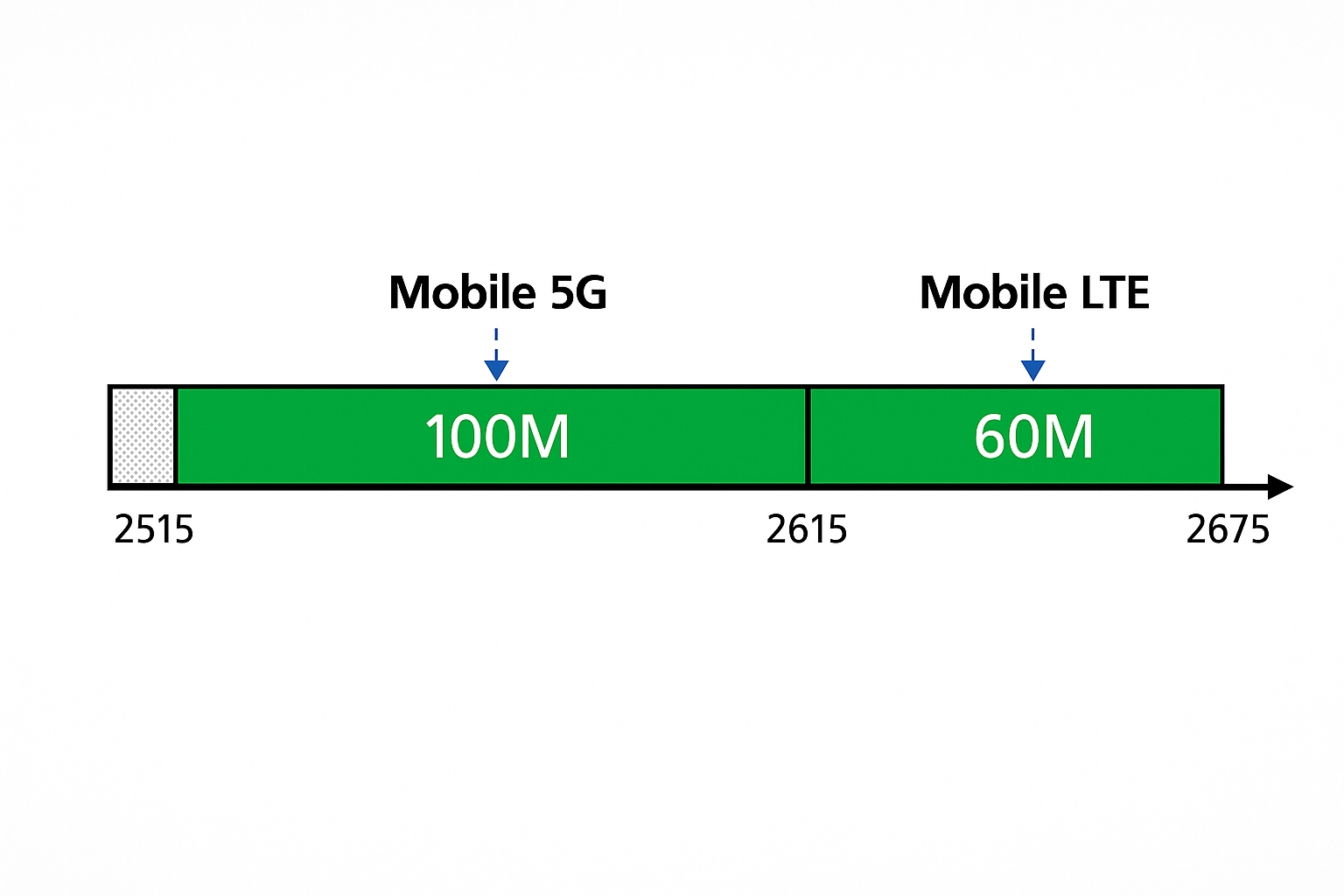
China Telecom and China Unicom mainly use 2.1 GHz (40 MHz) + 3.5 GHz (200 MHz, including shared bands). In some areas, 900 MHz (2×11 MHz) is added; in others, only 3.5 GHz 200 MHz is used. Field trials across many provinces and cities show measured downlink speeds often exceeding 4 Gbps. One report from Jiaxing, Zhejiang measured more than 5 Gbps using 3CC plus 1024QAM.
Uplink rates, combined with SUL (supplemental uplink / uplink-downlink decoupling), can reach several hundred Mbps and in some tests exceed 1 Gbps. Measured speeds depend on many factors, including the number of nearby terminals, environmental interference, whether Massive MIMO or higher-order modulation is used, and other conditions. As such, benchmark numbers are indicators rather than absolute comparisons. Note that 3CC can aggregate both FDD and TDD bands, supporting mixed-mode "F+T" aggregation.
Several new techniques in 3GPP Release 18, the first 5G-A release, are relevant to 3CC. FSA, Flexible Spectrum Access, enables intelligent multi-carrier optimization by flexibly splitting and combining full-band uplink resources, unifying control and data channel scheduling to improve resource utilization and uplink performance. MB-SC, Multi-Band Serving Cell, can integrate and reconstruct non-contiguous scattered spectrum to form a virtual large bandwidth, further improving resource utilization and uplink experience. These mechanisms provide unified management and scheduling across bands, carriers, and slots to realize the advantages of carrier aggregation.
Application scenarios for 3CC
The most direct effect of 3CC is a large increase in network connection speed, from under 1 Gbps to roughly 3–5 Gbps in ideal conditions. Even in busier environments, achieving user experience speeds above 1 Gbps becomes feasible. Very large aggregated bandwidths will better support use cases such as live video streaming, cloud gaming, autostereoscopic 3D, XR/VR, and other high-bandwidth services.
3CC is especially useful in transport hubs such as high-speed rail stations, subway stations, and airports, and in dense venues such as stadiums, tourist sites, and dense urban neighborhoods. Many operator deployments target these locations, often through small cells.
In industrial and enterprise contexts, 3CC can benefit smart manufacturing, AI-based inspection, remote inspection, security monitoring, and remote mining, where many high-rate terminals or high-definition cameras require significant uplink and downlink capacity.
3CC also supports differentiated QoS. Bandwidth can be scheduled and allocated according to service priority and quality requirements, ensuring that critical services receive prioritized, continuous, and stable connections. This capability is important for vertical industry applications. Another potential high-value use case is fixed wireless access (FWA). 3CC can provide larger bandwidth to CPE devices, enabling households, renters, visitors, and small businesses to obtain broadband connectivity quickly.
Devices that support 3CC
Not all smartphones support 3CC. Devices using Qualcomm X75 or MediaTek M80 modems theoretically support 3CC. For example, the M80 supports 3-carrier aggregation (up to 300 MHz) in 5G NR FR1 and up to 8-carrier aggregation for 5G mmWave FR2, with peak downlink rates up to 5 Gbps and uplink up to 1 Gbps in ideal conditions.
Specific phone models reported to support 3CC include Honor Magic6 Pro, Xiaomi 14 Pro, vivo X 100 Pro, and OPPO Find X7. Other models require further verification. Current iPhone models are not expected to support 3CC at this time.
Conclusion
This article summarized the principles, technical highlights, applications, and device support for 3CC carrier aggregation in the 5G-A context. Operators are expected to accelerate 3CC deployment. As 5G-A evolves and more device models enter the market, users will gradually experience much larger aggregated bandwidths. Until wider use of 6 GHz and millimeter-wave spectrum occurs, about 5 Gbps appears to be the practical upper bound for user downlink speeds in current deployments. High peak speed alone is not sufficient; viable applications that take advantage of such bandwidth will drive continued evolution.