Overview
5G distributed small cells are a type of distributed cellular base station that connect to the mobile core network via fixed broadband access. They provide fixed-mobile convergence services, including traditional cellular communication services. Distributed small cells are primarily intended for continuous indoor coverage scenarios, implement a three-level connection coverage system, use PTN access, offer larger coverage area and network capacity, and enable NR coverage applications.
System Characteristics
A 5G distributed small cell system is a distributed cellular base station system that supports NR access. It features a simple architecture, flexible deployment, lower engineering cost, and deep capacity coverage, which can accelerate resolution of indoor network coverage issues.
System Components and Topology
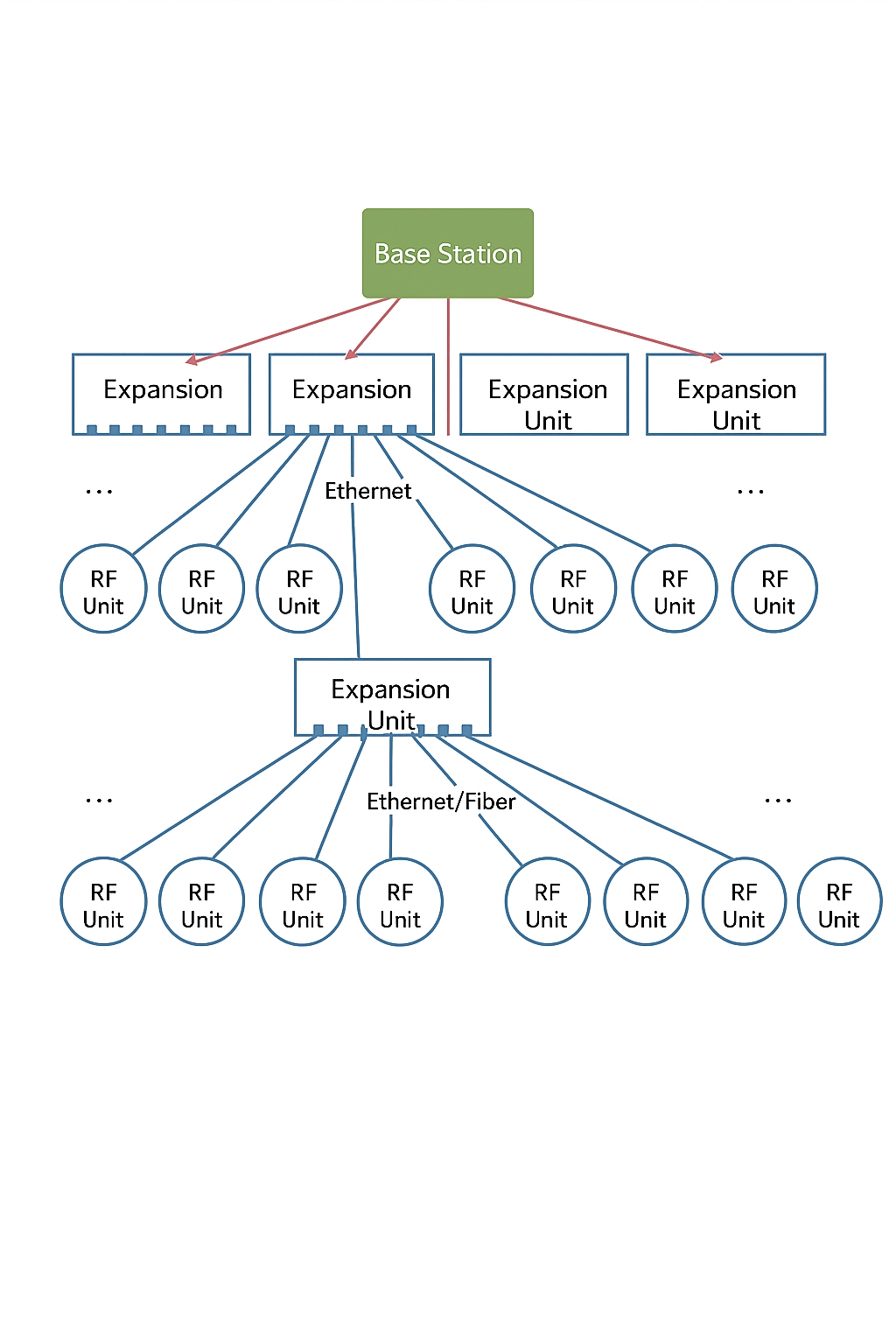
A 5G distributed small cell consists of three parts: the host unit, extension unit, and remote unit. The distributed small cell network topology is shown in Figure 1.
Coverage Range
The coverage range of a 5G distributed small cell varies with product form factor, transmit power, and the coverage scenario. In general, coverage ranges from 10 to 200 meters, but small cells are available in several types and each has a different coverage radius:
- Home base station: typically less than 20 meters, suitable for homes and small businesses.
- Micro base station: coverage within 300 meters, generally used for small-area coverage.
- Micro-micro base station: coverage within 100 meters, typically used for hotspots or small offices.
- Indoor base station: usually within 50 meters, suitable for indoor environments.
- Personal base station: much smaller coverage, typically around 10 meters, suitable for individual users or small devices.
Although the coverage area of 5G distributed small cells is relatively small, their flexible deployment allows optimization for specific scenarios to improve network coverage and signal quality.
Advantages
5G distributed small cells offer the following advantages:
- High capacity and high data rates: They provide greater capacity and higher data throughput to meet demand for high-speed internet and large-volume data transfer.
- Low latency: Deploying small cells closer to users reduces data transmission latency, which is important for real-time applications such as virtual reality, autonomous driving, and remote healthcare.
- Improved coverage: Small cells can be flexibly deployed across urban areas to fill coverage gaps that macro cells cannot reach, providing broader wireless coverage.
- Energy savings: Compared with traditional macro base stations, distributed small cells have lower transmit power and energy consumption, reducing energy usage and carbon emissions.
- Increased network capacity: By distributing capacity among many low-power cells, small cells relieve load on macro cells and increase overall network capacity.
- Better network resilience: With distributed deployment, failure of a single small cell has limited impact on the overall network, improving overall stability and availability.
Distributed small cells combine high capacity, low latency, broad coverage options, energy efficiency, increased capacity, and improved stability to better meet requirements for fast, reliable, and low-latency wireless communication.