Problem Summary
Symptom: After a core network upgrade by an operator, big data indicates a slight increase in voice call setup delay.
Fault Analysis
Performance statistics: After the core network upgrade, voice service indicators showed the following fluctuations.
- Average EPSFB call setup delay increased by about 50 ms and then stabilized.
- Average EPSFB process duration increased by about 40–50 ms.
- EPSFB process success rate increased by about 1% after the upgrade.
- Other provinces that upgraded their core networks showed similar EPSFB changes.
- Average VoNR delay showed no immediate change after the upgrade, but one week later the delay rose and fluctuated.
- Big data analysis shows that when the number of VoNR-to-VoNR calls decreases, the delay increases and fluctuates more.
- Per-city breakdown of VoNR-to-VoNR metrics shows that when call volumes are low, delay increases; when call volumes rise, delay decreases. Low total call counts produce small sample sizes, which amplify delay volatility.
Summary from statistics:
- EPSFB success rate improved significantly after the core network upgrade, while average process delay increased slightly.
- VoNR-to-VoNR success rate and delay showed no clear change after the upgrade. VoNR-to-VoNR delay fluctuations are influenced by call volume; with larger sample sizes the measured delay converges to the true average.
Service-Level Analysis
Combining the performance statistics, the core network upgrade optimized certain voice flows, particularly EPSFB, improving success rate but introducing a small increase in average delay. Core network-side analysis concluded the following.
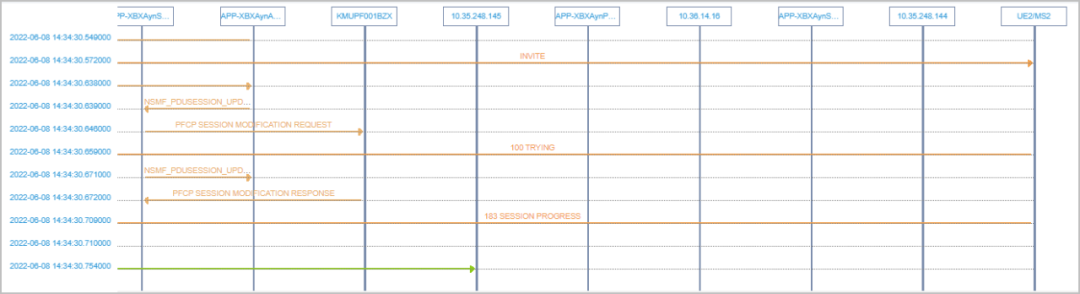
- The SMF underwent multiple flow optimizations in the voice procedures. While establishing the dedicated bearer, SMF received other concurrent events that caused conflicts (for example, a forward Xn handover). SMF handles flow conflicts using its conflict policy. The current SMF conflict retry policy is 3 s × 2 attempts: on a dedicated bearer conflict/timeout, it retries after 3 seconds, up to two attempts.
- Behavior before SMF upgrade: Prior to the upgrade, all event conflicts on the SMF used the same policy configuration. Conflicts such as Xn handover consumed the shared conflict retry quota. After exhaustion of the two retry attempts, dedicated bearer establishment could not be retried and the voice call failed directly.
- Behavior after SMF upgrade: After the upgrade, conflict policies were separated by flow type for voice, NGC, and EPC processes. NGC process conflicts (such as Xn handover) no longer consume the voice flow conflict retries.
- Therefore, in the upgraded SMF version, when dedicated bearer establishment conflicts with other flows, the SMF can still retry the dedicated bearer procedure to ensure call success.
- The impact of this optimization on EPSFB:
- Because EPSFB requires a 5G-to-4G handover, its signaling interactions are more numerous and have a higher probability of conflicts.
- Before the upgrade, repeated conflicts without differentiated policies prevented later attempts to rebuild the dedicated bearer (retry quota exhausted).
- The upgrade introduced conflict policy type differentiation. Previously failing processes can succeed after reasonable dedicated bearer retries, but the total EPSFB establishment delay increases by at least 3 seconds (due to timeout and retry), so these flows show both higher success rates and increased delay.
- The impact on VoNR:
- VoNR does not require a 5G-to-4G handover in the voice flow, so its process is shorter and encounters fewer conflict windows. Although the upgrade also applies to VoNR flow policies, conflict scenarios for VoNR are infrequent.
- Therefore, the core network upgrade has no significant effect on overall VoNR delay.
- VoNR delay analysis:
- VoNR originating call delay (VoNR caller, callee may include EPSFB) remained stable.
- VoNR-to-VoNR delay (both caller and callee VoNR) fluctuated more as user volume increased.
- VoNR delay mainly originates on the callee side.
- Traceback of high-delay VoNR-to-VoNR sessions shows that the increased delay is caused by multiple paging attempts on the callee side.
- When VoNR mutual call counts are low, a few multi-paging processes can raise the overall average delay and cause metric volatility. As call counts rise, average session delay smooths out and reflects the overall delay metric.
Troubleshooting and Conclusions
- After the SMF upgrade, conflict policy scenarios were optimized, resolving the pre-upgrade defect and improving voice call establishment success rate. However, the success is achieved via conflict policy optimization, and conflict handling can increase process delay (no less than 3 seconds, up to 6 seconds).
- After the SMF upgrade, EPSFB success rate rose and delay increased slightly. VoNR delay showed no change before and after the upgrade.
Figures